Fire Point has published details of its Freya anti-ballistic project: how it will work
The system will include the FP-7.x interceptor missile, which features a semi-active homing head and can accelerate to 1,500–2,000 m/s

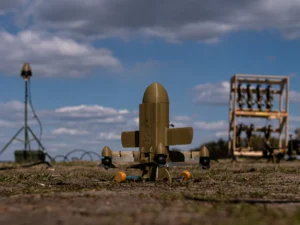
A frame from the FP-7 missile tests (Screenshot from a video by Denys Shtilerman)
Ukrainian company Fire Point plans to create a unified, integrated air and missile defence system called “Freya”. Its primary purpose will be protection against ballistic threats. Co-founder of the company, Denys Shtilerman, shared details of the project on X.
The system will include the FP-7.x interceptor missile, which features a semi-active homing head from Diehl Defence. A technology cooperation agreement with the German air defence systems developer was signed in April of this year. Built from composite materials, the missile can accelerate to 1,500–2,000 m/s, measures 7.25 m in length and 1.15 m in outer diameter. In March 2026, Fire Point conducted the second test launch of this missile.
For the long-range radar detection system, the candidates under consideration are the Giraffe 8A/4A from Swedish company SAAB, the Ground Master 400 from France’s Thales, or the TRML-4D from Germany’s Hensoldt. The latter is already in service with Ukraine and operates as part of the IRIS-T SLM air defence system. Meanwhile, SAAB reached an agreement with Ukraine as early as 2025 on the joint production of air defence systems.
Незважаючи на спроби завадити та багато відволікаючих факторів, наш караван іде. Компанія Fire Point приєднується до антибалістичної коаліції.
Скоро ракети-перехоплювачі будуть у небі не лише України, а й усієї Європи.
Докладніше — у презентації, яку я прикріпив у скріншотах. pic.twitter.com/RaqPVKqNbl
— Denys Shtilierman (@DenShtilierman) May 14, 2026
The candidates under consideration for the tracking radar are the GFTR-2100/48 from Weibel or the Kronos Land from Leonardo. The launch system will be developed by Fire Point itself.
The command centre is set to be the FDC from Norwegian company Kongsberg, the developer of the NASAMS air defence system. Fire Point states that it features an open architecture, allowing for custom integrations.
A key component of the system’s integration with Ukrainian air defence is the Link-16 protocol. It provides functional command of forces on land, in the air, and at sea, a tactical communications channel, and flexibility in data type. It enables the transfer of information between components, weapons, and military equipment, as well as the establishment of voice communications. Ukraine’s Delta system is already integrated with this protocol.
As Shtilerman told the Financial Times, the company is developing a “pan-European air defence shield” to avoid dependence on specific manufacturers. In parallel, Fire Point wants to reduce its reliance on the United States in matters of communications. To this end, it has already launched several satellites into orbit and plans to send dozens more in 2027. Meanwhile, Ukrainian company Stetman is pursuing the same goal – its test satellite is set to launch into orbit in October of this year.
Development of the Fire Point air defence system first became known in 2025, when the company announced the FP-7 and FP-9 ballistic missiles. To date, it has conducted two test launches of the FP-7. In Shtilerman’s view, having ballistic missiles in the company’s portfolio affects its valuation. In March 2026, Fire Point received an offer to sell a stake in the company at a valuation of $5.8 billion.
Reading now
1
F-Drones launches FPV drone simulator, Ukrainians to get free access on August 24
2

British platform Grenadyr has invested in five Ukrainian defence tech startups. Defender is telling its story for the first time
3

60+ new job openings in Ukrainian defence tech: offers from Vyriy, TENCORE, Ukrspecsystems and others
4
Ukrainian company has developed a jet-powered interceptor drone that reaches speeds of over 600 km/h
5
Rise Technologies unveils Nakande digital communications system for drones
By submitting this form, you give Defender Media consent to the processing of personal data.
Надсилаючи цю форму, ви надаєте Defender Media згоду на обробку персональних даних.

Latest news
1
Tencore developed a flamethrower combat module for its TerMIT 2.0 UGV
2
Skyeton has acquired a plot of land in Germany, local media report
3
Norda Dynamics announces partnership with American company Palladyne AI
4
Dutch Tulip Tech developed batteries that can double the flight time of Matrice and Mavic drones
5