General Staff says seven Ukrainian companies are developing guided aerial bombs
One of the latest developments in this field is the Vyrivniuvach guided aerial bomb, unveiled in May
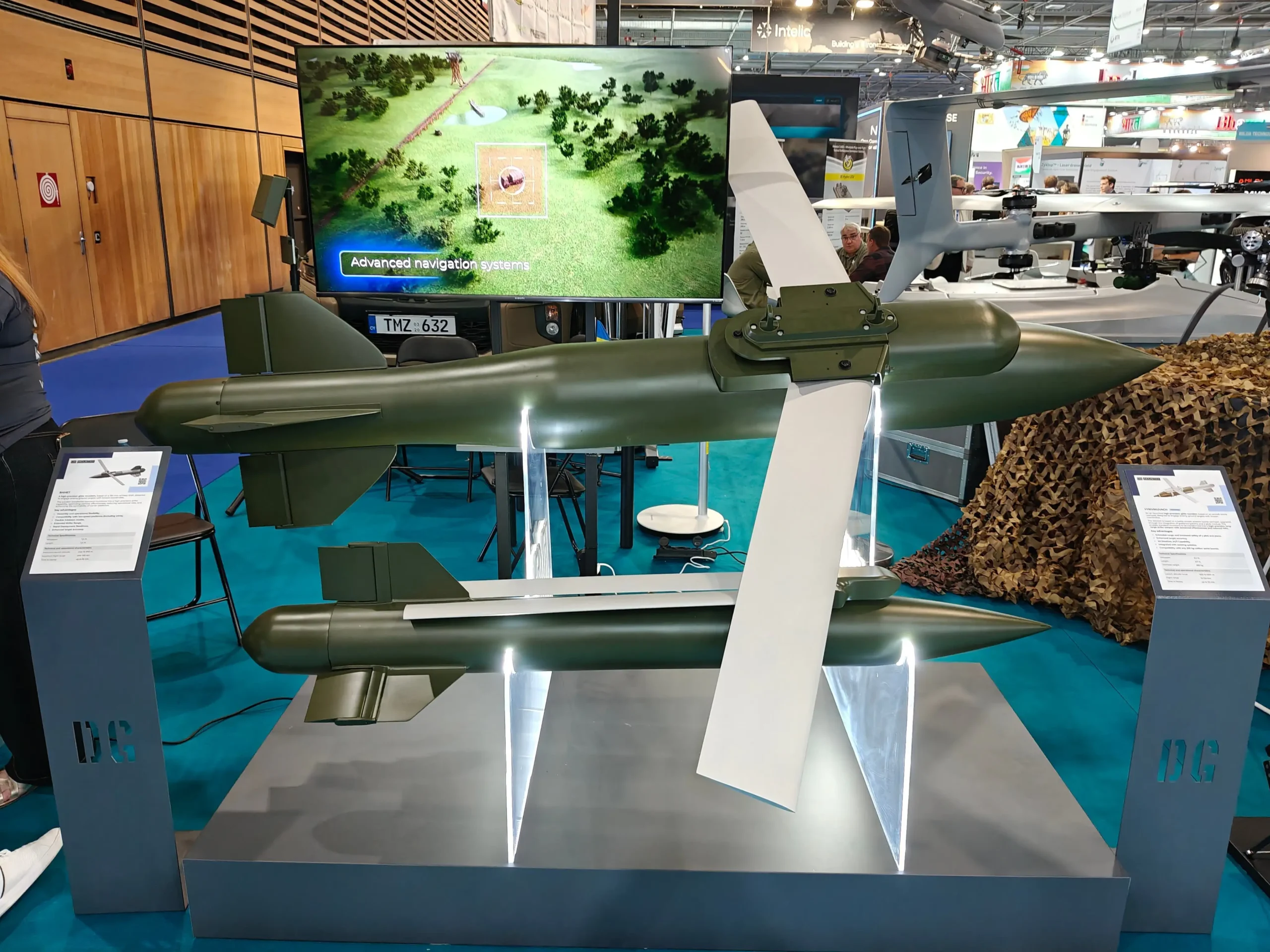
Ukrainian Vyrivniuvach guided aerial bomb
Seven Ukrainian defence industry enterprises are already working to develop domestic guided aerial bombs, Deputy Commander-in-Chief of the Armed Forces of Ukraine, Brigadier General Andrii Lebedenko, announced during a briefing.
According to Lebedenko, Ukrainian manufacturers were tasked with creating such systems in 2024, when the country lacked a domestic production base. He noted that supplies of foreign precision-guided aerial bombs, such as JDAM-ER and AASM Hammer, remain insufficient. Meanwhile, scaling up domestic production is expected to foster competition among manufacturers, boost overall supply, and enhance targeting precision.
Armed Forces data for the first half of the year shows that Russia dropped over 60,000 aerial bombs on Ukrainian territory last year. Lacking the resources to engage in a sheer volume contest, the Armed Forces are prioritising the high precision of every strike.
Lebedenko also noted that Ukraine already possesses deployment platforms for guided aerial bombs, which undergo continuous refinement. A prime example of this progress is the Vyrivniuvach — the first Ukrainian guided aerial bomb with a 250 kg warhead—unveiled in May by participants of the Brave1 defence cluster following a 17-month development cycle.
Because conventional unpowered guided bombs offer a range of 40–70 km that heavily relies on the aircraft’s altitude and release speed, Ukrainian engineers are developing turbojet-powered modules to bypass these constraints. Integrated propulsion extends the effective strike range to 100–200 km, enabling aircraft to launch precision strikes from low altitudes and deep within rear areas without entering enemy air defence zones.
In 2025, the Ukrainian private design bureau Medoid announced its own guidance and glide module for 500 kg aerial bombs, later publishing footage of flight tests conducted from a Su-24 strike aircraft.
By May 2026, the first official procurement of an experimental batch of Ukrainian KAB-250 guided bombs developed under the Brave1 cluster was confirmed. Additionally, Ukrainian company BlueBird Tech, collaborating with a state design bureau, announced the development of its own guided munition.
Reading now
1
SkyFall officially unveils Thor Hammer mid-strike and announces 1,000+ km version
2
Pentagon to hold Drone Dominance trials for bomber drones, with UFORCE, Gurzuf Defence, Grim Tech and others taking part
3

Terra Drone acquires 50% of Ukrainian Kurin Technologies for $3.5 million
4
British-Ukrainian Occam Industries raises €3.8m. The funds will go towards scaling drone autonomy software
5

Frontline Robotics CBDO Mykyta Rozhkov: Ukraine and Norway are working on an autonomous system to protect maritime infrastructure
By submitting this form, you give Defender Media consent to the processing of personal data.
Надсилаючи цю форму, ви надаєте Defender Media згоду на обробку персональних даних.

Latest news
1
6,000 lives saved by replacing people with robots. “Makar” on the ground strike drone unit NC13 and its role in Operation Vivaldi
2

M-Fly and Dwarf Engineering announce partnership: what it involves
3
Quantum Frontline Industries signs new contract with Ukraine’s National Guard to supply Linza and Zoom drones in 2027
4
SHOT-L1 drone detects sources of radio emissions and automatically homes in on target
5