“We’re flight-testing our interceptors this winter, get it into Ukraine, and hunt Shaheds.” Interview with NAD’s Dominic Surano
A conversation about the evolution of interceptor drones and the role of EDTH in advancing European defence tech
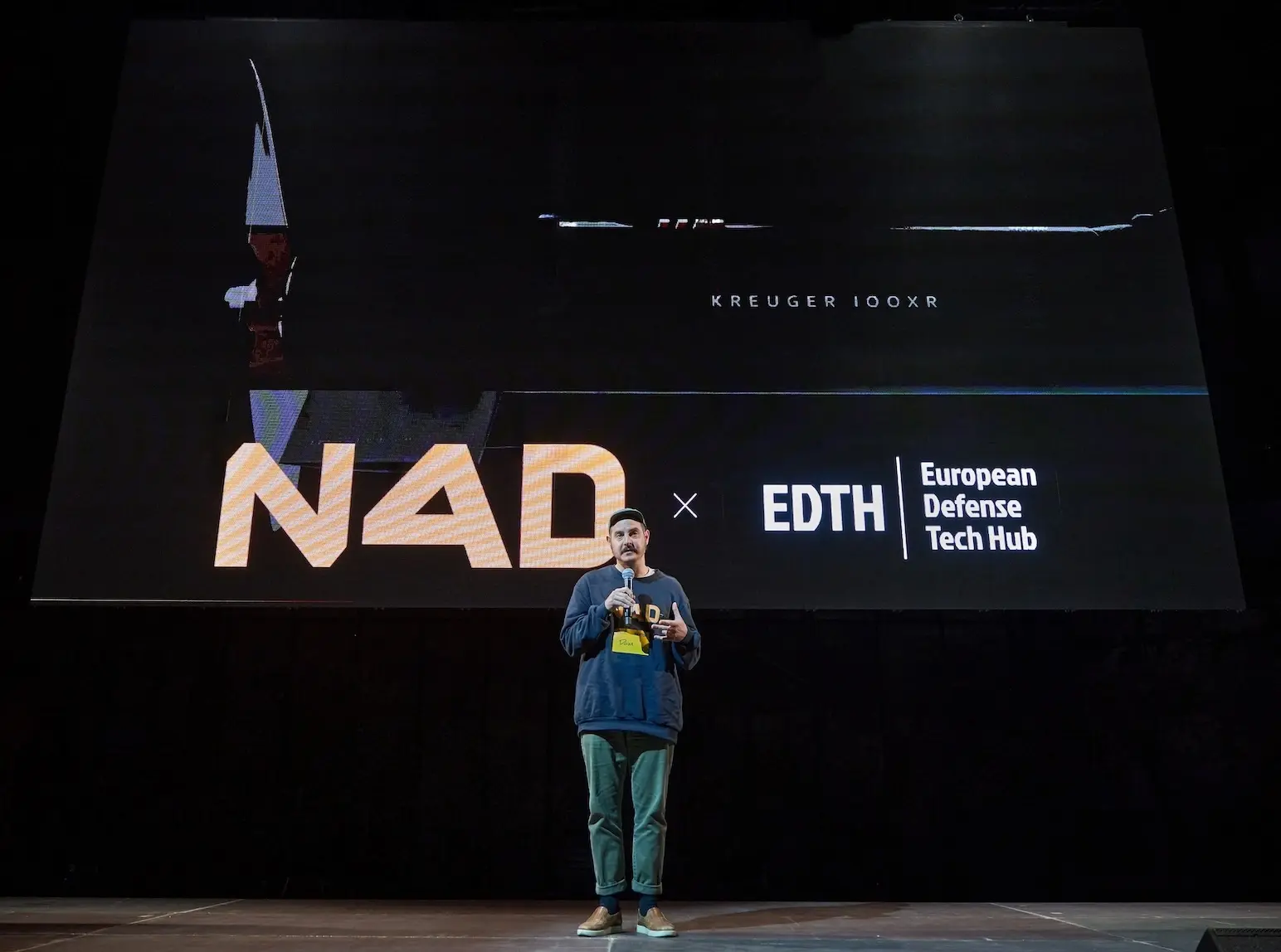
Dominic Surano at the European Defense Tech Hackathon in Kyiv / Image Credits: Mykyta Shandyba
In air defence, 2025 has become the year of interceptor drones. This segment is now developing rapidly not only in Ukraine but across Europe — especially as some EU countries now also have to shoot down Russian drones. One of the promising players in this market is the Swedish startup Nordic Air Defence (NAD), which is developing Kreuger interceptor drones.
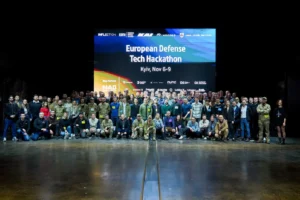
One of NAD’s top managers, Dominic Surano, recently came to Kyiv — he was among the jury members at the European Defense Tech Hackathon, held in the Ukrainian capital for the first time. For the special project Rewiring European Defence Tech, which Defender Media is producing together with the European Defense Tech Hub (EDTH), Bojan Stojkovski spoke with Surano about the evolution of interceptor drones and the role of EDTH in advancing European defence innovation.
Dominic Surano, the recently appointed Director of Special Projects at Swedish startup Nordic Air Defence (NAD), brings over 15 years of experience in unmanned aerial systems, with a career spanning General Atomics, Insitu, and most recently Anduril Industries.
At Anduril, Surano led the development of the Anvil product, a battlefield-tested quad-based interceptor deployed across conflict zones in the Middle East. His work included not just engineering and systems design, but also hands-on deployment operations – integrating telemetry, troubleshooting in GNSS-denied environments, and adapting UAS technology to real-time battlefield conditions.
Now at Nordic Air Defence, Surano is applying these lessons to develop the Kreuger series of interceptors and scaling production rapidly to deliver hardware and software systems that are both cost-effective and operationally robust. In this interview with Defender Media, he shares his insights on rapid defence innovation, Europe’s evolving defence tech ecosystem, and the lessons learned from operating cutting-edge UAS in one of the most demanding battlefields in the world.
Defender Media: Tell us about your background and your experience at Anduril’s Anvil product – what lessons are you bringing to NAD, and how do you see them shaping the program?
Dominic Surano: It was a wild ride. I joined in 2021 when the United States Special Operations Command (SOCOM) was dealing with a wave of drone attacks from ISIS and other groups in Afghanistan, Iraq, and Syria. They ran a bake-off competition, and no one had a ready fieldable solution, so in a few months, we put together Anvil, a quad-based interceptor. The program grew rapidly from there.

With events like the war in Ukraine, the threat landscape has evolved. In many ways, Anvil became a victim of its own success: it’s one of the few kinetic interceptors on the market that’s proven, has good sustainment, and can be produced at scale. But it isn’t fast enough to chase certain threats. I see Nordic Air Defence as the next iteration of what an interceptor should be — moving from a highly manoeuvrable quad that tops out around 60 m/s to an acrobatic fixed-wing design capable of exceeding 120 m/s.
You mentioned delivering defenсive hardware at scale. What does that mean in practice for a startup, especially given the rapid pace of battlefield innovation we’re seeing today?
I think of that in two ways. First, once you have something successful — even if it’s only an 80% solution — you need to be able to scale it extremely quickly. One thing Nordic Air Defence is doing well is setting up supplier agreements and aligning incentives with our suppliers through profit-sharing between our contracts and theirs, so they’re invested in our success. We already have agreements in place for the most critical parts of our system. We’ve also partnered with a stealth startup in Stockholm that has purchased a factory exclusively for making drones.
What good looks like is this: we take the Kreuger 100 — we’re flight-testing it this winter — get it into Ukraine, and hunt Shahed drones. We collect feedback from the troops and the people who are currently the most knowledgeable in drone warfare in the world — a tremendous talent pool. I’m looking for strong opinions on what people like about the system, what they don’t like, what works and what doesn’t. Once we’ve synthesised that feedback, we’re ready to hit the factory floor and produce thousands — even tens of thousands — per month.
You’ve spoken about ecosystem building and talent development across Europe. How do you see Nordic Air Defence’s role here?
I see Europe as very collaborative — one of its real strengths. In my experience, the U.S. tends to hold IP closely, and agreements between primes and startups are less common. Europe, on the other hand, is much more open: between the EU, NATO, and various partners, there’s a strong focus on sharing information and forming partnerships.
A great example was the recent Frontex competition we attended. There were three other teams, and everyone was incredibly friendly, looking for overlaps and potential collaboration. MBDA even approached us, saying they liked our tech and wanted to explore how they could contribute to the ecosystem. Rather than being purely competitive, the environment was extremely collaborative.

At Nordic Air Defence, we’ve decided to focus our efforts on being excellent at kinetic and munitions-based interceptors. Eventually, we may develop a ground detection system, but that market is crowded with established players. The same applies to C2 systems — every company and customer already has its own. We’re not trying to boil the entire ocean – our strategy is to excel in a specific segment of air defence and work with partners to integrate our system into existing ground and C2 platforms, creating a truly layered defence.
Nordic Air Defence is also a partner of the European Defense Tech Hub. How do you see the hub contributing to and helping European startups?
This is one of the coolest things about defence right now. For the last 20–30 years, defence wasn’t really seen as “sexy” or appealing to work in. Most talented graduates went to companies like Google or Facebook, building cloud infrastructure, while wars were still happening around the world. It wasn’t considered cutting-edge or exciting.
The war in Ukraine, terrible as it is, has been a wake-up call for many young people. It highlighted that sovereignty isn’t guaranteed — it must be earned and protected. Now we have brilliant young software, electrical, and computer engineers applying brand-new frameworks to defence problems in entirely new ways.
What Nordic Air Defence is doing through the European Defense Tech Hub is bringing perspective to the problems and capabilities needed. Essentially, there are two hard problems in modern warfare: timing and localisation – your computers all need to be synchronised, and everything needs to know where it is. We educate newcomers on the real challenges, what we’ve tried that worked, what didn’t, and then tap into this talent pool.

Through hackathons and collaborative “jam sessions,” we can develop real solutions in just a few days. The best part is that this knowledge doesn’t stay proprietary — we aim to democratise it as much as possible. And if we find talented, enthusiastic engineers, we’ll help them relocate to Stockholm, find an apartment, and open doors to real opportunities.
What are your expectations from the Ukrainian defence tech ecosystem?
I want to see what people are working on and share our problems with them. I also want to provide test data from what we’ve been flying at Frontex. At the end of the day, I’m very much a systems integration and test engineer — I love being in the lab late, hooking up PCBs, running software, and seeing what works and what doesn’t. Hackathons are basically an accelerated version of that process.
The energy at these events is always phenomenal. People get to spend a few days deeply exploring specific subjects and potential ideas. Often, in companies, there’s a critical path to getting products out, which leaves little freedom to explore off-the-wall concepts. Even if 90% of ideas don’t pan out, there are usually three or four that really click. Ideas that seemed ridiculous at the start can, after a few days of focused collaboration, turn out to have huge potential.
In that sense, isn’t Ukraine the real-time lab for defence innovation? Nordic Air Defence is basically seeing that battlefield firsthand.
Absolutely. My visa to move to Sweden, because I married a Swede, got approved in 2022. I initially told Anduril I was leaving the company, and they said, don’t leave — let’s figure out how you can work from Sweden. At that time, I transitioned from Anvil to Ghost, the UAS group, and we fielded 40 systems across various units in Ukraine. I was essentially the deployment engineer, consistently travelling in and out of the country, working with different units, handling GNSS-denied situations, and integrating Ghost telemetry and video with other systems – all while troubleshooting in real time.

Early in the war, Ukrainians were flying with Starlink, and I was sitting in my apartment in northern Sweden watching battle damage assessments from my living room. Everyone talks about “the future is now,” but that really felt like it. I also got to see Ghost fail in a variety of ways — Western tech often struggled in that theatre, for good reason. We spent months of sleepless nights analysing telemetry, testing new tech, and going in and out of the country. We implemented vision-based navigation on Ghost, got Xbox controllers working for manual flight, and fixed latency issues to create a responsive real-time HUD.
It was incredible to see what worked and what didn’t. The Ukrainians, of all the customers I’ve worked with, are extremely smart and dedicated. I visited a warehouse with all types of drones — AeroVironment, Anduril, Skydio, DJIs — and got to work closely in their workshops. They had already deep-dived the pilot projects, submitted their own PRs, and were making precise recommendations – like adjusting pitch gains. Unlike other customers who need to be taught everything about flight dynamics, these teams were contributing at a very high level. It felt phenomenal, like working with a well-oiled crew, almost like an Ocean’s 11 scenario.
There’s a lot of talk in Europe about long development cycles. How do you see European startups, investors, and institutions working to make this process more efficient?
Yeah, that’s something we’re very bullish on. When I joined, instead of relying on long development cycles, we pivoted to using what we call surrogate aircraft. We buy commercial off-the-shelf foam aircraft that fly the same avionics as the Kreuger but cost hundreds of euros instead of thousands. We’ve integrated over 70 Talon foam vehicles with all the Kreuger electronics, which allows us to test extremely quickly.
It may look ridiculous — at the Frontex event, flying foam aircraft after threats might seem amateur, especially compared to other European primes showing up with millions of euros of equipment. But it dramatically reduces the cost of failure, lets us take bigger risks, and allows us to quickly rule out what doesn’t work and focus on what does.

One strategy I’ve implemented at Nordic Air Defence is near-weekly flight tests. By Monday, we’re already planning what software and systems we need for Thursday’s test. Whether the test succeeds or fails, we always learn something, capture the data, and then go back to prepare for the next week’s test. Instead of developing a single product over several years, we’re developing a product pipeline — going from design to build to field flight in six weeks, rather than three or four years.
Again, comparing the U.S. and Europe, what do you see as the main cultural and structural differences in how these ecosystems approach defence?
I think the U.S. has struggled with this as well. Large defence primes like Raytheon, Lockheed, and Boeing had small internal Skunk Works-style teams that moved fast, but the overall companies did not. When I joined Anduril, and even before that at General Atomics, I thought things were fast – nearly a decade at GA – but Anduril was on another level, moving from six-month development cycles to six-week cycles.
Culturally, people initially laughed at Anduril, calling it amateurish, but it then began winning contracts. Europe has been watching this, especially with everything happening in Eastern Europe, and is realising that its processes and development cycles are too slow. Nordic Air Defence is leaning into this, along with other European startups in Helsinki and elsewhere.
One lesson the U.S. needed to learn was that procurement and tenders have to support rapid development. Europe is learning the same now. At Nordic Air Defence, we engage with Frontex, the European Commission, and other offices, showing why current procurement cycles don’t work, how tenders need to be structured, and why investing in companies that can deliver rapidly is far more effective than just setting requirements and hoping for the right product.
What excites you the most about being part of this new wave of European defence startups?
Honestly, it’s phenomenal. I moved to Europe because I value European democracy, Sweden, and Northern Europe’s approach to society. It was jarring when Trump got reelected and pulled away from NATO – that was painful and scary — but it also created tremendous opportunity for Europe to modernise its industrial defence base.
There’s no shortage of brilliant American engineers looking to move to Europe and contribute, and combined with the many talented young engineers in Sweden, the potential for building sovereign defence is huge. It’s an incredibly exciting time to be in the field, both now and in the next few years.
How do you see Nordic Air Defence’s mission and its relationship with the European Defense Tech Hub?
The European Defense Tech Hub will always be a strong partner for us. They get people excited about defence and introduce young, brilliant engineers to new companies in the space, which makes them an incredible recruiting outlet. We’re committed to supporting their work, sponsoring hackathons whenever possible. Their passion is remarkable, and the fact that they host events in places like Kyiv shows incredible dedication and focus. We’ll continue to work closely with them as we grow.

Bojan Stojkovski
Bojan Stojkovski is a freelance journalist. Based in Skopje, North Macedonia, he reports on technology, science, and environmental issues, as well as post-war societies in the Western Balkan countries. His work has been featured in Foreign Policy, WSJ, ZDNET, New Eastern Europe, and Interesting Engineering.
Reading now
1
Ukrainian SkyFall’s drone wins at Pentagon’s Drone Dominance selection
2

Black Forest Systems raises $400,000. Here’s what drones the startup is building
3
Sting interceptor by Wild Hornets downs costly Russian Granat-4 reconnaissance drone
4
UForce unveils Bucha middle-strike drone with a 200 km range
5
The F10 drone becomes the second Ukrainian finalist in the Pentagon’s Drone Dominance Program
By submitting this form, you give Defender Media consent to the processing of personal data.
Надсилаючи цю форму, ви надаєте Defender Media згоду на обробку персональних даних.

Latest news
1
DPA to diversify drone and ammunition orders among multiple suppliers
2
‘Ukrainska bavovna’ and Czech company Pavetra Aerospace to produce Shuhay UAV through joint venture
3
59th Assault Brigade downs Russian Ka-52 helicopter with General Cherry OPTIX FPV drone
4
Tencore develops evacuation module for TerMIT UGV
5