
From amusement rides to battlefield robots: The story of Tank Bureau
At the end of 2024, the company secured $200,000 in investment from Volodymyr Groysman’s venture fund

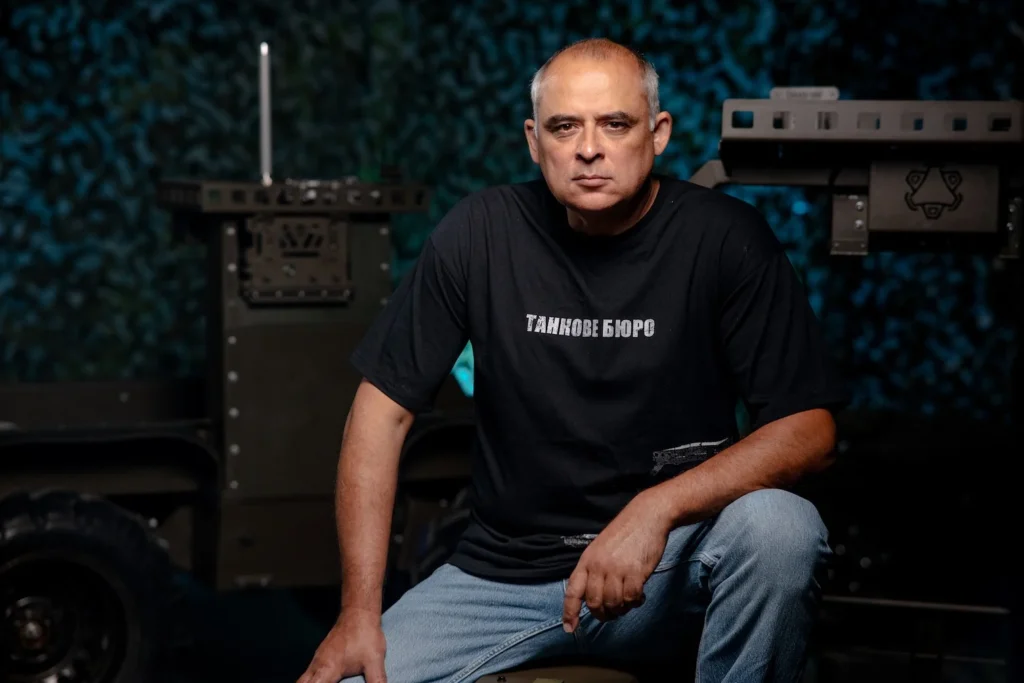
Tank Bureau’s CEO, Nazar Pryimak, calls his co-founder, Dmytro Mamonov, the “father of Ukrainian UGVs.” Mamonov holds several patents, and his blueprints have been used to build ground robots for companies in Ukraine and abroad.
Pryimak helped the inventor move from tinkering to business: late last year, Tank Bureau sold 20% of the company to the venture fund Gloster for $200,000. The deal enabled the partners to launch serial production of their flagship NUMO UGV, develop additional models, and set up full-service support.
By the end of 2025, Tank Bureau plans to produce 750 ground drones and introduce four new systems. The founders see the company as a future leader in Ukraine’s combat robotics market. Defender Media spoke with Mamonov and Pryimak about how the company was founded and where it is heading
From children’s rides to combat UGVs
The story began in 2017 in Sloviansk, Donetsk region, when Mamonov founded Tank Bureau as a family venture inspired by his son’s passion for tank design. A Minor Academy of Sciences school project led to creating a mini, track-mounted tank. The prototype worked so well that the family turned it into an attraction. Soon, scale replicas of T-34s and other tanks appeared in parks in Kyiv, Odesa, and Dnipro.
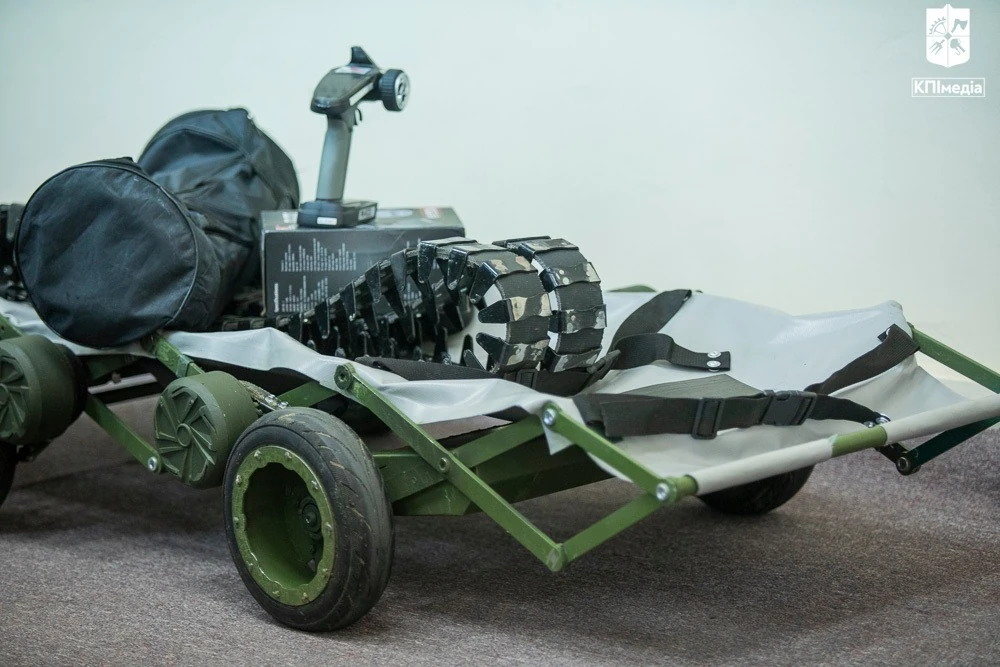
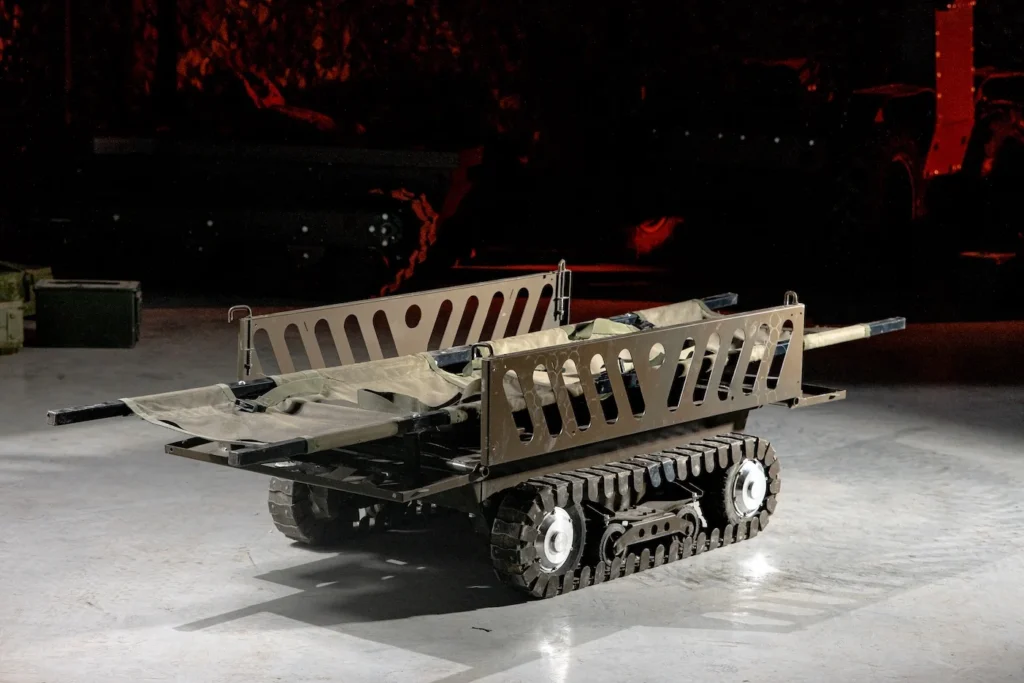
Until 2022, the company focused on entertainment. Russia’s full-scale invasion changed everything. Mamonov applied his skills to defence, first designing an electric stretcher – a small tracked platform for casualty evacuation. Production started in a garage in the Zhytomyr region, where the family had relocated after cluster munitions hit their neighbourhood in Sloviansk.
Eager to see his inventions reach the military quickly and at scale, Mamonov sold the first licence for the stretcher to a private company and transferred rights to the Kyiv Polytechnic Institute, where students built their own versions for training. He followed with a logistics drone, which caught the attention of an assault brigade. As before, he licensed his free and commercial designs to anyone able to scale up production.
In 2024, Mamonov met Pryimak, head of a volunteer initiative that had delivered over 4,000 pickup trucks to the front. Pryimak became CEO of Tank Bureau and set about turning the project into a proper business.
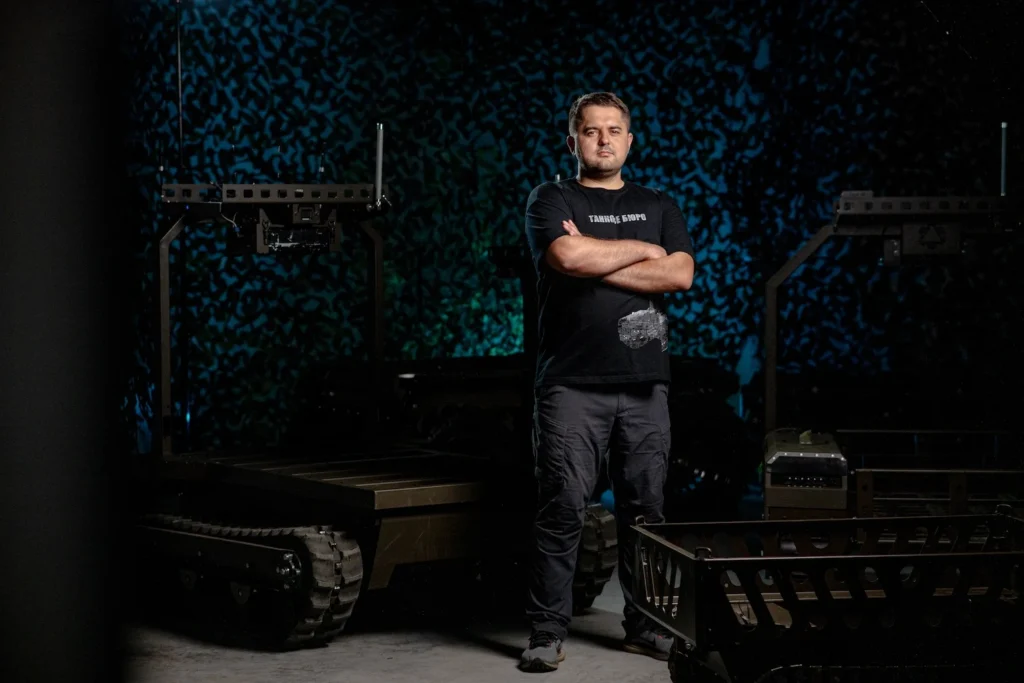
By the end of 2024, Tank Bureau secured $200,000 in investment at a $1 million valuation. According to registry data, the money came from Gloster, a venture fund backed by former Prime Minister of Ukraine Volodymyr Groysman.
NUMO: the flagship UGV
From stretchers and logistics drones, Tank Bureau pivoted to combat robots. The core of that effort is NUMO, the startup’s flagship platform, now entering serial production. On 17 September, as this article was being finalised, NUMO passed NATO codification and received its official code.
Working with DevDroid, Tank Bureau has already integrated remote weapon stations for PKT-7.62, Browning 12.7, and Mk-19 systems. Other modules, including autocannons, are under development.

The company highlights ease of use: basic training for NUMO takes just 5–10 minutes, with Tank Bureau providing training materials and frontline service support. Its modular design allows soldiers to swap out damaged components without complex repairs.
NUMO evolved from Mamonov’s logistics drone but incorporates major upgrades:
- Swappable batteries extend the range from 20 km to 50–80 km, depending on the number of installed units (2 to 8).
- Modularity – optional add-ons include mine-clearing ploughs, barbed wire rollers, tall masts for signal relay (extending comms range to 20 km), and an automatic system that switches between six communication channels.
- Design – sloped armour and practical green paint for low visibility.
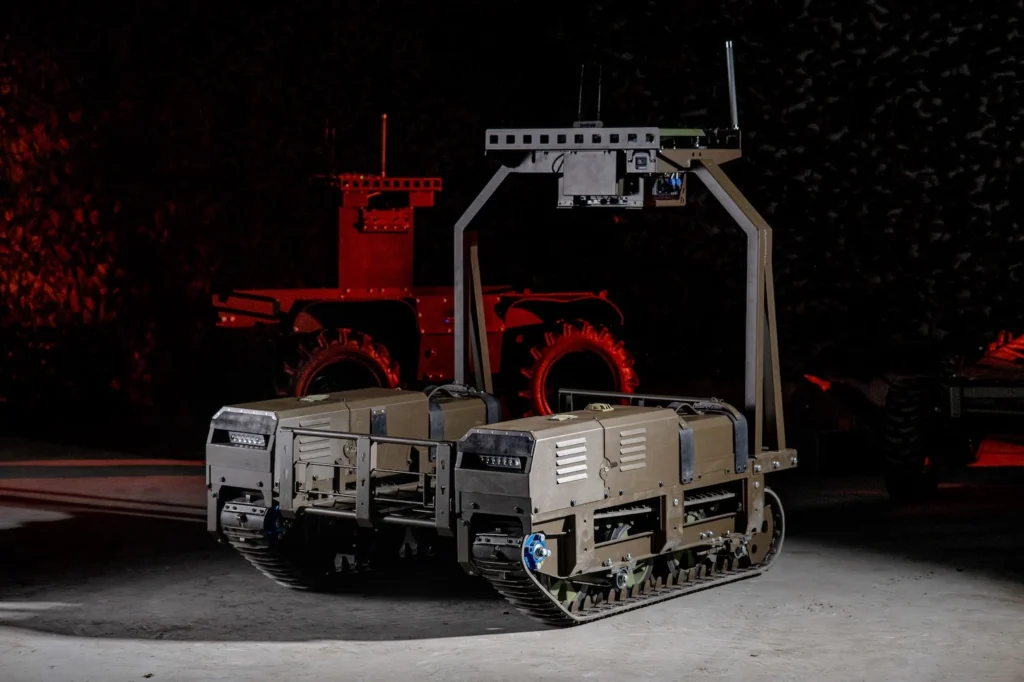
To date, around 300 Tank Bureau robotic systems – mostly the Droid TW-12 based on NUMO – have been delivered to frontline units.
What’s next
Next in line for codification is Gutir, a lightweight tracked UGV weighing around 90 kg with a payload capacity of 150 kg. Designed for medical evacuation, Gutir is compact and hard to detect. Tank Bureau is also developing wheeled UGVs, with four new platforms planned for codification by the end of 2025.
The company’s main production site is in Lviv, with a service centre in Dnipro and new hubs planned for Poltava and Kharkiv to support frontline operations. Pryimak emphasises after-sales service as a core advantage: “We support the machines throughout their entire lifecycle – from crew training to repairs. Even in cases outside warranty, we prioritise quick restoration so the machines can get back to the fight.”
Tank Bureau has joined Ukraine’s Diia.City legal regime and plans to join the Defence City ecosystem. The founders believe UGVs will play an ever-growing role on the battlefield and hope for longer-term state contracts. “We’d like contracts not for months, but for two, three, even five years,” Pryimak says. “That would allow us to plan ahead and be confident in tomorrow.”
Current capacity allows the company to produce up to 150 units per month. By the end of this year, the Tank Bureau expects to roll out around 750 UGVs with different modifications.
Yesterday, Defender Media reported that the government had expanded the ‘Army of Drones’ bonus programme to include ground-based robotic systems: from now on, military units will be able to receive ‘e-Bals’ for logistical operations carried out with the help of UGV.
Reading now
1

Ukrainian SkyFall’s drone wins at Pentagon’s Drone Dominance selection
2
Black Forest Systems raises $400,000. Here’s what drones the startup is building
3
Sting interceptor by Wild Hornets downs costly Russian Granat-4 reconnaissance drone
4
UForce unveils Bucha middle-strike drone with a 200 km range
5
The F10 drone becomes the second Ukrainian finalist in the Pentagon’s Drone Dominance Program
By submitting this form, you give Defender Media consent to the processing of personal data.
Надсилаючи цю форму, ви надаєте Defender Media згоду на обробку персональних даних.

Latest insights
1
What defence manufacturers need to know about Defence City — insights from the UCDI’s Head of GR
2
“In a year, my unit destroyed over 3,000 aerial targets.” Maksym Zaichenko on the 3rd Army Corps air defence system
3
Intelligence dependence as a strategic vulnerability: From satellite constraints to autonomous analytical platforms
4
A full-cycle unmanned business: Drone Fight Club founder Vladyslav Plaksin on manufacturing, pilot training, and investment
5