Turning Ukraine’s war-born innovations into global ventures: interview with founders of Invest in Bravery
David Nichols and Ryan Grant Little spoke about supporting and investing in Ukrainian startups

Invest in Bravery — an initiative launched by European volunteers and businessmen to support wartime entrepreneurship in Ukraine. The founders regularly organize events that bring together European investors and Ukrainian startup founders. Ahead of the next event, which will take place in Kyiv on April 30, Macedonian journalist Bojan Stojkovski spoke with two of Invest in Bravery’s co-founders for Defender.
Over the past three years, a growing number of European investors have turned their attention to Ukraine—not just for its resilience during the war, but for its emerging role as a hub of defence tech innovation. One initiative helping drive that momentum is Invest in Bravery, a platform that connects Ukrainian startups with international VC funds and helps them with raising capital and provides additional support through training sessions.
The idea was born at Mobile World Congress in Barcelona in early 2023, when one of the founders, David Nichols, visited the Ukrainian startup pavilion. There, he met entrepreneurs building world-class technology—often from bomb shelters, under constant threat, with air raid sirens in the background—and was captivated by their determination.
Together, Nichols and a small group of volunteers helped set the basis for what would become a grassroots movement to spotlight and support Ukrainian tech talent; it has since grown into a series of conferences, workshops, and investor gatherings in cities like Prague, Berlin, and Kyiv.
The previous edition of the conference, held in October 2024, saw the initiative selecting three standout Ukrainian startups that received recognition in the dual-use category – Falcons, Frontline, and Drill. The latter raised $100K in investment earlier this month, while Frontline recently closed a seed-round with Quantum Systems as lead investor.In an interview with Defender Media, two of the Invest in Bravery co-founders shared how it came together—and why they believe Ukraine’s startup sector deserves both attention and investment.
Defence tech investing is becoming impact investing
Nichols, a Prague-based startup founder and investor, spent the past two years working closely with Ukrainian companies and entrepreneurs. With over 20 years of expertise in high-tech and telecommunications industries, Nichols is now channeling his experience into strengthening Ukraine’s startup ecosystem through Invest in Bravery.
While the past editions of the conference in Kyiv weren’t solely focused on defence, Nichols explains that several standout companies working on dual-use technologies attracted particular interest from the international investment community, with a clear message: innovation is alive and well in Ukraine, and the world needs to pay attention.
Defender Media: Can you share the story behind how Invest in Bravery came to life—what was the initial spark?
David Nichols: I had worked in Ukraine in 2008 but didn’t feel a strong connection to the country at the time. I watched events there, how the country changed and started asserting its own identity separate to Russia, but it was the background of the rise of far-right, illiberal movements in Europe and the USA, particularly, that opened my eyes to the similarities between these politically and socially regressive movements and Putin and Russia.
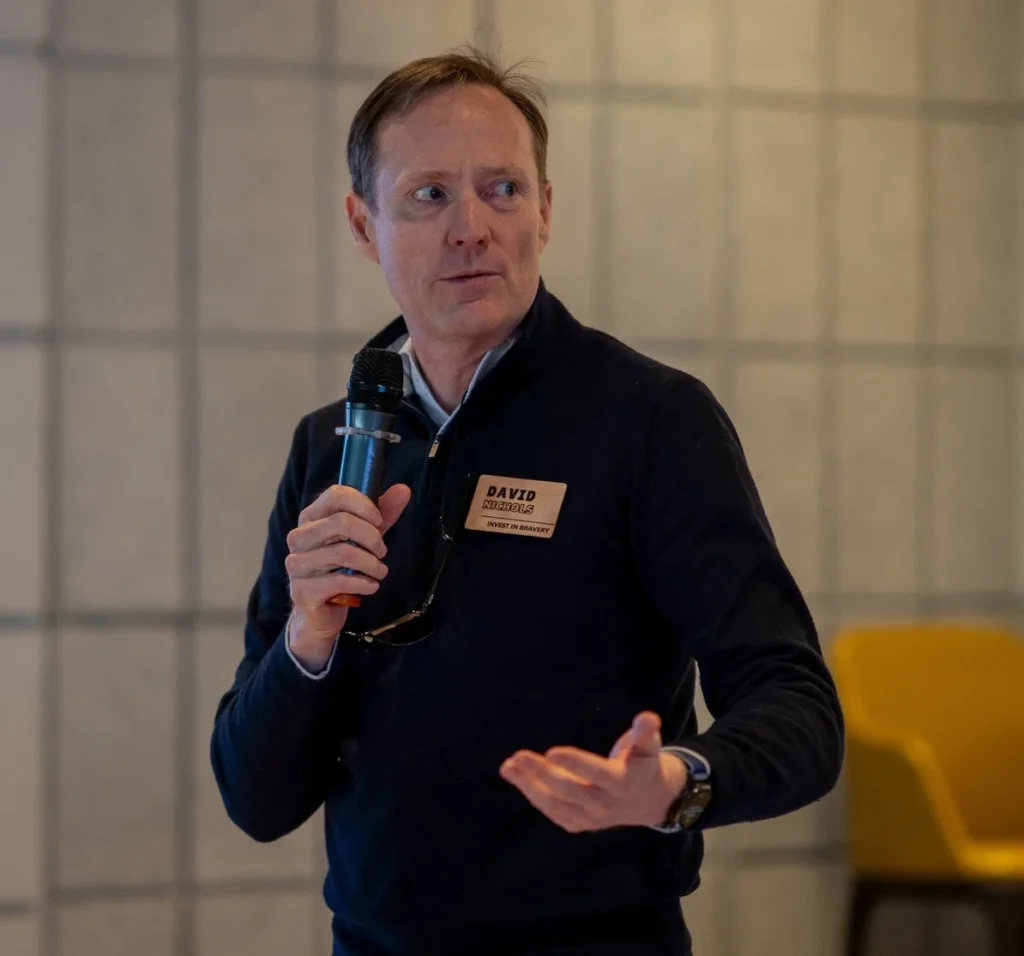
Before the full scale invasion, I was already convinced Putin was about to invade Ukraine. This was the point when I realized the heroic nature of Ukraine’s struggle, the drive for independence and democracy, the desire to be a part of Europe and free to develop their own identity as Ukrainians rather than to be enslaved by Russia. I was doing everything I could to support Ukraine after that, but finally in Barcelona at MWC in 2023, I was talking to the Ukrainian startups there, some of them who had founded their companies during the war and had already reached profitability and were scaling up, and I was blown away by these bright young people who were going to succeed at any cost, no matter what life threw at them.
The pictures of IT workers working in bunkers with laptops were 100% real, and meeting them inspired me to make an IT event in Kyiv during the war and bring people that felt like me there to show them support in person and be a constructive part of their story. That’s how it started, and I’m really grateful that I’ve met so many amazing people that share this drive with me.
Dual-use and defence technologies played a big role at your events—how are Ukrainian founders navigating the line between commercial viability and battlefield relevance?
Ukrainian startups want to be successful, but for most the top priority is to make a difference on the battlefield for their country and their people. The ones that can get connected to NATO and in particular the US Department of Defense do so, as this is a different level than just providing solutions domestically in terms of the potential to scale.
There is a challenge sometimes to balance impact on the battlefield and commercial success, and each company finds their own way to do it – in the end they must be commercially successful to keep supplying the ZSU in any case, and the Ukrainian MoD is aware of this as well.
You’ve said that investing in Ukrainian startups is a way of directly supporting democracy and rule of law. How do you communicate this mission-driven angle to investors who are usually more focused on ROI?
I believe that investors generally are aware of this in any case, but I will keep on saying it. This is one of the opportunities where you can put your money to work with a huge potential for profit while also making a critical impact on society. Jan Barta, an investor here in the Czech Republic, said at one of our events that investing in defence tech is now actually impact investing. I see it exactly like that.
With millions of euros earmarked at your Kyiv event and now more visibility in Prague, what does success look like for Invest in Bravery over the next 6–12 months?
We need to line up new sponsors — success for me will be securing independent funding to continue our mission of supporting Ukrainian entrepreneurs and startups and also closer integration of Ukraine into Europe and with other like-minded democratic countries.
What are some of the most compelling innovations or startups—especially in defence tech—that have come out of Ukraine in the past year and really surprised or inspired you?
I have seen a lot of really cool stuff, from the naval drones and missiles that have allowed Ukraine, a country with no navy, to defeat the Russian Black sea fleet, to the explosive-laden ultralight aircraft destroying Russian refineries, to interceptor drones capable of chasing down Shaheds, to drones with autonomous onboard AI-driven navigation that allow them to be used effectively in a GPS-denied environment, and much more. One of the most inspiring for me to be honest is not a miltech company, but rather Syla, a startup developing an AI-powered prosthetic leg.
The background of why that would be important for Ukrainians right is the sacrifices that they are making for Europe – and for everyone around the world that believes in democracy and the rule of law – and also highlights an integral part of the Ukrainian character – taking an incredibly challenging situation and finding a way to make something positive out ot it. The entire nation is capable of it to some degree, some more, and some less, but as a nation they stand high up in my eyes and are exceptional folk that have earned my respect and deserve our support.
The climate investor that now backs defence tech
Alongside Nichols is Ryan Grant Little, a climate investor with a background in mission-driven startups. Ryan shifted his focus to Ukraine shortly after the invasion began, first offering humanitarian support, and later co-creating Invest in Bravery to help channel funding toward promising ventures. Recently, he moved to Kyiv where he continues his efforts to strengthen the local startup ecosystem and build connections with international investors.
Defender Media: You were deeply involved in humanitarian efforts from the very first week of the full-scale invasion. What was the moment that pushed you from watching events unfold to actively supporting Ukraine on the ground?
Ryan Grant Little: I had a friend from Berlin visiting me in Vienna that week. We were walking around town in shock. Finally we sat at a café and started thinking about what people in Ukraine needed most right now. We started with the question: what would you need if everyone became a soldier from one day to the next? So we thought: good boots, camouflage everything, freeze dried foods, battery packs, flashlights, camping gear of every kind. It went from a list to a rental of a trailer to a visit to an outdoor shop and a drive eastwards.
You’ve co-founded startups and now invest in climate-focused ventures. How did your background influence the creation of Invest in Bravery—and how do you connect that mission with Ukraine’s wartime innovation?
There’s a magic to getting the right people in the room together. The long-term impact ROI of some beer, pizza, a room and a projector can be astronomical if you get the people who can fund impact and the people who are devoted to delivering impact in the same room. I’ve been doing this for decades with a focus on social and environmental investors and founders – in Canada, Berlin, Vienna.
Because of the world we live in now, the most important impact work we can do—more important than fighting climate change, which is my passion—is to secure a decisive victory for Ukraine. So now I’m focused on this kind of convening here in Kyiv, where the topic is defence tech.
What would you say to fellow investors or founders in the West who still see Ukraine’s war as separate from their work?
I don’t understand it. We all grew up with the same World War II movies and I thought we learned the price of inaction from these. Didn’t we all decide that we wouldn’t just sit by and watch it again, that we would do something? How Americans can let Russia infiltrate their country so easily—their arch enemy of the last 80 years—is just beyond what my brain can process.
Investors and founders are people of major influence with outsize resources. They should be doing something—anything—for the cause. If they can’t be persuaded by the astonishingly clear moral argument, they should at least consider that their businesses will inherit the world that is born out of this war.
At the same time, what type of defence innovations are you most excited about?
Honestly my only interest in defence tech is to win this war. I don’t get excited by it and I wish I didn’t have to be involved in this industry. I don’t like that the world is re-arming and that these armaments will be used in unjust wars after this one. But I will continue to support it until victory is won.
Ukraine’s startup ecosystem is adapting under extreme conditions, from mobilization to having founders innovating on the battlefield itself – what are some stories or founders that have personally impressed or surprised you?
People working from bomb shelters, keeping their businesses running from a smartphone while in the army, turning their homes into workshops, soldiers spending whatever’s left from their paycheck on their drone startup.
What’s your vision for Invest in Bravery over the next year? Do you see it evolving beyond connecting investors and startups into something larger?
Some events turn into communities or movements. Invest in Bravery is the experience of a lifetime for many of our international participants, who are experiencing Ukraine and a state of war for the first time. Being there makes people feel powerful; they feel in a visceral way that they can play some role in the most important thing that’s happening in the world right now. That they can make history.
Bojan Stojkovski
Bojan Stojkovski is a freelance journalist. Based in Skopje, North Macedonia, he reports on technology, science, and environmental issues, as well as post-war societies in the Western Balkan countries. His work has been featured in Foreign Policy, WSJ, ZDNET, New Eastern Europe, and Interesting Engineering.
Reading now
1
Ukrainian SkyFall’s drone wins at Pentagon’s Drone Dominance selection
2

Black Forest Systems raises $400,000. Here’s what drones the startup is building
3
Sting interceptor by Wild Hornets downs costly Russian Granat-4 reconnaissance drone
4
UForce unveils Bucha middle-strike drone with a 200 km range
5
The F10 drone becomes the second Ukrainian finalist in the Pentagon’s Drone Dominance Program
By submitting this form, you give Defender Media consent to the processing of personal data.
Надсилаючи цю форму, ви надаєте Defender Media згоду на обробку персональних даних.

Latest insights
1
What defence manufacturers need to know about Defence City — insights from the UCDI’s Head of GR
2
“In a year, my unit destroyed over 3,000 aerial targets.” Maksym Zaichenko on the 3rd Army Corps air defence system
3

Intelligence dependence as a strategic vulnerability: From satellite constraints to autonomous analytical platforms
4
A full-cycle unmanned business: Drone Fight Club founder Vladyslav Plaksin on manufacturing, pilot training, and investment
5