Dorozvidka #80: European defence tech boom, Drone Forces, Artem Moroz and Eric Schmidt
The most interesting articles, interviews and videos from social media and other media outlets over the past week
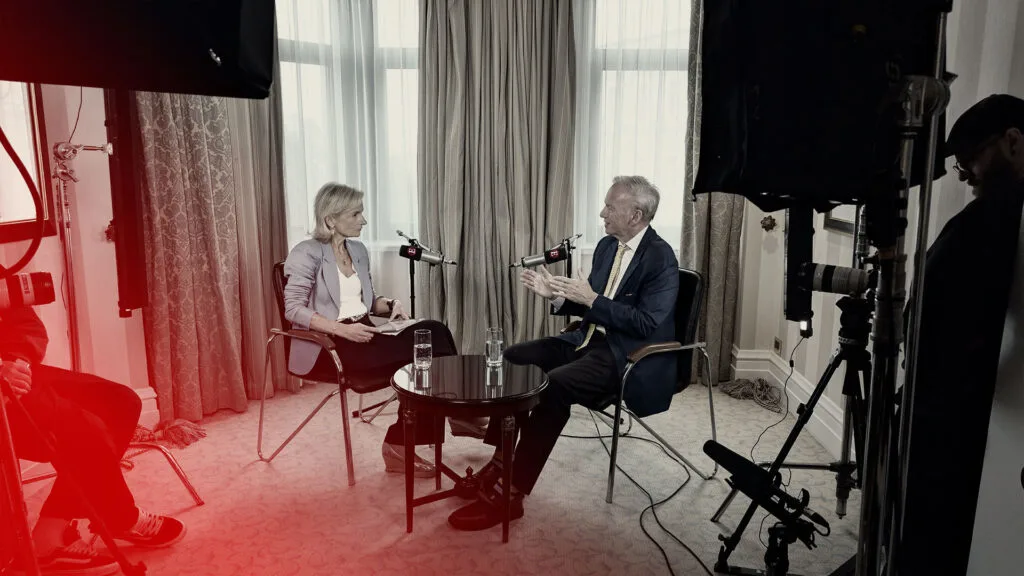
Eric Schmidt in The Economist studio. Photo: The Economist
In this issue of Dorozvidka:
- European deftech startups raised a record $7.4 billion in 2026
- The key takeaways from Eric Schmidt’s interview with The Economist
- Ukraine’s Defence Ministry reviewed weapons contracts and procurement, freeing up UAH 15.6 billion for the military’s current needs
- Artem Moroz leaves Brave1
- P1-SUN JetKiller interceptor drone takes down a second jet-powered Geran-5
- Ukraine’s Ground Forces establish Drone Forces.
European deftech startups raised a record $7.4 billion in 2026
Venture investment in European defence tech is breaking records, but Ukraine is still receiving only a fraction of this boom. That is according to the State of Defence Tech 2026 report, published by Dealroom and Resilience Media.
European defence startups have already raised $7.4 billion in venture funding in 2026, according to the report. This is a record for the sector. The figure could reach $10.5 billion by year-end, four times higher than in 2025.
Before 2020, defence startups accounted for just 0.5–1% of all venture investment in Europe. That share has now risen to 11.1%, and to 15% across the 27 EU member states.
The report also provides data on Ukraine, though it includes only deals tracked by the Dealroom platform. Since the beginning of 2026, it has recorded $19.8 million in venture funding raised by Ukrainian defence startups. The report’s authors acknowledge that the actual figure is likely higher.
The key takeaways from Eric Schmidt’s interview with The Economist
The Economist has published an interview with former Google CEO and current defence tech investor Eric Schmidt. He said Russia has narrowed the technological gap with Ukraine and is now improving its military technologies at roughly the same pace. Ukraine remains ahead in innovation, he said, but Russia has significantly more resources to scale. Schmidt identified jet-powered Shaheds, glide bombs, ballistic missiles and the potential Russian Rassvet satellite network among the key threats.
Schmidt also highlighted jet-powered Shaheds, saying Russia began fitting them with Chinese-made jet engines much faster than expected. According to Schmidt, more than half of Shaheds may now use such engines. He said at least five Ukrainian companies are developing solutions to counter the threat. In his view, Ukraine needs not only new technologies but also the funding and capacity to rapidly scale their production.
Schmidt also distinguishes between autonomous guidance and full-scale military AI. He considers machine vision that allows a weapon to identify a target and guide itself during the terminal phase primarily a result of good engineering rather than AI. True military AI, he predicts, will analyse vast amounts of intelligence, identify problems and recommend optimal ways for commanders to deploy forces and capabilities.
At the same time, Schmidt argues that humans should remain in the loop in military decision-making. He warns that autonomous systems capable of independently selecting targets and planning military operations could create a risk of large-scale mistakes and unpredictable escalation. In his view, future warfare will require clear rules for military AI, while Ukraine and its partners need to keep pace with innovation and scaling to prevent Russia from gaining a technological edge.
Ukraine’s Defence Ministry reviewed weapons contracts and procurement, freeing up UAH 15.6 billion for the military’s current needs
Ukraine’s Defence Ministry, together with the General Staff and the Logistics Forces Command, reviewed the military’s current needs, existing contracts and planned procurement. The review will free up UAH 15.6 billion, officials said. The funds will be redirected to areas that are currently a higher priority for the military.
The reasons for the review include the fact that the specifications of some systems no longer meet current battlefield requirements, suppliers cannot produce the planned quantities, some systems have not yet completed codification, certain needs are now fully covered by partners, while some tasks can be performed using cheaper systems that can be procured in larger quantities.
Some contracts will be terminated, while some planned procurements will not go ahead. The Defence Ministry said it has already informed manufacturers affected by the changes. The list of weapons whose procurement has been reviewed has not been disclosed for security reasons.
Artem Moroz leaves Brave1
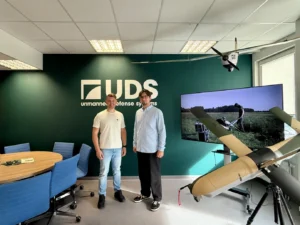
Artem Moroz, who headed Brave1’s investor relations efforts, has left his position after nearly three years with the organisation. During that time, his team launched Defense Tech Valley and the Brave1 investment portal, held more than 30 investment days and built a community of more than 400 investors.
“Here, I saw just how many people in Ukraine create things that did not exist yesterday, every single day. And how much depends on whether we can connect these people with those who are ready to believe in them,” Moroz wrote on his Facebook page.
According to Moroz, Ukrainian defence tech has already attracted hundreds of millions of dollars, and the figure could reach $1 billion by the end of 2026.
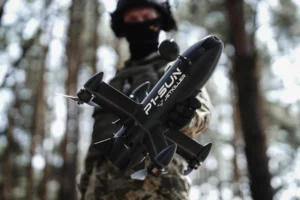
P1-SUN JetKiller interceptor drone takes down a second jet-powered Geran-5
The unmanned systems crew of the National Guard of Ukraine’s Lasar’s Group has destroyed a Russian jet-powered Geran-5 strike drone for the second time. The company SkyFall reported the strike, which, as in the first case, was carried out by its P1-SUN JetKiller interceptor drone.
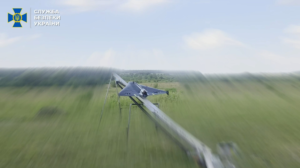
Footage from the interceptor’s onboard camera shows the JetKiller closing in on the target on a crossing head-on course. The Geran-5 enters the interceptor’s field of view, after which the pilot confirms the kill.
Ukraine’s Ground Forces establish Drone Forces
Ukraine’s Ground Forces have established Drone Forces. Ukrinform reported on their presentation. The Drone Forces are an integrated system of units and capabilities that includes aerial systems — FPVs, heavy bombers, reconnaissance aircraft, and deep- and mid-strike platforms — as well as ground unmanned systems, including assault platforms, logistics systems for delivering supplies and evacuation platforms for wounded troops on the battlefield.
Each Ground Forces battalion has a company of unmanned systems, each brigade has a battalion, and each corps has a regiment. According to the Ground Forces, drones account for up to 80% of enemy personnel casualties, 70% of reconnaissance, up to 90% of frontline logistics and half of battlefield medical evacuations.
Reading now
1
SkyFall officially unveils Thor Hammer mid-strike and announces 1,000+ km version
2
Pentagon to hold Drone Dominance trials for bomber drones, with UFORCE, Gurzuf Defence, Grim Tech and others taking part
3
British-Ukrainian Occam Industries raises €3.8m. The funds will go towards scaling drone autonomy software
4
Terra Drone acquires 50% of Ukrainian Kurin Technologies for $3.5 million
5

Autonomous interceptor drones need radars to work. Why is there still a lack of them
By submitting this form, you give Defender Media consent to the processing of personal data.
Надсилаючи цю форму, ви надаєте Defender Media згоду на обробку персональних даних.

Latest news
1

Dorozvidka #80: European defence tech boom, Drone Forces, Artem Moroz and Eric Schmidt
2
US Buys 1,320 more FPV drones from Ukraine’s F-Drones for $6.5M
3
Robotic systems carried out 94 assault and sabotage operations during Operation Vivaldi, says NC13 unit commander
4
NeoLens, an AI assistant for military vehicle repair, is now available as an Android app
5