Dorozvidka #58: Lima vs. the Kinzhal, plus Berlinska, Tsvok, “Achilles” and TechNovator
The most interesting publications on Ukrainian defence tech from Ukrainian and international media outlets

Yurii Fedorenko, commander of the 429th UAV Systems Brigade “Achilles”. Illustration: press service of the 429th Separate Unmanned Systems Brigade “Achilles”
In the latest Dorozvidka:
- Zelensky: the first tranche of €90 billion in EU aid will go toward joint drone production
- Ukrainian developer of wireless charging for drones and robots wins hackathon
- “Achilles” brigade commander Yurii Fedorenko on the brigade’s R&D center
- The Kyiv Independent: Ukraine’s Lima electronic warfare system intercepted 58 out of 59 Kinzhal missiles
- Mariia Berlinska on “Mindichgate”, Fire Point, and the first 100 days of Minister Fedorov
- Danylo Tsvok on AI as a tool of battlefield advantage
Zelensky: the first tranche of €90 billion in EU aid will go toward joint drone production
The first tranche of the European support package for Ukraine will be directed toward the launch of joint production facilities for unmanned systems, President Volodymyr Zelensky said. He noted that Ukraine and the EU have already agreed on a financing schedule and begun work on a strategic “Drone Deal” agreement aimed at integrating their defence-industrial complexes.
“A meaningful conversation with Ursula von der Leyen today. We discussed the European support package — including the timeline for the first tranche, which will be directed toward joint drone production. We also agreed to actively move forward on a Drone Deal with the European Union and discussed the details of such a potential security cooperation. We are preparing a plan of steps that will allow us to build the necessary security infrastructure,” Zelensky said on Monday, May 4.
Mariia Berlinska on “Mindichgate”, Fire Point, and the first 100 days of Minister Fedorov
Mariia Berlinska, head of the Air Reconnaissance Support Center and the Victory Drones project, addressed several key topics in a video interview with Channel 5, including the so-called “Mindich tapes” and the company Fire Point, whose name has once again surfaced in the scandal. Berlinska expressed support for the work of anti-corruption bodies but urged “not to mix things up.”
In particular, she noted that she has no questions regarding the effectiveness of Fire Point’s products or the engineering capabilities of its co-owner and chief designer, Denys Shtilerman. According to Berlinska, there are not many engineers of Shtilerman’s level in Ukraine’s defence sector, and they “can be counted on the fingers of both hands.”
She also discussed with host Yanina Sokolova the first 100 days of Mykhailo Fedorov’s team in the Ministry of Defence.
The Kyiv Independent: Ukraine’s Lima electronic warfare system neutralized 58 out of 59 Kinzhal missiles
The Kyiv Independent reports on Ukraine’s Lima electronic warfare system, which is said to “down” Kinzhal missiles by disrupting the satellite navigation of enemy rockets. According to the report, since last summer Lima has neutralized 58 out of 59 missiles.
The system is being developed by Cascade Systems and operated by the air defence unit “Night Watch.” Lima simultaneously jams signals, feeds false coordinates, and conducts cyber interference against the missile’s receiver. “Alchemist,” commander of “Night Watch,” said: “We figured out how to load it with incorrect data in a way that it doesn’t update them for a long time even after leaving the coverage zone.”
According to him, the system can also be used against Shahed drones and other targets in Ukraine’s airspace. “To cover the entire country against everything that flies would require $1 billion, plus $800 million to counter ballistic threats,” he added.
Yurii Fedorenko, commander of the “Achilles” brigade, on the brigade’s R&D center
Yurii Fedorenko, commander of the “Achilles” brigade, spoke with Forbes Ukraine, including about the developments of the unit’s R&D center. “For example, our R&D developed a remote control system for Mavic drones so that operators can stay at a safe distance,” he said.
He also noted that the brigade actively cooperates with manufacturers. According to Fedorenko, in some cases “garage” makers can deliver solutions that are even better than those of top-tier companies.
The brigade’s R&D center is ready to share its developments with manufacturers. “Anyone willing to produce can receive technical documentation from us,” he said.
A Ukrainian developer of wireless charging for drones and robots has won a hackathon.
The TechNovator project, which develops wireless charging for drones and robots, has won the final of the Deep Tech Accelerator: Hardware Edition programme. The startup received a $10,000 prize.
The team has developed a wireless energy transfer technology that powers devices at a distance and in motion with minimal losses. The innovation enables autonomous operation of drones, robots, and medical implants without cables or contact-based charging stations.
Danylo Tsvok on AI as a tool of battlefield advantage
Artificial intelligence will become Ukraine’s advantage on the battlefield, says Danylo Tsvok, head of the Defense AI Center “A1,” in an interview with Associated Press. The technology will enable Ukraine to outpace the enemy through faster data analysis and decision-making — from strategic operational planning to practical execution on the battlefield.

Tsvok says that artificial intelligence is already making Ukrainian weapons smarter: drones are becoming resistant to electronic warfare systems and can complete missions even without communication with an operator. The next step is integrating equipment into a single “digital organism,” where drones, ground robots, and information systems operate as a coordinated network.
At the same time, according to Tsvok, Ukraine’s goal is not to develop fully autonomous combat systems, as the final decision must remain with a human operator.
Reading now
1
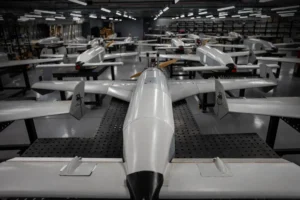
SkyFall officially unveils Thor Hammer mid-strike and announces 1,000+ km version
2

260+ vacancies in Ukrainian defence technology at BlueBird Tech, Sine Engineering, Buntar Aerospace and more
3
British-Ukrainian Occam Industries raises €3.8m. The funds will go towards scaling drone autonomy software
4

Terra Drone acquires 50% of Ukrainian Kurin Technologies for $3.5 million
5

Autonomous interceptor drones need radars to work. Why is there still a lack of them
By submitting this form, you give Defender Media consent to the processing of personal data.
Надсилаючи цю форму, ви надаєте Defender Media згоду на обробку персональних даних.

Latest news
1
Forbes: Airlogix plans to raise $100m at a $2bn valuation
2

Tencore launches an ecosystem to bring together UGVs and components from several manufacturers
3

Defense companies may see staff deferrals cut from 100% to 85%
4
Japan signs contract with Ukrainian company SkyFall to procure interceptor drones
5