The promise and challenges of metasurface-driven EW: Interview with Stronghold AI’s co-founder Dr. Rafael Licursi
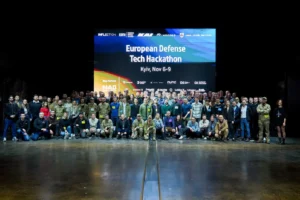
On the eve of the European Defense Tech Hackathon in Kyiv, we talk to winner of August’s event in Copenhagen

CEO Stronghold AI Rafael Licursi / Photo credit: babypro
Metasurfaces, reconfigurable environments and electromagnetic fields: this is the most complex text in eight months of Defender Media’s existence.
In the second interview of the special project Rewiring European Defense Tech, which our editorial team is producing in partnership with the European Defense Tech Hub, we talk to one of the EDTH hackathon winners — Dr. Rafael Licursi. He explains how new materials are transforming the field of electronic warfare, what lessons the European defence industry can draw from the war in Ukraine, and how EDTH is helping high-tech ideas turn into real defence projects.
Electronic warfare is evolving at an unprecedented pace, driven by the convergence of AI, software-defined systems, and advanced materials, including metasurfaces. Dr. Rafael Licursi, co-founder and CEO of Stronghold AI, has been closely involved in this transformation, influencing how these technologies are applied to modern defence.
A former military pilot and electronic-warfare officer, Dr. Licursi combines rare operational experience with deep technical expertise. He earned a PhD from the Institut Polytechnique de Paris, specialising in reconfigurable metasurfaces for antennas, and has held senior engineering and leadership roles across multiple deep-tech defence companies.
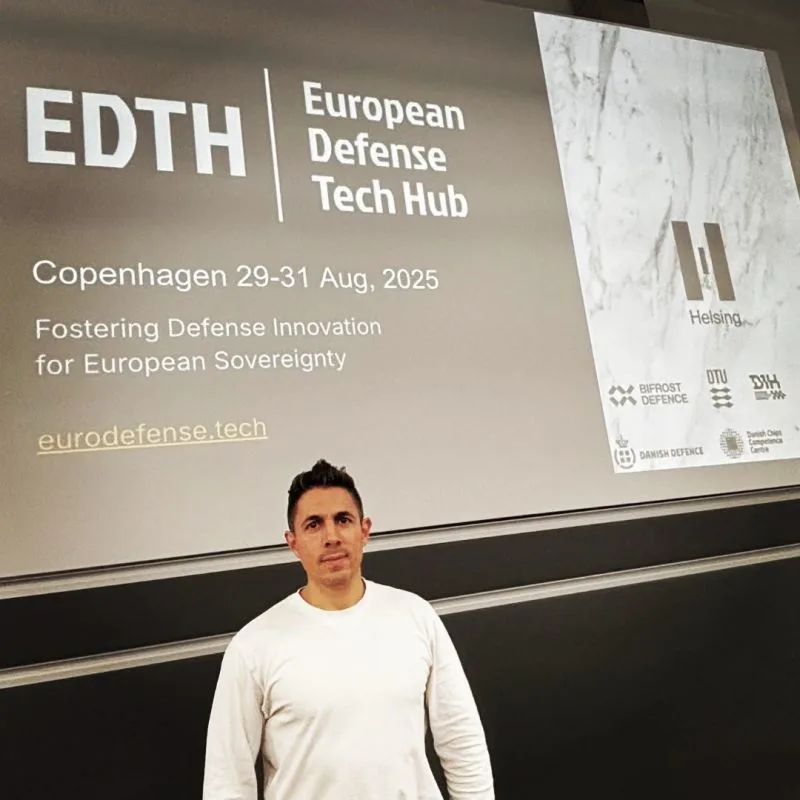
Under his leadership, Stronghold AI develops distributed, software-led sensing systems that extend awareness across wide areas, providing early indicators, persistent tracking, and real-time alerts in unpredictable threat environments. The company also takes an active role in the European Defense Tech Hub, collaborating with warfighters, startups, and innovators to accelerate the development of field-ready defence technologies.
In this conversation with Defender Media, Dr. Licursi discusses how his operational experience shaped his perspective on EW, the challenges and opportunities of metasurfaces, lessons Europe can learn from Ukraine’s rapid innovation cycles, and how the next decade of electronic warfare will be defined by the seamless integration of AI, software, and hardware.
Defender Media: You began your career as a military pilot and electronic-warfare officer. How did those early operational experiences shape your understanding of the electromagnetic battlespace and inspire your later research?
Dr. Rafael Licursi: My operational experience has been crucial to the work I do today. Research and development can produce impressive systems, but unless they’re designed with real-world use in mind, they might not be practical in the field. During my years in the Air Force as a pilot and electronic-warfare officer, I learned how equipment is actually used, how operational doctrines shape decisions, and what armies truly need from the tools they deploy. That hands-on experience gave me a unique advantage – it allows me to bridge the gap between research and reality, ensuring that the systems we build are not only capable but also effective and usable on the battlefield.
Your book Metasurface-driven Electronic Warfare proposes that entire environments can become reconfigurable through metasurfaces. How close are we to seeing this concept transition from research to real-world defence systems?
The idea of a reconfigurable environment is quite advanced, but we’re not too far from seeing it become reality — it just won’t happen within the next couple of years. In the civilian world, for example, research on 6G communications is already exploring what are called reflective or reconfigurable intelligent surfaces. These will be distributed throughout cities to improve signal propagation.

Imagine being in the middle of Paris, where I am today. Right now, my phone receives a 5G signal that bounces off walls and buildings before reaching me. In a 6G world, those walls will be coated with metasurfaces that can actively reconfigure themselves to optimise how electromagnetic waves travel from a base station to the user.
Once this technology is deployed at scale for civilian use — backed by significant funding and development — it will mature enough to be adapted for defence applications. There are still technical challenges to solve, such as bandwidth limitations and signal losses, but I believe that after sufficient progress in the civilian sector, the defence community will be able to leverage it effectively.
In my view, we can expect to see operational military applications of reconfigurable environments emerging in the early 2030s, roughly alongside the rollout of 6G technology.
What are the biggest technical or industrial barriers still preventing metasurfaces from being adopted in next-generation electronic warfare platforms?
Metasurfaces can already be used in certain defence applications – especially in the antenna domain. In fact, similar concepts are already being applied in 5G systems, offering significant advantages.
In the past, reconfigurable antennas relied on expensive components such as phase shifters and amplifiers. Phased-array antennas, for example, are powerful but costly, energy-intensive, and bulky, which limits their deployment — say, to a few units on a fighter aircraft. Metasurfaces, on the other hand, allow us to build reconfigurable antennas that are far more compact, cost-effective, and energy-efficient. This technology is mature enough to be used today.
However, more advanced applications — like creating reconfigurable environments — require a new class of metasurfaces. These still face key technical challenges. Their bandwidth, angle dependence, and losses are not reasonable for operational purposes yet. Overcoming these limitations is essential before this new class can dynamically shape the entire electromagnetic environment.
Stronghold AI focuses on distributed, software-led sensing for unpredictable threat environments. What sets this approach apart from conventional radar or sensor-fusion systems?
Conventional radars and classic sensor-fusion architectures tend to concentrate capability into a few large, expensive assets. You put a powerful, power-hungry radar in one location to cover a wide area; depending on frequency, waveform and technique, those systems can be very effective at detecting things like drones – but they’re costly, power-hungry, and evident to adversaries.
That concentration creates a vulnerability in conflict: when you centralise valuable assets, they become high-value targets. Operational experience from Ukraine shows that adversaries will try to destroy or neutralise those assets – either to avoid detection or to impose cost on you. Replacing or protecting those exquisite systems is expensive and logistically painful.
A distributed, software-led approach flips that model. Instead of relying on one or a few concentrated sensors, you spread many low-cost sensing nodes — for example, hundreds or thousands of inexpensive sensors or drones – and let software fuse and interpret their data. That gives you multiple observation angles, redundancy, and resilience: no single strike removes your capability. It also makes the sensor network less evident and harder for an adversary to target effectively.
Practically, distributed sensing adds geometric and operational advantages: better spatial coverage, parallel data collection, graceful degradation if nodes are lost, and the ability to scale or reconfigure dynamically. Software-led fusion and edge processing let the system combine many weak signals into a coherent picture without depending on a single centralised platform. Those features are what differentiate distributed systems from conventional radar-centric architectures.
Ukraine has become one of the most innovative defence tech ecosystems in the world. What lessons do you think European startups and defence companies can learn from Ukraine’s speed and battlefield-driven innovation?
The lessons from Ukraine remind me of a quote by Giulio Douhet, air power theorist: ”Victory smiles upon those who anticipate the change in the character of war, not upon those who wait to adapt themselves after the changes occur.” Ukraine shows that speed is everything in innovation. We no longer have the luxury of long, traditional development cycles where a military concept moves through years of planning, procurement processes, and development. In the past, it could take four, five, or even ten years to see a capability realised. That model worked for certain contexts, but Ukraine is showing us that we also have some cases where it’s no longer effective.
The biggest lesson is that development cycles must shrink dramatically: not decades, not years, not even semesters, but months or even weeks. Many systems in Ukraine are actively being tested in combat, and operators maintain constant communication with developers. Through this continuous feedback, systems are iteratively improved on a weekly basis to become operationally effective.
Why is Ukraine able to move this fast? Because necessity drives creativity. They face an adversary with greater resources, both in terms of equipment and manpower. Clausewitz famously described military power as the combination of tangible means and will. Ukraine’s strength lies in its will — the determination of its people and military to resist despite being outmatched materially. That will fuel innovation, improvisation, and rapid adaptation, allowing them to counterbalance an adversary’s superior resources.
The key takeaway for European startups and defence companies is that creativity, speed, and constant iteration, driven by clear operational needs, can be more decisive than having the largest or most sophisticated resources. Innovation under pressure is not just possible; it’s transformative.
Do you see opportunities for Stronghold AI to collaborate with Ukrainian defence tech teams or integrate their rapid prototyping methods into your own development cycles?
Absolutely. The purpose of Stronghold AI is to provide tools that are truly impactful in operational scenarios. There are different ways to build a defence startup. One approach is to work from a peaceful country, observe conflicts from afar, and try to develop technology remotely. That’s not the model we adopt.
For us, the most effective approach is to stay closely connected with warfighters. Development cycles happen on a weekly basis, with rapid feedback between operators and developers. We resonate with this pace.
We are currently developing our partnerships in Ukraine because being part of this ecosystem is essential. Collaborating directly with Ukrainian companies and forces allows us to deliver solutions that are operationally relevant and truly impactful. We see this engagement as not just beneficial — it’s a must.
How can initiatives like the European Defense Tech Hub help bridge the gap between deep-tech research and field-ready defence capabilities in Europe?
The European Defense Tech Hub plays a crucial role in today’s defence sector. My own operational experience gives me a clear understanding of what is truly needed in the field, but not every researcher, engineer, or early-stage entrepreneur had the chance of obtaining such experience. The hub helps to fill this gap.
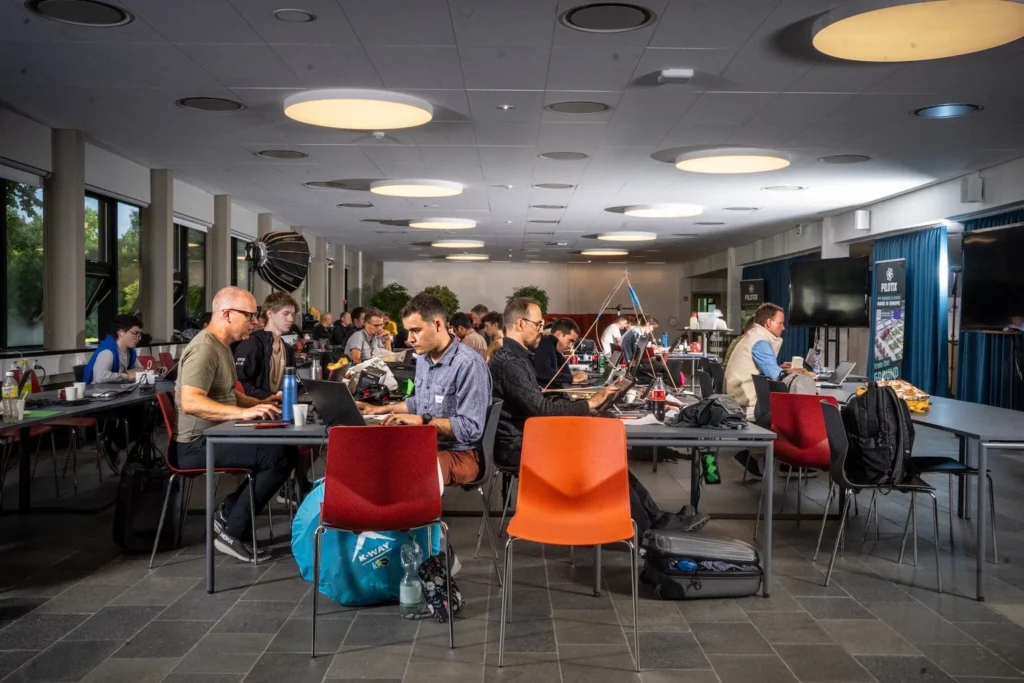
Through hackathons and other initiatives, participants can meet real soldiers, warfighters, and companies already deploying systems on the battlefield. This interaction allows them to compensate for an eventual lack of operational experience. I’ve had the privilege of receiving direct feedback from warfighters, who could tell me what aspects of a system were promising and which ones wouldn’t work in the field. Their insights helped me understand how to translate technology from the lab into practical, operational tools.
For me, the key value of the European Defense Tech Hub is exactly this: it helps attendees to see what is truly needed and what will actually work in operational contexts. Without this input, engineers might develop impressive systems in theory that end up being of limited use in the real world.
Looking ahead, how do you see the convergence of AI, software-defined systems, and metasurfaces reshaping the future of electronic warfare over the next decade?
I like to think of defence forces as octopuses: each has a brain and many tentacles, which are the assets expressing the brain’s will. In a conflict, two of these “octopuses” face off.
For me, AI represents the brain – it drives situational awareness and decision making. But a powerful brain alone isn’t enough; it needs tentacles to act upon. That’s where high-performance antennas and strategically placed metasurfaces come in — they allow the AI to communicate, sense, and influence the electromagnetic environment effectively.
Over the next decade, success in electronic warfare won’t come from investing solely in AI or solely in hardware. The winning forces will be those that integrate both: advanced software and cutting-edge hardware. A complete, software-defined system combines powerful AI with effective, distributed physical assets, allowing forces to sense, decide, and act faster and more effectively than adversaries.

Bojan Stojkovski
Bojan Stojkovski is a freelance journalist. Based in Skopje, North Macedonia, he reports on technology, science, and environmental issues, as well as post-war societies in the Western Balkan countries. His work has been featured in Foreign Policy, WSJ, ZDNET, New Eastern Europe, and Interesting Engineering.
Reading now
1
Ukrainian SkyFall’s drone wins at Pentagon’s Drone Dominance selection
2

Black Forest Systems raises $400,000. Here’s what drones the startup is building
3
Sting interceptor by Wild Hornets downs costly Russian Granat-4 reconnaissance drone
4
UForce unveils Bucha middle-strike drone with a 200 km range
5
The F10 drone becomes the second Ukrainian finalist in the Pentagon’s Drone Dominance Program
By submitting this form, you give Defender Media consent to the processing of personal data.
Надсилаючи цю форму, ви надаєте Defender Media згоду на обробку персональних даних.

Latest news
1
DPA to diversify drone and ammunition orders among multiple suppliers
2
‘Ukrainska bavovna’ and Czech company Pavetra Aerospace to produce Shuhay UAV through joint venture
3
59th Assault Brigade downs Russian Ka-52 helicopter with General Cherry OPTIX FPV drone
4
Tencore develops evacuation module for TerMIT UGV
5