Black Mirror #29. The Multik EW system, Klin and Listopad drones, and other new developments in Russian miltech
Review of Russian military innovation developments for the third week of October

Тurret-mounted laser system by Laboratoriya PPSH / Source: Russian Telegram channels
Ukrainian drones continue to disrupt not only Russian troops on the front line and nearby, but also the enemy’s economy deep in the rear. As a result, Russian engineers are putting major effort into developing counter-drone systems. This week, they showcased a wide range of such technologies — from a laser turret complex to upgrades of Soviet-era light aircraft and a system resembling Afganit. At the same time, Russia also presented several offensive projects, primarily its own drones.
More on these and other enemy developments — in Black Mirror #29.
LiDAR production
In the Tomsk region, production of LiDARs (laser rangefinders) is set to begin. The project involves producing LiDARs intended for use in automobiles, specialised machinery, and unmanned aerial systems. The primary focus will be on UAV applications.
EW system Multik is designed to protect helicopters from FPV drones
The Russian company Gradient has developed the Multik electronic warfare system intended to protect helicopters from FPV drone attacks. Its specifications have been shared by both Russian and Ukrainian Telegram channels. Ukrainian forces have repeatedly and successfully targeted Russian helicopters using FPV drones in the past.
New counter-drone system
User Volke shared information on X about a new Russian counter-drone system that visually resembles the Afganit active protection system.
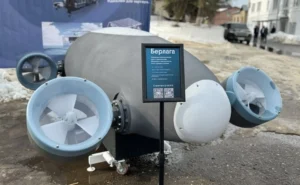
Like Afganit, the new system uses radar and optical sensors to detect targets and then deploys effectors—munitions that create a cloud of fragments around the drone. The idea is to destroy an incoming FPV drone or loitering munition before it reaches the vehicle.

Russian sources claim the system is designed to counter FPV drones and loitering munitions actively used by Ukraine.
According to Militarnyi, based on an analysis of several sources, the new Russian system appears to be more of a prototype or a testing-ground experiment than an operational weapon. There is currently no evidence of mass production or deployment on the front line.
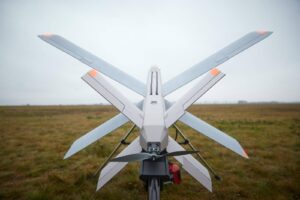
Klin kamikaze drone with AI
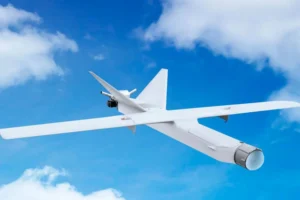
The Russian defence‑industrial complex has developed the kamikaze drone Klin, which is capable of loitering in the air for more than an hour. According to reports, the UAV can autonomously detect and attack targets at ranges up to 120 km when a relay is used, or operate as an “airborne minefield”, loitering for about 80 minutes.
Takeoff weight – 13.5 kg, flight speed ranges from 108 to 300 km/h. Fuselage length is 1.6 m, wingspan is 1.9 m. Maximum flight altitude – up to 2 km. Warhead weight is 5 kg. The UAV is equipped with an air-burst fuze and features two types of warheads: shaped-charge and high-explosive.

Judging from published photos, some components of the UAV are manufactured using 3D printing technologies: in particular, the optical module appears to be 3D printed.
The drone has an aerodynamic layout similar to the Shahed – a delta‑shaped “tailless” design – while also incorporating canard elements with forward horizontal surfaces. Additionally, one of the control surfaces is located on top of the fuselage.
Turret-mounted laser system against UAVs
Photos have surfaced online showing a turret-mounted laser system developed by the Russian company Laboratoriya PPSH. Reports indicate that testing of the system has already begun.
It is most likely a fibre-optic laser with a power output of 5–10 kW, capable of targeting small quadcopters and fixed-wing kamikaze drones at a distance of 1.5–2 km.

The turret is equipped with a thermal imaging sighting system featuring an LCD that shows infrared images of heat-contrast targets. A shielded casing protects the laser module and optical system.
UAVs at the St. Petersburg Gas Forum
At the forum in St. Petersburg, Russians presented samples of domestic unmanned aerial vehicles. The large multicopter Moskit BS1 from the Tomsk Scientific and Production Centre for Unmanned Aviation Systems is capable of carrying a payload of 200 kg over a distance of up to 35 km. Still, its flight duration is limited to 30 minutes.
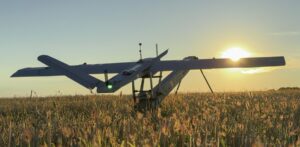
The UAV system Listopad has a flight range of 150 km and a duration of 3 hours, but its payload capacity is only 1.7 kg. The vehicle is designed for monitoring industrial facilities and mapping, including under electronic warfare (EW).

The UAV Polkan M1 can transport a 40 kg cargo over a distance of 200 km. The drone is equipped with an automatic takeoff and landing system, allowing it to remain airborne for up to 3 hours.
3D printed reconnaissance drone
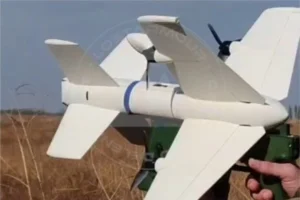
Russian company Azimut is conducting field tests of its new universal drone. The fuselage is entirely 3D-printed and represents a “tube” with a robotic nose section.

The drone costs less than similar models with comparable specifications. This is achieved by using a single engine for all flight modes, vertical or horizontal. Additionally, additive manufacturing technologies help reduce the overall cost of the product. The main intended use of this UAV is monitoring.
Modified AN-2
Near Yeysk in Russia’s Krasnodar Krai, flight tests of a modified AN-2 aircraft have begun. The aircraft has been equipped with a turboprop engine developed based on the TV2-117 helicopter engine.
The first flight of the new version – TR-301/117 – lasted 10 minutes.

The company Technoregion has long been experimenting with re-engineering the AN-2. This time, engineers used the TV2-117 engine, which is usually installed on Mi-8T helicopters. To adapt it, the engine was converted into a single-shaft turboprop. The free turbine was removed, and the gearbox was connected directly to the compressor.
After the modification, the power decreased by 40% – from 1,500 to 900 hp. Representatives believe that even with such losses, the TR-301/117 will outperform the previous version with the Czech M601 engine (720 hp).
The prototype of Yak-130M advanced trainer/light-attack aircraft
The United Aircraft Corporation of state corporation Rostec has completed construction of the first experimental prototype of the modernised Yak-130M advanced trainer/light-attack aircraft. The work was carried out as part of an experimental design project at the Irkutsk Aviation Plant. The aircraft has now been sent to the ground and flight test phase, and the assembly of two more airframes is underway in parallel.
The Yakovlev company is developing the aircraft. During ground tests, the new and upgraded systems will be checked to confirm the declared technical characteristics.
The corporation states that the modernisation will enable the Yak-130M to be armed with air-to-air missiles and air-to-surface munitions using satellite and laser guidance systems.

The base for the new modification was the Yak-130 advanced trainer/light-attack aircraft. According to the developers, the updated aircraft will be capable of performing missions both day and night.
Specifically, the aircraft is equipped with a new onboard radar station, BRLS-130R, an optical-laser thermal-imaging system, SOLT-130 K, the President‑S130 defensive suite, and a modern communications system, KSS-130.
Reading now
1

Ukrainian SkyFall’s drone wins at Pentagon’s Drone Dominance selection
2
Black Forest Systems raises $400,000. Here’s what drones the startup is building
3
Sting interceptor by Wild Hornets downs costly Russian Granat-4 reconnaissance drone
4
UForce unveils Bucha middle-strike drone with a 200 km range
5
The F10 drone becomes the second Ukrainian finalist in the Pentagon’s Drone Dominance Program
By submitting this form, you give Defender Media consent to the processing of personal data.
Надсилаючи цю форму, ви надаєте Defender Media згоду на обробку персональних даних.

Latest news
1

DPA to diversify drone and ammunition orders among multiple suppliers
2
‘Ukrainska bavovna’ and Czech company Pavetra Aerospace to produce Shuhay UAV through joint venture
3
59th Assault Brigade downs Russian Ka-52 helicopter with General Cherry OPTIX FPV drone
4
Tencore develops evacuation module for TerMIT UGV
5