Black Mirror #28. Loitering munition Assol, Shaheds with a napalm warhead, FPV-drone with satellite communication
Review of new Russian military technology developments in the second week of October
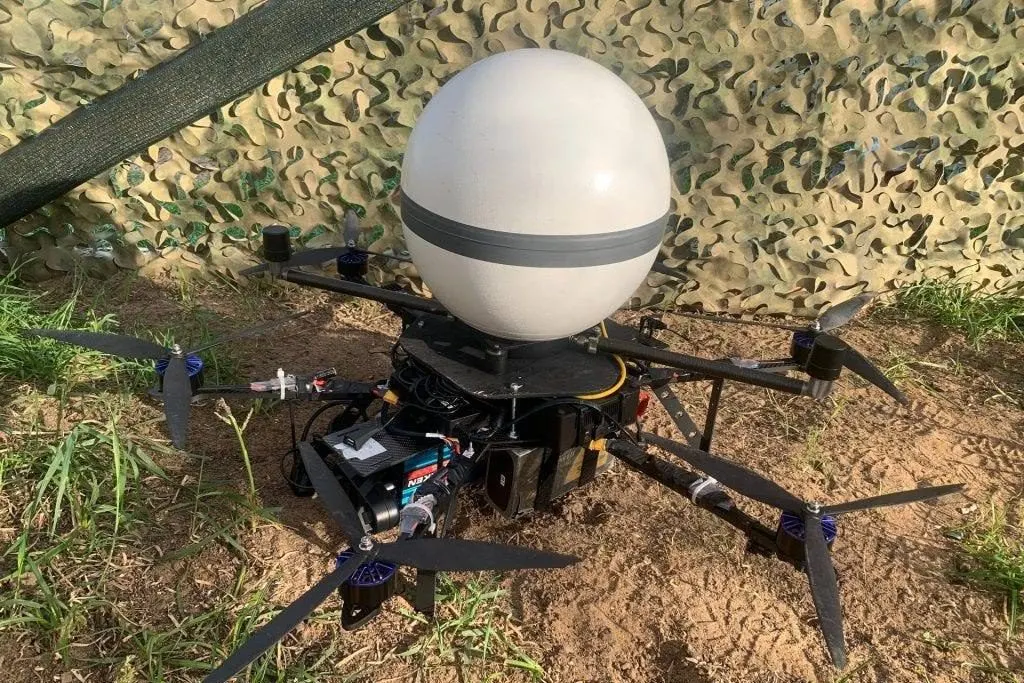
FPV drone with satellite communication / Photos here and below: Internet
Among the Shaheds attacking Ukraine, kamikaze drones have been identified carrying warheads with airburst and napalm charges. These are capable of inflicting greater damage than previous versions. In addition, Russian developers are working on hybrid satellite constellations for UAV control, next-generation infrared camera matrices for drones, FPV drones with satellite communication, and new loitering munitions.
Read more about these and other enemy military innovations in Black Mirror #28.
Drone project exchange
Russians plan to launch a drone project exchange based on a digital personnel registry for the unmanned aerial systems (UAS) market. In addition, the platform is expected to feature rankings of educational institutions, training programs, and employers, as well as a UAS expertise centre.
It will enable citizens with relevant experience and specialised knowledge in this field to seek opportunities to apply their skills and expertise to projects posted within the registry.
New Russian interceptor drone

The NPC-BASiRTK demonstrated tests of a new domestic interceptor drone. It is reported that such drones will be used, in particular, as part of a distributed system with heterogeneous robotic complexes for monitoring maritime conditions and infrastructure.
The drone follows a typical interceptor design, featuring four motors and vertical takeoff. In the published video, only its flights are shown, including horizontal flight and hovering in the air.
Shahed with an airburst and napalm warhead
The Russians have begun installing a new fragmentation‑high-explosive warhead with airburst capability on the Shahed kamikaze drones. The warhead body has a diameter of 300 mm and a length of 375 mm. The exterior features batch markings, a manufacturer’s designation, and a yellow line.
The ready-to-use lethal elements are located in the upper part of the body. At the bottom, there are three filling ports and six threaded bolts for attaching an inertia-type base detonator 493M. The explosive charge is described as a plastisol charge, likely OLA or LP-30T, though the exact mass and weight of the charge are currently unknown. Additionally, a LiDAR sensor was found in the body, which may indicate the capability of airburst detonation at a predetermined altitude over the target.


This suggests that the new warhead is designed not only for contact impact but also to increase the effectiveness of fragmentation-high-explosive damage by detonating at a specified height. The use of such warheads may be driven by the need to strike targets protected by anti-drone structures, such as nets. Additionally, they can be employed for strikes over open areas, maximising damage to people, buildings, vehicles, and other objects.
A Shahed warhead with napalm was also discovered. The warhead has no official designation. It is filled with a red-brown liquid incendiary mixture, presumably napalm. A notable feature of the design is the non-standard initiation method: the burst charge is based on OFBCH-2 with a UZ-2 detonator. According to the markings on the UAV, the total weight of the warhead is approximately 90 kg. The warhead is shaped as a cylinder with visually thin walls. In the centre, an OFBCH-2 explosive charge weighing 2 kg is installed for igniting and dispersing the incendiary mixture over a specified area.
An additional reservoir of incendiary mixture was found in the nose, apparently using a container similar to the fuel tank in Gerber-type UAVs.
Airships with variable configuration
A patent for an industrial design of an “airship with variable configuration” from the scientific and production enterprise Spec-Radio was found in the database of the Federal Institute of Industrial Property. Externally, it resembles the ATLА series transport and cargo, as well as patrol-cruise airships.
This enterprise can be considered the most competent and technologically prepared for serial production of aerostat technology, for example, aerostats capable of meeting the needs of air defence in protecting against UAV attacks. For the launch of the serial output, the enterprise has prepared several small tactical aerostats.
Hybrid satellite constellations for UAV control
In Russia, the creation of hybrid satellite constellations for drone control is being explored.
At the National Technology Initiative Fund, led by Dmitry Peskov, the issue of creating hybrid constellations is being developed. The term “hybrid” refers not to the communication network between satellites and ground systems, but rather to the integration of mission objectives, including communication, navigation, and optics, into a single platform for controlling drone constellations.
Battery factory for UAVs
A facility opened in Innopolis will produce lithium-ion batteries for 30 industrial sectors — from robotics to UAVs. The project received an investment of 1.5 billion rubles from the company Batareon, and the Industrial Development Fund funded the procurement of equipment.
The enterprise will manufacture batteries, battery cells, chargers, and BMS boards — electronic controllers that manage the battery’s operation.

Data transmission on small spacecrafts
Geoscan and the Gonets Satellite System (Roscosmos) have successfully tested high-speed data transmission on small spacecraft.
The testing was conducted on the Geoscan-4 and Geoscan-5 satellites, equipped with Gonets transceivers. Communication sessions were carried out in the S-band (2-4 GHz) in various modes, with data transmission speeds of up to 1 Mbps.
The S-band is considered optimal for satellite control and management in orbit, as well as for organising mobile satellite communications. The spacecraft successfully transmitted technical data, test arrays, and video files from onboard cameras, and the ground infrastructure received all the information in full.

In the future, representatives expect also to obtain statistical data, which can be used for modelling advanced satellite systems.
Drones at the PMGF-2025 Exhibition
UAVs and counter-UAV systems have become an integral part of major industry exhibitions.
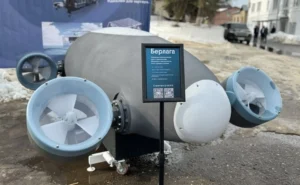
At the Petersburg International Gas Forum, KVV fire drones from Rostec and robotic platforms with interceptor drones were demonstrated, highlighting the current challenging situation with attacks on Russian infrastructure.


Passive detection device Ogonyok
The holding company RosEl (Rostec) has designed a portable passive detection device, Ogonyok, which intercepts video signals from enemy drones. It is reported that the device has already successfully passed testing in a combat zone.
Ogonyok scans the surrounding area in a 360-degree radius for radio signals across a wide frequency range. When a drone’s radio stream is detected, it extracts the video signals and classifies different FPV drones as well as DJI and Autel UAVs.
The device can be powered from a standard car outlet, and any Android device can be used as the operator’s display.
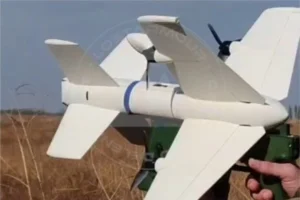
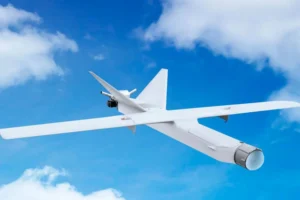
New model of the loitering munition Assol
Specialists in the defence-industrial sector have completed the development and testing of a new kamikaze-type strike UAV. The system was designed with tactical suggestions from UAV operators in the combat zone in mind.
Tactical and technical specifications:

- Payload — up to 3 kg
- Operational range — up to 15 km
- The main feature of the system is the Plug-and-Strike technology, which maximises the simplification of deployment procedures.
The system includes: a needle-type contact detonator located in the nose of the UAV; a mechanism for guaranteed activation of the warhead upon impact at any angle; automated pre-launch preparation, eliminating the need for additional adjustments; and an airborne remote detonation function.
As a result, UAV operations are reduced to minimal actions: charging the battery, installing the detonator, and moving it to the launch position.
Next-generation sensor arrays for UAV infrared cameras
The holding company Shvabe of the state corporation Rostech has developed the first domestic matrix photodetector based on colloidal quantum dots. This technology will enable the mass production of compact and affordable cameras with an extended spectral range.
The use of colloidal quantum dots presents significant opportunities for developing a new generation of photodetector arrays. Structures based on them are substantially cheaper and easier to manufacture, offering a wide sensitivity range. They will provide efficient control of unmanned vehicles, including in challenging weather conditions and low-light environments.
Such arrays are expected to be in demand across various industrial products and Rostec enterprises’ outputs, as well as in other industries, such as mineral exploration.
FPV Drone with satellite communication
In Russia, information has emerged about the first drone that flew while transmitting data via a purely Russian satellite internet.
For such purposes, geostationary satellites are used. Such a satellite hovers over the Earth at an altitude of 36,000 kilometres and rotates along with the Earth. From the perspective of an observer on the ground, it remains in the same position at all times, functioning similarly to satellite television systems.
To cover different parts of the Earth, these satellites are positioned at various points in orbit. In this case, the Yamal 601 satellite is located at 49 degrees east longitude and covers the Earth with 32 beams. It covers Ukraine only partially.
There are two ways to maintain communication via this satellite while in motion:
- Flat antenna, similar to Starlink. The beam to the satellite is formed using a phased array of elements.
- Small “dish” antenna that rotates inside a protective sphere, which shields it from wind and precipitation.
Features:
- The primary issue with such systems is the significant signal delay resulting from the considerable distance between the terminal and the geostationary satellite. That is why, if one reads the press release carefully, it refers to transmitting video from the drone, rather than controlling the drone.
- Since there is only one satellite, any obstruction between the terminal and the satellite will interrupt the connection.
- The antenna system weighs up to 3 kg, and the protective sphere has a diameter of 30-40 cm, which is suitable for marine vessels but too large for UAVs.
Reading now
1

Ukrainian SkyFall’s drone wins at Pentagon’s Drone Dominance selection
2
Black Forest Systems raises $400,000. Here’s what drones the startup is building
3
Sting interceptor by Wild Hornets downs costly Russian Granat-4 reconnaissance drone
4
UForce unveils Bucha middle-strike drone with a 200 km range
5
The F10 drone becomes the second Ukrainian finalist in the Pentagon’s Drone Dominance Program
By submitting this form, you give Defender Media consent to the processing of personal data.
Надсилаючи цю форму, ви надаєте Defender Media згоду на обробку персональних даних.

Latest news
1
DPA to diversify drone and ammunition orders among multiple suppliers
2
‘Ukrainska bavovna’ and Czech company Pavetra Aerospace to produce Shuhay UAV through joint venture
3
59th Assault Brigade downs Russian Ka-52 helicopter with General Cherry OPTIX FPV drone
4
Tencore develops evacuation module for TerMIT UGV
5