Dorozvidka 23: Zhumadilov, Seely, Budanov, Poulsen, General Cherry, and three approaches to Flamingo
What Ukrainian and foreign media wrote about UA defence tech last week
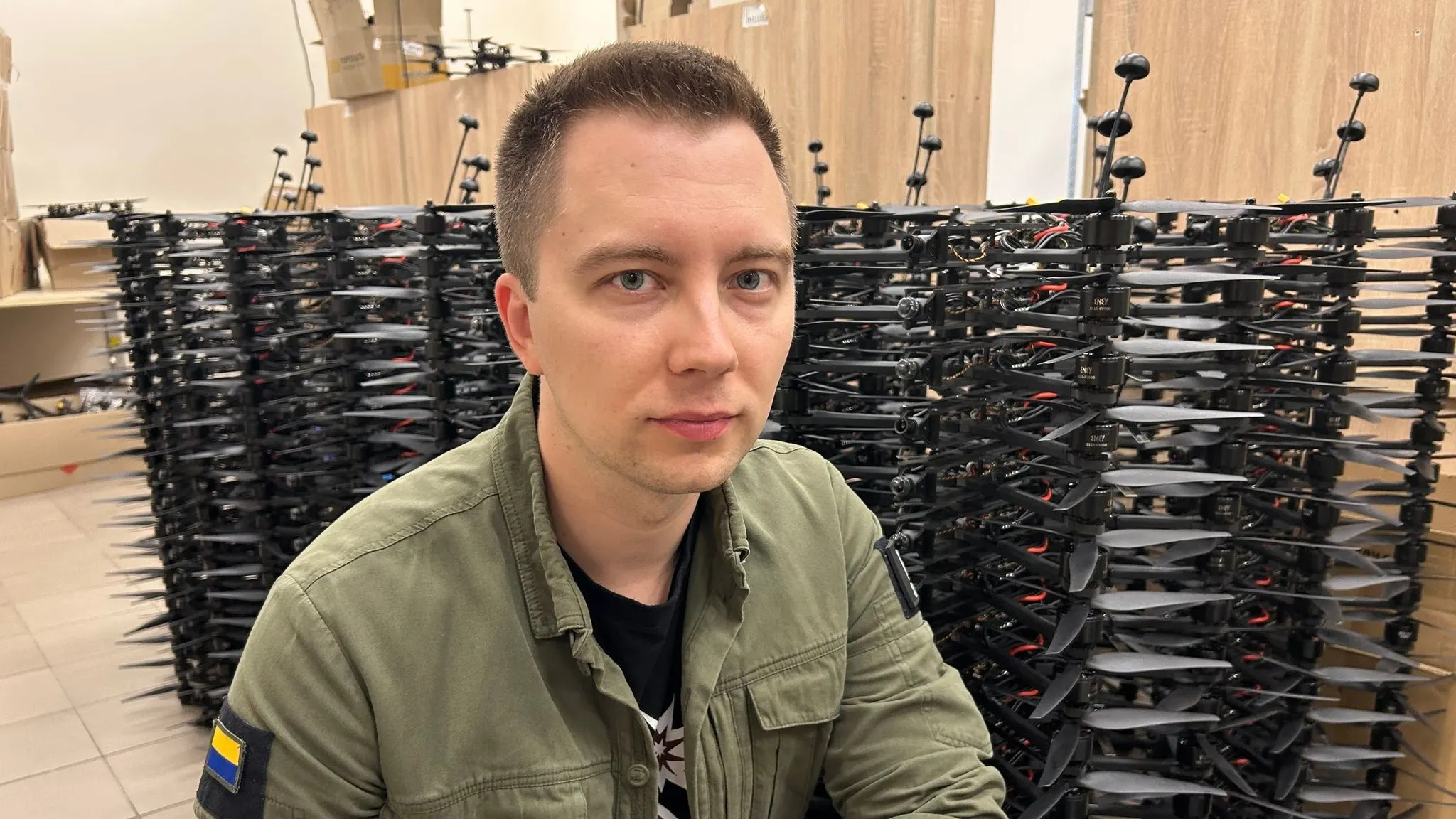
In the photo: Andriy Lavrenovych, HR Director of General Cherry
Last week, the Ukrainian cruise missile Flamingo continued to puzzle journalists in Ukraine and around the world. The three most intriguing publications about it appeared in The Economist, Kyiv Independent, and the Telegram channel “Nikolaevsky Vanek.”
The most interesting points from these sources are summarised in Dorozvidka #23, which also includes:
- An interview with Trypillian’s Chief Strategy Officer Bob Seely;
- A column by Arsen Zhumadilov on the development of DOT-Chain Defence;
- A report from British Sky News on the drone manufacturer General Cherry;
- Quotes from speeches by the head of Ukraine’s Main Intelligence Directorate, Kyrylo Budanov, and Denmark’s Defence Minister Troels Lund Poulsen.
Sky News report from General Cherry production
Last week, British publication Sky News published a high-profile piece on the drone war between Russia and Ukraine. At the heart of the article is a report from the drone factory of the company General Cherry.
The factory’s location is strictly guarded and frequently changed, as Russia constantly attempts to target production facilities. Sky News journalists observed how drones are assembled and packed by the thousands in an ordinary office space—they are handmade and individually configured.
Arsen Zhumadilov – how the DOT-Chain Defence marketplace works
Arsen Zhumadilov, Director of the Defence Procurement Agency (DPA), wrote a column for Ukrainska Pravda, sharing initial results from the DOT-Chain Defence weapons marketplace and plans to scale the platform. Its main goal, Zhumadilov explains, is to enable the military to quickly and conveniently acquire the drones they need, precisely when and where they need them.
He noted that 12 combat brigades participated in the DOT-Chain Defence pilot, operating across the Kherson, Zaporizhzhia, Donetsk, and Kharkiv fronts. Brigades order drones directly via the marketplace, and deliveries go straight from manufacturer to unit. Each brigade has a set limit; within that limit, the unit places orders, while the DPA handles everything else, including payment.
“The results speak for themselves: over 3,000 drones on the frontlines within the first weeks, the fastest order took just five days from placement to delivery to the combat unit,” Zhumadilov writes. “On average, FPVs arrive in 7–10 days, bombers in two weeks. That’s more than five times faster than the standard procurement procedure, before UAVs even reach logistics warehouses.”
Zhumadilov emphasises that DOT-Chain Defence changes the logic of supply. Units form their own requests, select the models they need, and receive them as quickly as possible. “It’s not just about speed—it’s about putting the military at the centre of the process,” he writes.
“This approach also impacts the market. When the military dictates demand, manufacturers are incentivised to provide high-quality, relevant products—or they simply won’t be ordered. The better your product and customer support, the larger and more predictable your sales, and consequently, your production. DOT-Chain Defence not only makes supply flexible and modern but also stimulates development in the corresponding segment of the defence technology market.”
Interview with Trypillian co-founder Bob Seely
Bob Seely is a British politician and military veteran who served in Iraq and Afghanistan, worked as a correspondent for The Times in former Soviet countries, led the Ukrainian group in the UK Parliament, and was among the first in the West to consistently warn of the Russian threat. He is also the Chief Strategy Officer of the British-Ukrainian defence startup Trypillian, which develops deep-strike systems and other defence technologies.
This week, the portal DOU published an interview with Seely. He discussed how Ukraine is changing the rules of modern warfare, why the Western defence model requires radical reform, and what the future of war will look like.

Flamingo: The Economist article, Kyiv Independent investigation, and combat launch videos
Journalists at The Economist believe that at least part of the production process of the FP-5 Flamingo cruise missile takes place outside Ukraine. The publication also learned the cost per missile – just under €1 million. The Economist argues this price may be too high, given the volumes Ukraine needs, as well as doubts about the missile’s actual effectiveness. “The missile is bulky and sharply ascends at launch, making it more visible to enemy radar. Therefore, it is assumed that a significant portion will be detected and intercepted,” the article notes.
Meanwhile, Kyiv Independent, citing its sources, reports that Ukraine’s National Anti-Corruption Bureau (NABU) is investigating Fire Point, the manufacturer of Flamingo and the FP-1 deep-strike UAV. The company is suspected of inflating component costs for its UAVs. On social media, the NABU has already denied an investigation regarding “Flamingo,” though nothing was said about the drones in its public statement.
On 31 August, the popular Telegram channel “Nikolaevsky Vanek” published a video reportedly showing combat launches of Flamingo missiles from a coastal site. Sources in military circles told Military that FP-5 missiles were used to strike a FSB outpost and patrol boats in Crimea near Armyansk.
Denmark to invest €1.4 billion in Ukrainian defence production by the end of 2025
By the end of 2025, Denmark plans to invest around €1.4 billion directly into Ukrainian defence companies, Danish Defence Minister Troels Lund Poulsen said at a press conference following an informal meeting of EU defence ministers in Copenhagen, according to Suspilne.
He stated that Ukraine currently needs more military support, and any delays could result in “much higher costs in the long term.”
“Ukraine’s defence industry produces very quickly compared to European companies. They can manufacture in months rather than years. Secondly, it is also a very cost-effective model,” Poulsen said.
The official also hopes that within a few weeks, the first Ukrainian defence company will begin production in Denmark, with other Ukrainian defence enterprises joining later.
Budanov on artificial intelligence in defence
According to Ukrinform, Ukraine’s military intelligence uses artificial intelligence to process large volumes of information. Head of the Main Intelligence Directorate Kyrylo Budanov said this at the international forum “Information Warfare: From Resistance to Resilience.”
“We primarily use AI to process large datasets. This involves working with databases—millions of gigabytes of information, and it can be impossible to find what you need. AI handles this problem reasonably well,” Budanov said.
The head of military intelligence noted that he has yet to see “significant progress” in using AI in weapons systems. “I believe it will happen, but it is not here yet. Regarding individual elements used in drones—like guidance systems and other components—yes, but this is far from what people think,” Budanov added.
Reading now
1

Ukrainian SkyFall’s drone wins at Pentagon’s Drone Dominance selection
2
Black Forest Systems raises $400,000. Here’s what drones the startup is building
3
Sting interceptor by Wild Hornets downs costly Russian Granat-4 reconnaissance drone
4
UForce unveils Bucha middle-strike drone with a 200 km range
5
The F10 drone becomes the second Ukrainian finalist in the Pentagon’s Drone Dominance Program
By submitting this form, you give Defender Media consent to the processing of personal data.
Надсилаючи цю форму, ви надаєте Defender Media згоду на обробку персональних даних.

Latest news
1
DPA to diversify drone and ammunition orders among multiple suppliers
2
‘Ukrainska bavovna’ and Czech company Pavetra Aerospace to produce Shuhay UAV through joint venture
3
59th Assault Brigade downs Russian Ka-52 helicopter with General Cherry OPTIX FPV drone
4
Tencore develops evacuation module for TerMIT UGV
5