Black Mirror #2. “Hozyayka”, “Gortenzia”, “Kuznechik”, “Mirage”, and other recent updates from Russian miltech
Overview of the main news in Russian military technology for the first week of April 2025

Image source: runet
In the weekly Black Mirror, Defender discusses technological innovations in the Russian defence industry. In early April, hostile state and private designers presented several developments that deserve the attention of Ukraine and its allies — photonic chips for optical communication, a new cargo drone, an UAV interceptor, a 30 km fiber optic drone, and more.
Skoltech develops photonic chips
The startup of the Russian Skoltech Technological University “Fistech”, has designed and tested photonic integrated circuits for working with high-frequency signals with a bandwidth of up to 22 GHz. Such circuits are used in optical communication systems with a bandwidth of up to 100 Gbit/s per wavelength in the DP-QPSK format.
The photonic chips have already been tested by “Kurchatov Institute”. The second stage of tests will be the testing of the IQ modulator supporting the QPSK format and the coherent receiver.
“Hozyayka”and “Kuznechik”
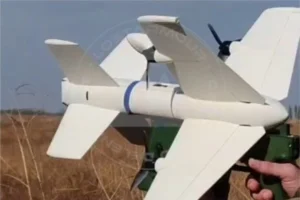
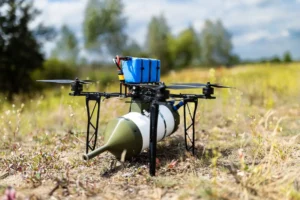
A cargo drone “Hozyayka” and a communication and control system for the UAV “Kuznechik” have been developed in Krasnodar. It is stated that the “Hozyayka” drone has already proven its effectiveness on the front. The drone is used to deliver water and food, ammunition and other necessary equipment to the military.
However, the developers claim that the “Hozyayka” can be equipped to perform combat missions, for example, dropping explosive devices. Smoke bombs can also be attached to the drone to create curtains that make it difficult to see the movement of the Russian military personnel. The drone has a load capacity of up to 15 kg and a speed of up to 60 kilometers per hour. The “Hozyayka” can be in flight for up to 20 minutes and move away from the operator by a distance of up to 15 km.

The “Kuznechik” UAV communication and control system can operate at any frequency from 27 megahertz to 6.5 gigahertz, which allows it to complicate the work of enemy EW. This encrypted communication system can quickly change frequencies during the flight.
“Gortenzia” fiber optic drones
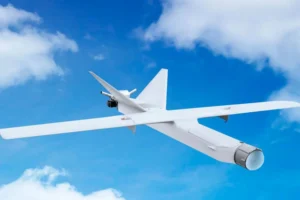
In the combat zone, the Russians have tested dozens of samples of the new fiber-optic drones “Gortenzia 7” and “Gortenzia 10”.

The drone is equipped with a hybrid communication system that automatically switches between fiber and radio channels without any delay for the operator. If the fiber connection is lost due to mechanical damage or insufficient length, the drone seamlessly continues operating via the radio channel. This allows the pilot to retrieve and reuse the drone with a new fiber coil after completing the mission.
The range of the “Gortenzia 7” device is 5–10 km. It is reported to be convenient for operational tasks, compact, and capable of rapid deployment—in under 3 minutes. The fiber-optic drone “Gortenzia 10” has a range of up to 30 km.
Antennas for manned spaceships
The Russian company Information Satellite Systems, which creates spacecraft and navigation systems, is completing the creation of antenna systems to ensure communication between new manned spaceships and ground control centers. The devices are designed to operate in different frequency ranges, ensuring stable data transmission in space missions.

The system includes an antenna with a reflector with a diameter of 800 mm, temperature and angle of rotation control sensors, as well as mechanical and electronic units.
A new method for 3D printing magnetic materials
Scientists at Russia’s Ural Federal University have developed a new technology for 3D printing magnetic materials. This could expand their capabilities, particularly in robotics and aerospace. The technology will allow them to create products with predefined properties, which is especially important for high-tech industries.
The research team uses metal powder that is fused layer by layer with a laser to form products with unique characteristics. Scientists combine magnetic and non-magnetic materials in one element. They can also create a conductive area and an insulating one next to each other. These combinations are achieved at the micro level, which is impossible to achieve with traditional manufacturing methods. The introduction of the technology into industrial production could take from two to four years, depending on the availability of an investor.

New encryption system for drone control
The Russian military started receiving a new Mirage drone control signal encryption system. It is stated that it minimizes the risk of UAV interception and prevents the enemy from calculating the flight route and the exact location of the operators. The signal is encrypted using a unique key — without it, the enemy will only see noise. There are more than 60 thousand options for the encryption key.

The ability of Mirage to encode any signal expands the scope of application and allows the encoder to be used, in particular, for video surveillance systems, including cable and radio. The Russians plan to use this technology not only on the front line, but also at military-industrial enterprises. This will complicate connection to local video cameras, for example, for sabotages.
Infantry drone interceptor
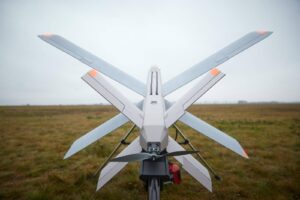
The Russians started using a new infantry interceptor drone. Its body is made using 3D printing. In the basic version, control is carried out from a remote control, and launch is made from a launch station for two drones with a bispectral optoelectronic guidance module. The UAV is X-shaped, has four engines and is equipped with thermal and television homing heads.

The combat module is controlled via a wired command and telemetry channel using a remote control.
Reading now
1

Ukrainian SkyFall’s drone wins at Pentagon’s Drone Dominance selection
2
Black Forest Systems raises $400,000. Here’s what drones the startup is building
3
Sting interceptor by Wild Hornets downs costly Russian Granat-4 reconnaissance drone
4
UForce unveils Bucha middle-strike drone with a 200 km range
5
The F10 drone becomes the second Ukrainian finalist in the Pentagon’s Drone Dominance Program
By submitting this form, you give Defender Media consent to the processing of personal data.
Надсилаючи цю форму, ви надаєте Defender Media згоду на обробку персональних даних.

Latest news
1
DPA to diversify drone and ammunition orders among multiple suppliers
2
‘Ukrainska bavovna’ and Czech company Pavetra Aerospace to produce Shuhay UAV through joint venture
3
59th Assault Brigade downs Russian Ka-52 helicopter with General Cherry OPTIX FPV drone
4
Tencore develops evacuation module for TerMIT UGV
5