
“In a year, my unit destroyed over 3,000 aerial targets.” Maksym Zaichenko on the 3rd Army Corps air defence system
Commander of the ‘Aquila’ Separate Anti-Aircraft missile battalion talks weaponry, R&D, and unit performance
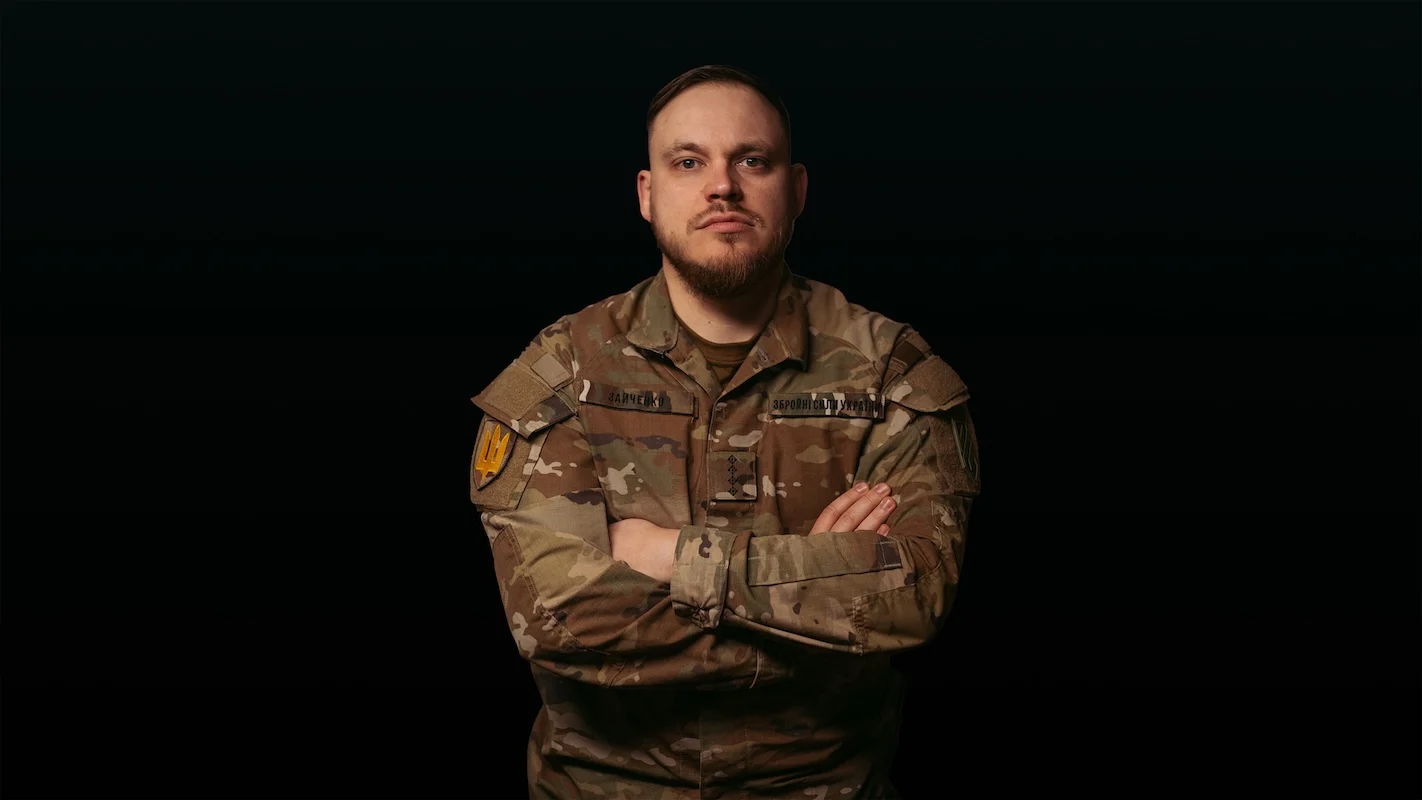
Major Maksym Zaichenko is the commander of the ‘Aquila’ separate anti-aircraft missile battalion of the 3rd Army Corps. This unit provides air defence for 3rd AC forces. Zaichenko has overseen the evolution of air defence from a single brigade to a full-scale corps structure, which today protects the skies over the most intense sectors of the front — from the Kharkiv region to Donetsk.
‘Aquila’ maintains its own R&D department, where it enhances the performance of interceptor drones and develops new products, such as automated anti-aircraft turrets. In an interview with Defender Media, Major Zaichenko explained how the 3rd Army Corps has modernised the classic air defence triad, identified the primary issue with equipment arriving at the unit, and discussed why fully automated solutions have yet to become established on the frontline.
Reform and structure: the logic of effective management
The ‘Aquila’ separate anti-aircraft unit (Latin for ‘Eagle’) was formed as part of the 3rd Army Corps. In the spring of 2025, a large-scale reform began, creating specialised corps-level units for unmanned systems, combat engineers, and air defence. Our team is not starting from scratch: the core of the unit comprises experienced troops from the anti-aircraft missile and artillery battalion of the 3rd Separate Assault Brigade, who have now moved up to the corps level.
Establishing a corps-level unit has allowed us to secure more personnel and resources. We now have the capacity to reinforce battalion or brigade sectors that cannot manage on their own. We maintain a reserve that allows us to manoeuvre systematically across the entire AO (area of operations), plugging any gaps.
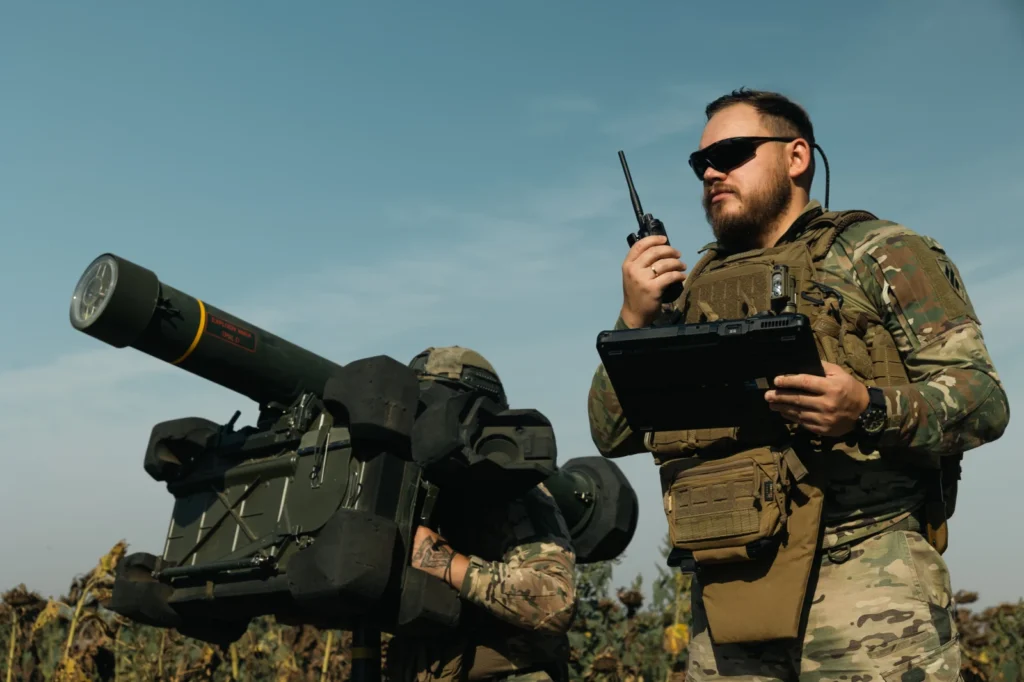
Our primary objective is to provide air cover for corps units across the entire frontage and to the full depth of our responsibility. This covers over 150 kilometres of the frontline: Kharkivshchyna, Luhanshchyna, and Donetschina, including the Lyman sector, where the enemy is constantly attempting to push forward. We operate from the very line of contact, protecting the infantry, all the way back to frontline towns and critical infrastructure within a 100-kilometre zone. Effectively, we serve as the first echelon of air defence not just for our corps, but for the country as a whole, as ‘Shaheds’ frequently transit through our sector.
Within the Land Forces, air defence operates on three primary levels. The first consists of line battalions with anti-aircraft missile platoons protecting forward positions. The second level is the brigade battalion, covering a zone 30–40 kilometres from the front. Their task is to protect artillery and command posts. Today, this has become a true ‘kill zone’; whereas a tank once felt safe 40km back, that space is now dominated by enemy FPV wings and loitering munitions like ‘Lancets’ or ‘Molniyas’.
From ‘Strela’ to high-speed interceptors
Our arsenal is built upon a classic ‘triad’. The first component consists of short-range surface-to-air missile systems for countering aviation. We use Soviet-era assets, such as the ‘Strela-10’ or modernised ‘Dragon’ SAMs based on R-73 air-to-air missiles, alongside Western MANPADS: Stinger, the Swedish RBS-70, and the Polish Piorun. Soviet ‘Iglas’ are also in use, though they lag behind in range. Thanks to this saturation of assets, enemy aviation suffered heavy losses during the Avdiivka and Bakhmut campaigns. They are now afraid to fly closer than 10–15km to the frontline. Our MANPADS have become a deterrent: 98% of aircraft entering the engagement zone will be destroyed.
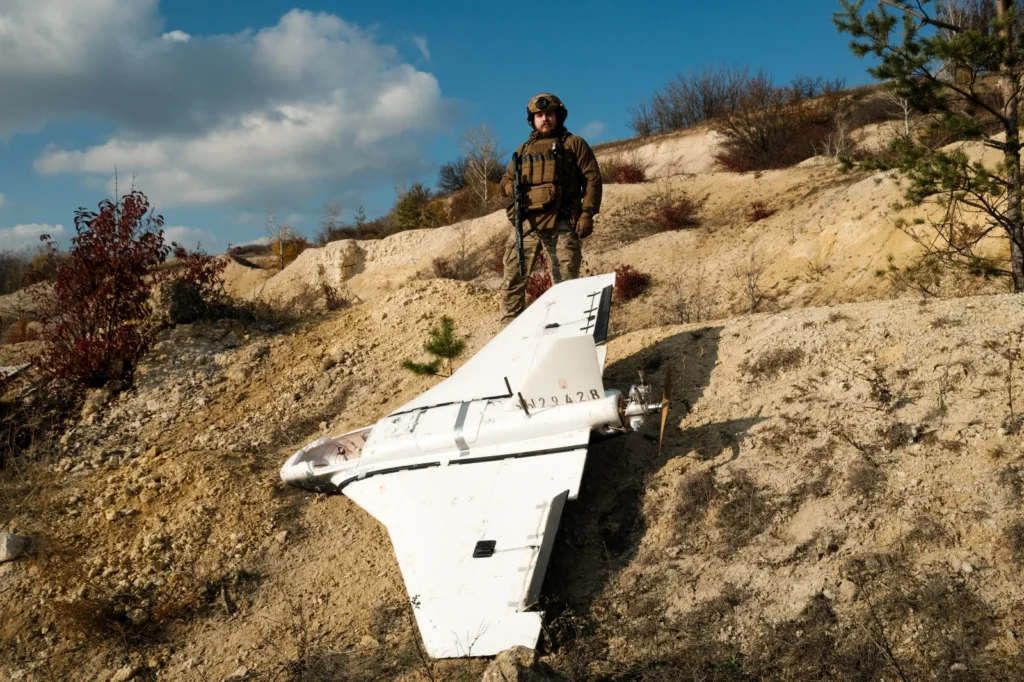
The second component is anti-aircraft artillery. This isn’t just machine guns on pickups, though Mobile Fire Groups (MFGs) certainly do their part. Recently, ‘Shaheds’ have returned to flying at very low altitudes—down to 100 metres—trying to hide in the terrain, whereas they previously operated mostly at 3–5 kilometres.
We use Soviet ZU-23s, which we modernise ourselves and, with the help of private design bureaus, install with modern electro-optical sighting and guidance systems. This is significantly more cost-effective than purchasing expensive Western systems like Skynex. One battery of such Western assets, despite its advantages, costs around $100 million; for that price, we can modernise hundreds of our ‘ZU-23s’, which are available in Ukraine in sufficient numbers. Anti-aircraft artillery is indispensable for point defence—protecting crossings, depots, or command posts where a true ‘fire dome’ is required.
The third line consists of UAV interceptors. These emerged about a year ago, based on standard strike drones. When the question of modernising brigade air defence arose, we began looking for technical solutions to down ‘Orlans’ and ‘Supercams’ using our own drones. Today’s classic interceptor is a 10-inch multi-rotor UAV. It is a versatile platform where everything can be swapped: from the warhead to the video link and control systems. Switching to digital communication systems was a matter of principle for us, ensuring a high-quality feed over long distances and protection against enemy EW (electronic warfare).
We work within an integrated system: radar detection, target tracking, and drone guidance. I won’t name specific manufacturers for security reasons, but the top models include both foreign-made drones and several Ukrainian brands. We collaborated with Ukrainian companies to refine these interceptors in our R&D workshop; in terms of kill rates and product quality, they are currently the best ‘anti-Shaheds’.
Regarding the economics of air defence, many factors come into play. An effective all-weather asset is a missile system, but a Stinger launch costs $100,000, while a ‘Shahed’ costs up to $50,000. The maths doesn’t add up. Therefore, we use interceptors specifically where conditions are favourable for an engagement. This does create a statistical issue: when poor weather or low altitude prevents an interceptor launch—due to the near-certainty of losing the airframe—we end up with far fewer launches and kills. However, overall, my unit destroyed over three thousand aerial targets last year, the majority of which were downed by unmanned systems. These included multi-rotor drones, reconnaissance and strike wings, and long-range UAVs. Our primary task is to maintain a clear sky over the infantry, and we are delivering.
R&D and automation
Our R&D group is more than just a workshop for servicing drones returning from sorties or preparing for flight. It is the unit that keeps us on the pulse. 90% of the funding for innovation and development here comes from private sources, volunteers, or businesses that have a vested interest in ensuring ‘Shaheds’ don’t hit their warehouses.
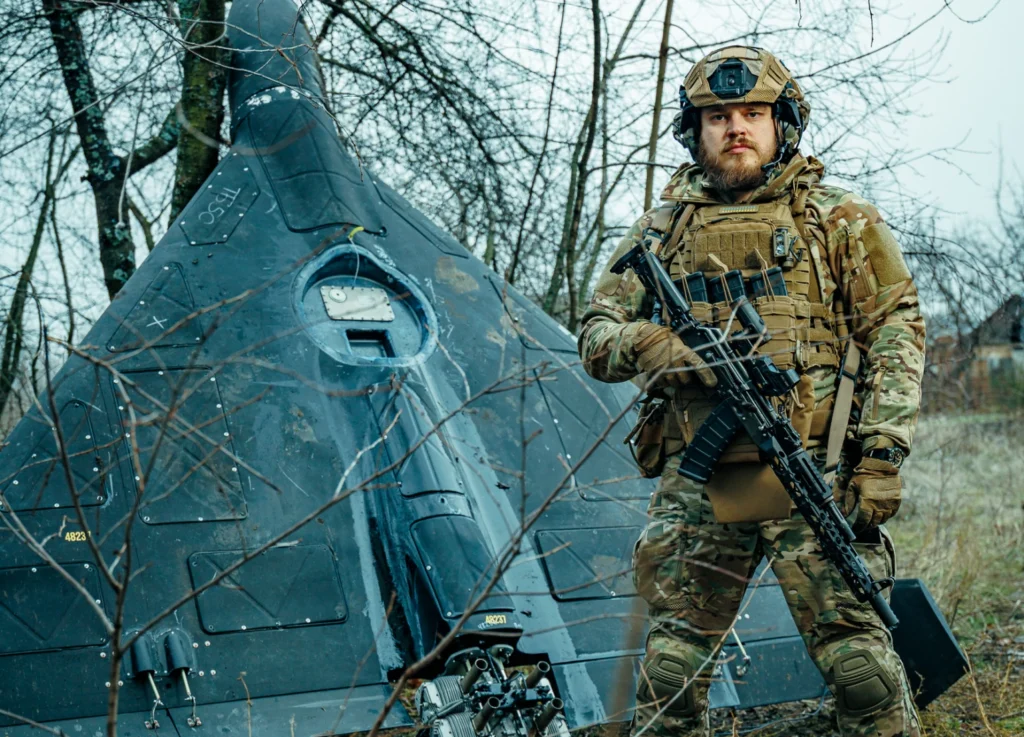
We are currently working on several priority areas. In addition to enhancing the performance of interceptor drones, we are developing automated anti-aircraft turrets. These are already being tested by our units for remote-controlled engagements. The key focuses of our development are high-quality automatic target tracking and a ballistic calculator.
Western militaries use the C-RAM (Counter Rocket, Artillery, and Mortar) and C-UAS (Counter-Unmanned Aircraft Systems) concepts. These are complete systems where the anti-aircraft gun is merely one element, integrated with radar, optical, and acoustic detection. The system calculates the trajectory itself, rather than a soldier aiming ‘by eye’. We are adapting this idea to our conditions, seeking cheap but effective solutions. This not only allows for more precise engagements but also reduces infantry losses to FPV drones in the tactical depth.
The main problem with new developments reaching the unit is quality control during mass production. The initial prototypes might be excellent, but the next batch won’t fly. Or the software is such that a drone with auto-track might lock onto a cloud instead of a ‘Shahed’ and fly off into nowhere. In reality, many initiative groups trying to enter the market attempt to test their products in combat conditions, because range tests don’t even cover 50% of the issues that arise ‘on a live op’.
Western partners also often push for full automation, but in our environment, that doesn’t always work. If the radar loses the target track, the drone simply becomes disoriented. Therefore, for us, the operator remains vital for now—someone who sees the feed through the camera and can manually lead the target or apply the correct intercept tactic.
Supply economics and flexibility of decisions
We utilise direct procurement, volunteer drone deliveries, and the state DOT-Chain Defence system. The advantage of the latter is that the unit purchases equipment using points. The logic is simple: you down a target—points are credited; you open this ‘store’ and select what you need. This is great for motivation and slightly reduces the burden on the military unit. We expend drones to destroy targets—we replenish them with the points earned.
However, DOT-Chain doesn’t solve all logistics issues. You can’t buy a radar or a pickup there. There are also questions regarding the inventory: we work with specific EW assets that cover all necessary frequencies, and we won’t spend points on something that doesn’t meet our requirements. For instance, some of the interceptors we consider most effective aren’t available there. Therefore, the primary resources remain the private sector, volunteers, or soldiers’ own funds.
The fundamental issue is the flexibility of state-level decision-making. We are often forced to play catch-up with the enemy, and a six-month delay in reaction means we are forced by inertia to throw money at things that are already ineffective. For example, continuing to recruit for Mobile Fire Groups, even though it is clear that ‘Shaheds’ have changed tactics and these systems have become less effective.
We need a direct bridge between the combat units with the expertise and those making strategic decisions in Kyiv. Information shouldn’t pass through ten filters where it gets distorted. The solutions we started at the line battalion level, then at the brigade battalion level, we are now scaling across the entire corps. As a corps, we have ensured, within six months, that every brigade has combat crews actually downing targets. We aren’t waiting for someone to come and do it for us—we are delivering results ourselves.
Reading now
1

Ukrainian SkyFall’s drone wins at Pentagon’s Drone Dominance selection
2
Black Forest Systems raises $400,000. Here’s what drones the startup is building
3
Sting interceptor by Wild Hornets downs costly Russian Granat-4 reconnaissance drone
4
UForce unveils Bucha middle-strike drone with a 200 km range
5
The F10 drone becomes the second Ukrainian finalist in the Pentagon’s Drone Dominance Program
By submitting this form, you give Defender Media consent to the processing of personal data.
Надсилаючи цю форму, ви надаєте Defender Media згоду на обробку персональних даних.

Latest insights
1
What defence manufacturers need to know about Defence City — insights from the UCDI’s Head of GR
2

“In a year, my unit destroyed over 3,000 aerial targets.” Maksym Zaichenko on the 3rd Army Corps air defence system
3
Intelligence dependence as a strategic vulnerability: From satellite constraints to autonomous analytical platforms
4
A full-cycle unmanned business: Drone Fight Club founder Vladyslav Plaksin on manufacturing, pilot training, and investment
5