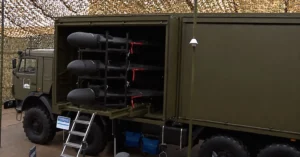
Black Mirror #10. Chinese 50 km fibre optics, Belarusian Rodnik 3D, and Russian Molniya carrying FPV
Weekly overview of military innovation of Russia and its allies
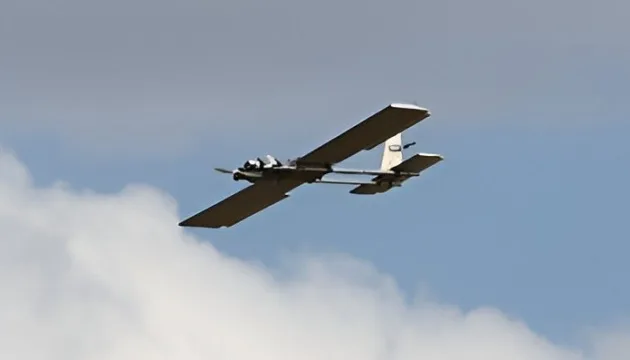
The Molniya drone. Photo from Russian Telegram channels
The Russian military may soon receive fibre-optic drones equipped with 50 km coils from Chinese partners. A video featuring a 50 km spool weighing just over 3.8 kg was published on X on June 5.
Meanwhile, Russia continues to push forward with its own miltech developments. Over the past week, Russian sources have unveiled both satellite-based and satellite-free navigation systems for drones, introduced a new automated air defence system against UAVs, and showcased several new UAVs and UGVs.
More details in Black Mirror — our weekly digest of military tech updates from Russia and its allies.
100 Russian satellites for drone control
Russia intends to launch over 100 satellites to control drones, as revealed by the head of the state corporation “Roscosmos” at the “CIPR‑2025” conference.
In addition, Russia plans to send another thousand spacecraft into orbit. According to the project, this includes 886 “Rassvet” broadband internet satellites, as well as 114 Earth observation satellites.
FPV riding atop the Molniya drone
The Russians have begun using the Molniya strike UAV as an FPV carrier. Military expert Serhii “Flesh” Beskrestnov writes that “the Molniya flies to attack the target and carries along an ‘accompanying passenger’ into our rear lines, which will be controlled separately,” he suggests.
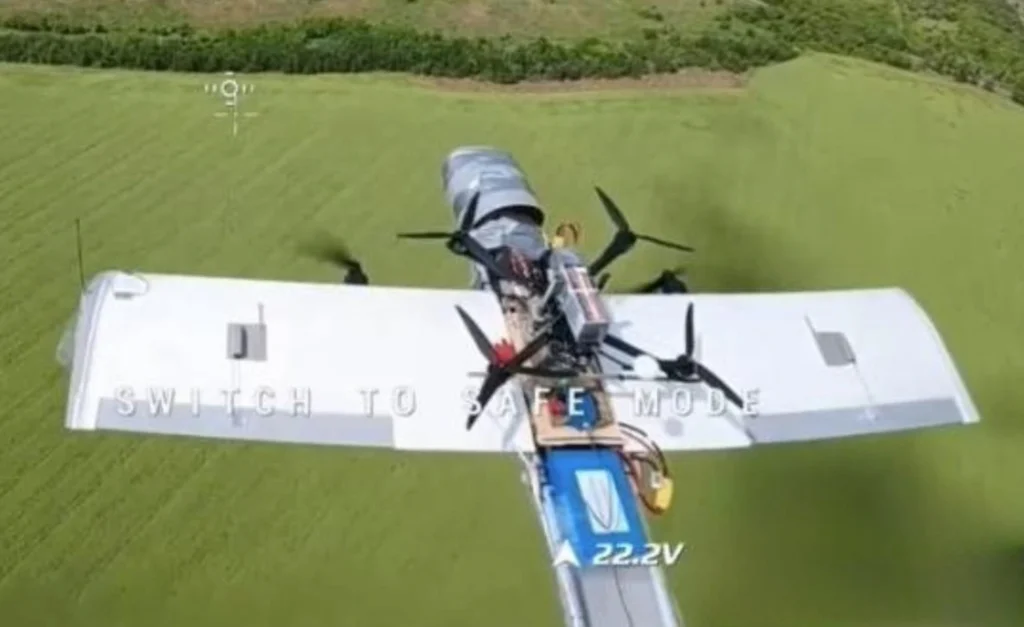
Likely, after deployment from the carrier, the FPV drone will attack the air-defence systems attempting to intercept the Molniya.
“Stupor” in Kaluga
The Russians plan to establish a pilot drone-monitoring centre in the Kaluga region, based on the “Stupor” hardware–software complex integrated into the ERA‑GLONASS system. This centre will link Kaluga Airport with a number of critical facilities to detect and swiftly respond to potential threats.
“Rosel” has developed a non‐satellite navigation system for UAVs
The company Rosel — part of the Russian defence‑industrial giant Rostec — has introduced a novel non‑satellite navigation system for unmanned aerial vehicles. This advanced system is an enhanced version of a compact Doppler velocity and drift‑angle measurement unit. The redesign delivers significantly improved durability, with power consumption reduced by a factor of four, dimensions scaled down several times, weight cut tenfold, and measurement accuracy boosted thanks to digital signal processing enhancements.
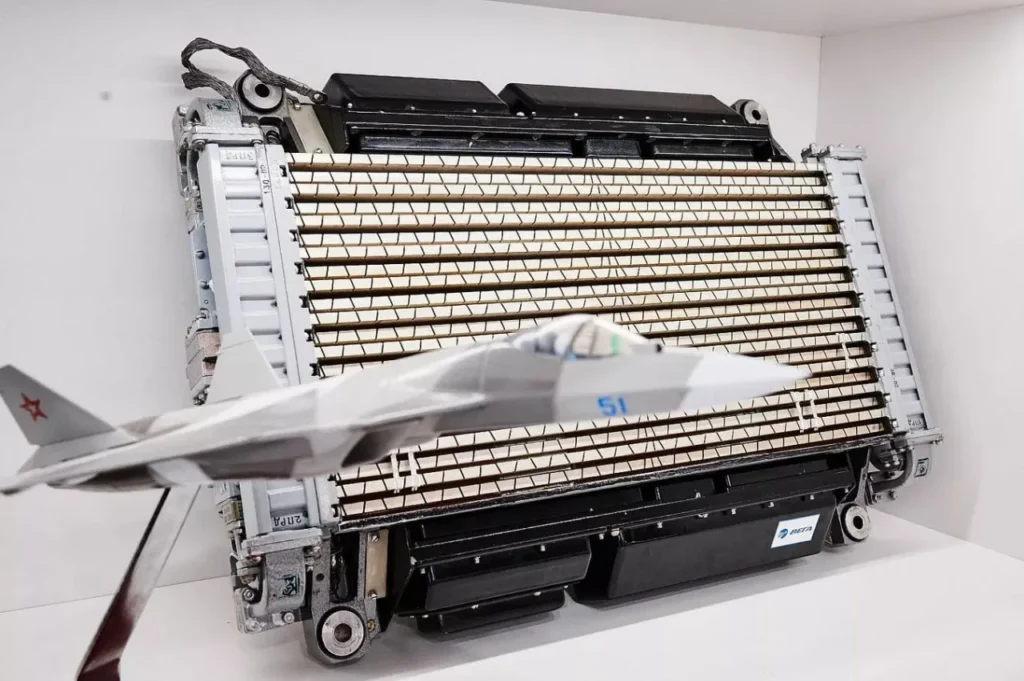
In short, Rosel’s upgraded non‑satellite navigation offers UAVs reliable, energy‑efficient positioning—even in environments where satellite signals are degraded or denied.
A wind tunnel is being built in Moscow to test drones
At the Moscow Aviation Institute (MAI), engineers are installing a small wind tunnel designed to test drone propellers and propulsion systems in an airflow. They plan to carry out the first experiments by the end of summer.
This compact wind tunnel is well suited to drone testing because it doesn’t require a large power supply or lengthy preparation. The design calculations at MAI have been completed, and the tunnel installation is underway. Once operational, it will be able to simulate flight conditions at speeds of up to 50–60 km/h.
In Chelyabinsk, an automatic air defence system has been developed to protect against drones
In Chelyabinsk, a prototype of an air defence system has been created to protect stationary objects from UAVs. The main components of the system have already successfully passed testing, according to the developers. They describe the system as a rotating turret armed with shrapnel, guided, and unguided missiles. In combat mode, the turret independently detects UAVs of various types by sound. The drone then enters the field of view of a video camera and, depending on the type, is struck by shrapnel or a missile. Unguided missiles are equipped with a special detonator that responds to the drone’s sound.
For aircraft-type drones with a maximum takeoff weight over 300 kg, the detection range is at least 1,200 meters; for drones weighing between 10 and 300 kg, the range is no less than 500 meters; and for helicopter-type UAVs, the range is at least 150 meters. Targets are engaged at distances up to 500 meters. Mass production is planned to begin in 2026.
Belorusian “Rodnik 3D“
In Belarus, a mobile radar station named “Rodnik 3D” has been developed to detect small-sized drones. The developers claim that this radar system can automatically detect, track, and analyze various aerial objects, even in conditions of active electronic jamming.
The primary advantage of the system is its ability to automatically detect targets with an effective radar cross-section (RCS) as low as 0.1 m², enabling the detection of low-flying UAVs. The radar can determine precise coordinates of aerial objects, including azimuth, range, elevation angle, and calculate the target’s course, speed, and altitude. Additionally, the system is resistant to both active and passive electronic jamming, enhancing its reliability in contested environments.
Reading now
1
SkyFall officially unveils Thor Hammer mid-strike and announces 1,000+ km version
2

260+ vacancies in Ukrainian defence technology at BlueBird Tech, Sine Engineering, Buntar Aerospace and more
3
British-Ukrainian Occam Industries raises €3.8m. The funds will go towards scaling drone autonomy software
4

Terra Drone acquires 50% of Ukrainian Kurin Technologies for $3.5 million
5

Autonomous interceptor drones need radars to work. Why is there still a lack of them
By submitting this form, you give Defender Media consent to the processing of personal data.
Надсилаючи цю форму, ви надаєте Defender Media згоду на обробку персональних даних.

Latest news
1
Phantom Defense acquires net-launcher developer KARAKURT to integrate its technology into own ecosystem
2

Acoustic sensor developer Zvook raises investment from new Czech fund managed by DEPO Ventures
3

Denmark to hold first-ever Danish Defense Tech Week in four cities: what to expect
4
Forbes: Airlogix plans to raise $100m at a $2bn valuation
5