UCDI publishes White Paper on defence industry transformations
The document outlines key 2025 milestones and strategic priorities for 2026
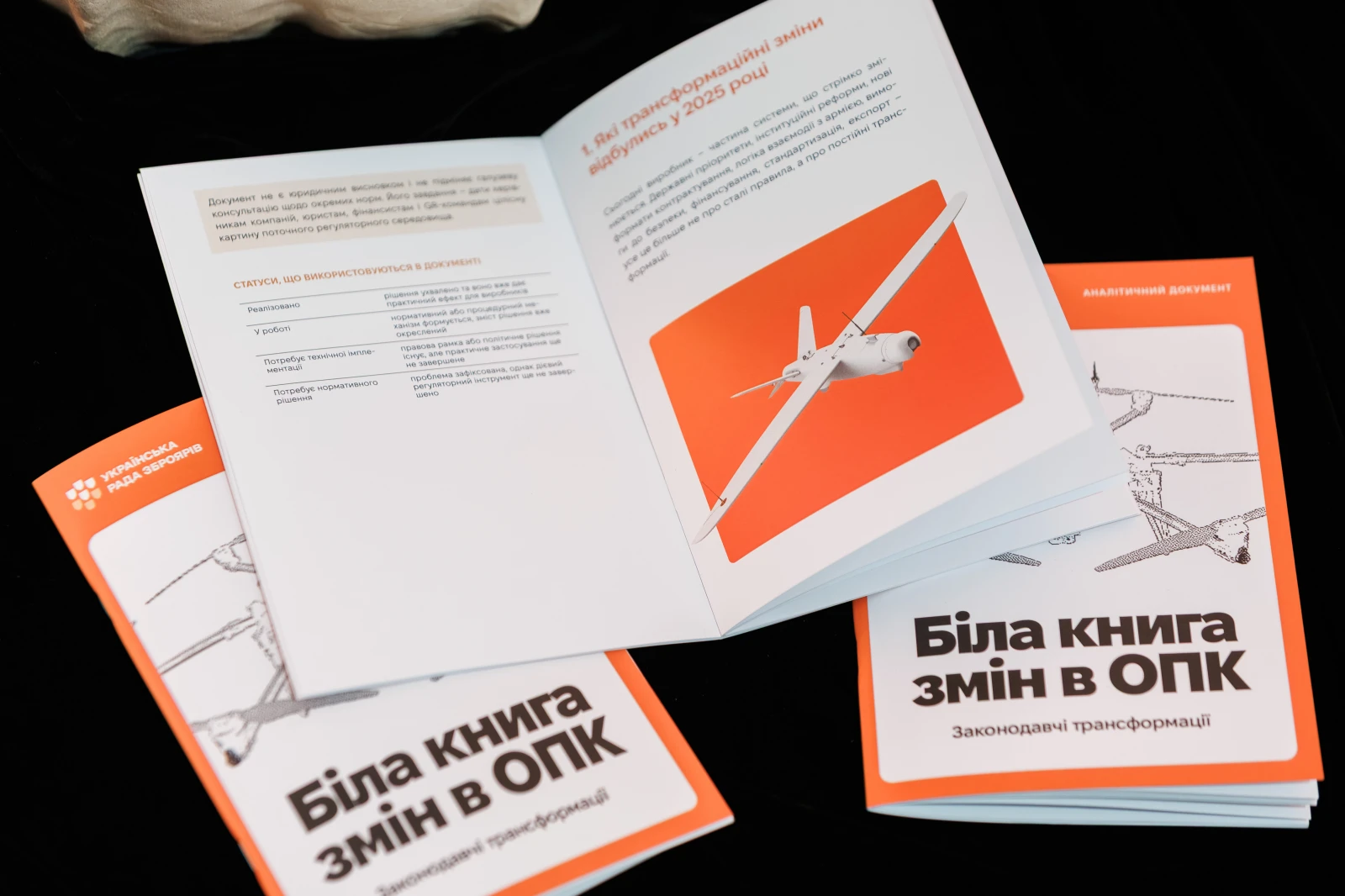
Біла книга змін в ОПК. Фото Ради зброярів
The Ukrainian Council of Defence Industry has released an analytical report, “White Paper on Changes in the Defence Industry: Legislative Transformations”. The document, now available on the organisation’s website, details pivotal sector decisions from 2025 and sets the agenda for 2026.
The paper synthesises core policies, priorities, and barriers impacting Ukrainian defence manufacturers, focusing on business implications and the industry’s capacity to scale. All analytical sections are informed by consultations with key stakeholders, including the Ministry of Defence, the General Staff, and relevant industry associations.
According to the authors, Ukraine’s defence sector transitioned from ad-hoc measures to a systematic regulatory framework in 2025. Key implemented reforms include restricting data access for defence enterprises, the launch of the Defence City legal regime, and accelerating staff deferment (rebooking) procedures from 72 to 24 hours. Additionally, limits on the number of reserved employees were abolished, and tax relief was introduced for the re-import of components and raw materials lost in strikes.
The White Paper identifies several unresolved issues, such as the tax regime for unmanned ground vehicles (UGVs), penalties within defence contracts, non-public reporting, software certification and codification, and export protocols.
Systemic barriers highlighted in the report include cumbersome export procedures, localisation and import incentives, limited adoption of DOT-Chain, and the absence of robust public-private partnership mechanisms or war-risk insurance. Furthermore, the sector remains constrained by a lack of long-term contracts, restrictions on foreign-currency operations, the absence of compensation for damaged property, limited access to infrastructure, and acute personnel shortages.
The Arms Council concludes that the primary challenge lies in converting these identified issues into a cohesive package of solutions with defined legal status, designated authorities, and measurable benefits for manufacturers.
Reading now
1
SkyFall officially unveils Thor Hammer mid-strike and announces 1,000+ km version
2
Pentagon to hold Drone Dominance trials for bomber drones, with UFORCE, Gurzuf Defence, Grim Tech and others taking part
3

British-Ukrainian Occam Industries raises €3.8m. The funds will go towards scaling drone autonomy software
4

Terra Drone acquires 50% of Ukrainian Kurin Technologies for $3.5 million
5

Frontline Robotics CBDO Mykyta Rozhkov: Ukraine and Norway are working on an autonomous system to protect maritime infrastructure
By submitting this form, you give Defender Media consent to the processing of personal data.
Надсилаючи цю форму, ви надаєте Defender Media згоду на обробку персональних даних.

Latest news
1
Ukraine’s Defence Forces hit a record number of Russian air defence systems and radars in September
2

Nataliia Mykolska to become VP of Growth and Affairs at Sine Engineering
3
Black Mirror #79: What’s inside Geran-4, unmanned tanks, balloon barrages and more of a new russian miltech
4

6,000 lives saved by replacing people with robots. “Makar” on the ground strike drone unit NC13 and its role in Operation Vivaldi
5