
What defence manufacturers need to know about Defence City — insights from the UCDI’s Head of GR
A FAQ on the new tax regime for defence companies — how to join, what it offers, and what obligations it imposes

On January 1, Defence City — a special legal regime for Ukrainian defence industry companies — came into effect in Ukraine. The first resident was SkyFall, a manufacturer of Shrike, Vampire, and P1-SUN drones.
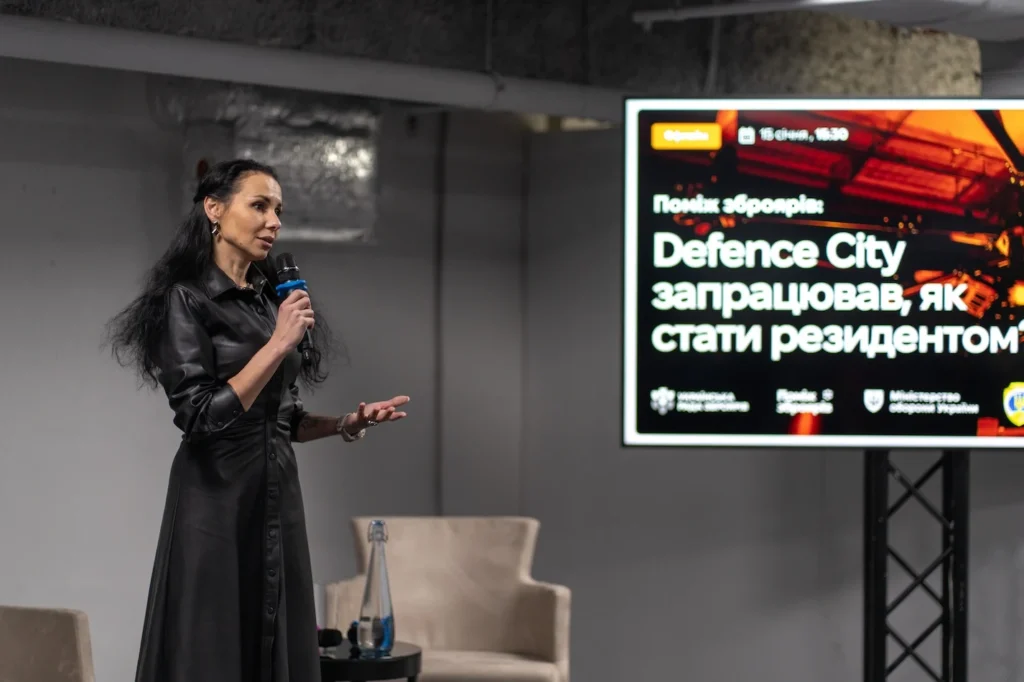
Defender Media spoke with Valentyna Vedrovska, Head of Government Relations at The Ukrainian Council of Defence Industry, about the new regime. She explained the benefits of Defence City, the requirements for joining, whether Diia City residents can apply, and answered other questions that concern defence industry companies.
How can a company become a Defence City resident?
First of all, a company must assess whether it can meet the program’s requirements this year. To join Defence City, a company must comply with several criteria. They are not numerous, but they are significant and filter out a large portion of market participants.
The key requirement is the level of qualifying revenue. At least 75% of a company’s revenue in the previous reporting year must come from defence-related activities — manufacturing products, providing services, or performing work for defence purposes.
Regulations define the specific categories of such products and services. These include:
- weapons
- military equipment
- UAVs
- ground robotic systems
- maritime drones
- electronic warfare and electronic intelligence systems
- reconnaissance equipment
- ammunition
If a company received 75% of its revenue from these categories in 2025, it can now apply for Defence City residency. The only exception is aircraft manufacturing, where the threshold is lower — 50% qualifying revenue.
Who verifies that companies meet these criteria?
All administrative functions — maintaining the registry, reviewing applications, issuing approvals or refusals, and removing residents — are handled by the Ministry of Defence of Ukraine.
The ministry is the primary authorised body responsible for the regime’s functioning. It determines whether companies meet the requirements both at the entry stage and during their residency. The final decision always rests with the Ministry of Defence.
How complicated is the application process?

It is still difficult to assess, because publicly, only one Defence City resident has been announced so far — SkyFall.
However, the company submitted its 2024 financial statements, while new applicants will submit 2025 reports. Those reports are currently being prepared, after which companies can apply for residency.
In practice, the procedure is not overly complicated. Companies must:
- submit an application to the Ministry of Defence
- provide financial reports confirming the qualifying revenue criteria
- include a small set of additional documents defined by government regulations
According to the Ministry of Defence, the application review should take up to one month.
If the documentation is incomplete or incorrectly prepared, the ministry promises to respond within five days, allowing the company to correct and resubmit the application. Documents can be submitted electronically. The key legal framework regulating Defence City is a dedicated section of the Law on National Security. The Ministry of Defence website provides links to all relevant regulations, including templates for applications and reports. Manufacturers’ legal teams are advised to review these materials before applying.
Will companies need to confirm their status regularly?
Yes. To remain Defence City residents, companies must confirm compliance annually. Іn addition to submitting financial reports by June 1, companies must also provide an independent auditor’s report confirming compliance with the requirements.
According to my estimate, there are currently 40–50 audit firms in Ukraine capable of preparing reports that meet the required standards. But companies joining this year will have plenty of time before next year’s reporting cycle to organise their reporting processes.
Are there other residents besides SkyFall?
Most likely yes, but this information is not disclosed without the companies’ consent. Publicly identifying a Defence City resident can create security risks, as it effectively marks a facility as a potential target for enemy strikes.
The defence sector already operates under constant threat, so there is no reason to provide the enemy with additional information. The government will not publish official lists of residents. It is up to the companies themselves to decide whether to disclose their status.
If it is important for reputation or media visibility, they may choose to announce it. I expect the first statistics on residents to appear around April.
What benefits does Defence City provide?
According to manufacturers, export opportunities are one of the most attractive aspects. Companies that become Defence City residents will be able to export their products without obtaining special exporter status. Currently, only companies with special export licenses can transport military goods across the border for sale abroad.
Manufacturers must therefore either:
- work through a licensed intermediary exporter and pay a commission, or
- apply for special exporter status themselves — a process that can take one to one and a half years, with no guarantee of approval.
Defence City residents will only need to obtain an export permit for specific shipments. The state will still control exports through permits tied to specific contracts and quantities, but manufacturers will no longer need intermediaries.
This can significantly save both time and money — something companies are very interested in, even though the defence export market is not yet fully operational.
What other benefits exist?
Another important advantage is tax incentives. The most significant one is an exemption from corporate income tax. However, there is an important condition: the saved funds must be fully reinvested into the company’s development.
If the funds are not reinvested within the following calendar year, the company may be removed from the register and face tax penalties. This option may be less attractive to mature companies that prefer to distribute dividends rather than reinvest profits.
However, using the tax exemption is not mandatory. A company can choose to remain a resident of a Defence City while continuing to pay normal corporate tax and distribute dividends.
Additional tax benefits include exemptions from:
- environmental tax
- land tax
- property tax
These benefits apply only to land and property owned by the legal entity that is the Defence City resident.
What else does the program offer?
Another important benefit is support for relocation. This refers to moving operations within Ukraine to safer regions — primarily western areas such as Zakarpattia. The relocation mechanism includes support from both state and local governments.
Half of the personal income tax paid by the company’s employees is returned to the local community from the state budget. These funds must then be used to create the infrastructure needed for the company’s operations.
The state can also assist with:
- allocating land
- providing facilities
- transporting equipment
- relocating employees
In essence, this is a comprehensive relocation support package.
What obligations do companies take on?
First and foremost, companies must comply with residency requirements. The key rule remains the 75% qualifying revenue threshold.
The regime was designed specifically to support companies that manufacture weapons, military equipment, or dual-use products used for military purposes — including drones. The core requirement is simple: defence must remain the company’s primary activity.
Can only Ukrainian companies become residents?
Yes. Companies registered abroad cannot become residents of Defence City. Companies with connections to the aggressor state, sanctioned entities, or undisclosed beneficial owners are also excluded.
The regime is designed specifically for Ukrainian companies with transparent ownership structures and Ukrainian beneficiaries.
Can companies lose their residency?
Yes. Companies may voluntarily withdraw by submitting a request. If the government initiates removal, the case must go through a review process. Residency cannot be revoked automatically — it requires a justified decision by the Ministry of Defence, possibly involving other authorities such as the tax service or security agencies.
Removal may occur if a company violates the established criteria, for example:
- having links to sanctioned individuals
- failing to meet the 75% qualifying revenue requirement
- failing to disclose beneficial owners.
How many residents does the government expect?
I have heard estimates of 50–60 companies, but personally, I believe the number may be significantly higher. Earlier versions of the legislation had much stricter requirements, which only 10–15 companies could meet.
Now the framework allows even subcontractors to qualify, so the final number will depend on the manufacturers. I believe we could see around 100 companies by the end of 2026, with further growth in 2027.
How does Defence City compare with Diia City?

Diia City is designed for IT companies, while Defence City is focused on defence manufacturers.
Some defence companies — such as developers of UAVs, electronic warfare systems, or military software — may qualify for both regimes.
However, companies producing heavy armoured vehicles, ammunition, or other hardware cannot join Diia City. A company that is already a Diia City resident can also join Defence City, but it will not be able to use Defence City tax benefits simultaneously.
However, it will still gain access to other advantages, such as:
- export facilitation
- relocation support
- data protection in state registries.
I also expect additional benefits for Defence City residents in the future, such as faster access to government grants.
Companies must therefore evaluate which tax model is more advantageous. For example, if a company plans to build a new factory or launch new production lines, the Defence City income tax exemption could be beneficial because profits would be reinvested anyway.
A simple example: Let’s say a company earns $1 million in profit. Under the standard tax system, it would pay an 18% corporate income tax of $180,000.
If the company is a Defence City resident (and not using Diia City tax benefits), it can avoid paying this tax — but must reinvest the entire $1 million into development, modernisation, or expansion. In other words, companies can remain residents of both regimes but must choose which tax benefits to use.
Does participation mean more inspections?
No. The only obligation is to submit reports. No additional regulatory burdens or interference in business operations are expected. However, the Ministry of Defence will have access to residents’ financial information.
What concerns do manufacturers have?
From what we hear, manufacturers are mostly concerned about the limited list of eligible product categories. For example, communications equipment — such as radio manufacturers — is not currently included. Fibre-optic manufacturers cannot join yet either.
But the regime was designed specifically for companies in the defence-industrial complex, so there is a certain logic behind the current scope.
Overall, there are no major objections — mostly uncertainty about how the system will work in practice. I expect 2026 and even 2027 to be a period of stabilisation and refinement for the Defence City regime.
Your personal advice — should companies join?
My role is not to persuade manufacturers, but Defence City genuinely offers interesting and useful opportunities for defence companies. And it may be better to join now, before the program becomes overcrowded.
As someone responsible for government relations, I value feedback from manufacturers. The sooner companies join and begin providing feedback, the sooner we can start improving the system.
Ideally, within a year or a year and a half, Defence City should become a highly effective and well-refined regime.
Reading now
1
Jobs at Alta Ares, 3DTech, Drone Space Labs, Wild Hornets and other companies in the defence innovation sector
2

British platform Grenadyr has invested in five Ukrainian defence tech startups. Defender is telling its story for the first time
3

Vyriy Industries becomes first Ukrainian defence tech company to issue corporate bonds: why does it need them?
4
Ukrainian company has developed a jet-powered interceptor drone that reaches speeds of over 600 km/h
5

60+ new job openings in Ukrainian defence tech: offers from Vyriy, TENCORE, Ukrspecsystems and others
By submitting this form, you give Defender Media consent to the processing of personal data.
Надсилаючи цю форму, ви надаєте Defender Media згоду на обробку персональних даних.

Latest insights
1
Can Europe afford a war of expensive platforms? DevDroid co-founder on the cost of modern warfare
2

UFORCE, Freedom Fund, 25,000 Starlinks for UAF: Interview with the CEO of Ukraine’s first defence tech unicorn
3

Codification mechanisms for defence products: What manufacturers should consider
4

How to prepare for searches and other investigative actions: a checklist for defence companies from lawyer Anastasiia Didenko
5