Black Mirror #48: a guided munition with a 100+ km range, a UAV with pepper spray, and other new developments in Russian miltech
A review of new developments in Russia’s military-industrial complex during the last week of February
Black Mirror is a weekly digest covering updates in the enemy’s military technologies. Defender Media produces this roundup to help Ukrainian military personnel and engineers understand the challenges they may soon face.
In the 48th edition, we report that the Kalashnikov unveiled an upgraded loitering munition with a claimed strike range of over 100 km, as well as new developments from KB Spektr, Ushkuynik, Gaskar, Geopager, and other companies in Russia’s miltech industry.
From 1 March, Russians required to register civilian drones
Starting 1 March, Russian operators must register civilian drones and integrate them into the ERA-GLONASS state monitoring and navigation system. UAVs are required to transmit identification data, aircraft category, precise coordinates, flight altitude, and other telemetry to the state. All costs associated with connection and maintenance are to be borne by the owners.
To comply, operators must install compatible modems costing between 5,000 and 20,000 roubles, in addition to a subscription fee of up to 5,500 roubles. Furthermore, operating drones with a take-off weight exceeding 30 kg now requires an official state certificate. It is anticipated that these registration measures may lead to the lifting of current restrictions on civilian drone flights within Russia.
In Tatarstan, satellite-free navigation system developed for robots
The Russian company Geopager has developed navigation technology for robotic systems that functions independently of satellite constellations. The solution reportedly enables robots to transition seamlessly between outdoor and indoor environments, achieving millimetre-level positioning accuracy while maintaining constant communication.
The system relies on Geopixel sensors deployed across a designated area to form a unified navigation and monitoring grid. Movement data is processed and stored locally within the facility, preventing external transmission. The technology is currently undergoing trials within a large-scale network of logistics warehouses in Moscow.
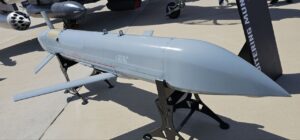
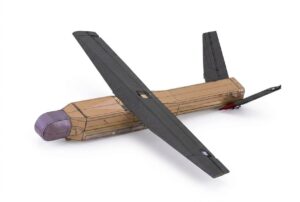
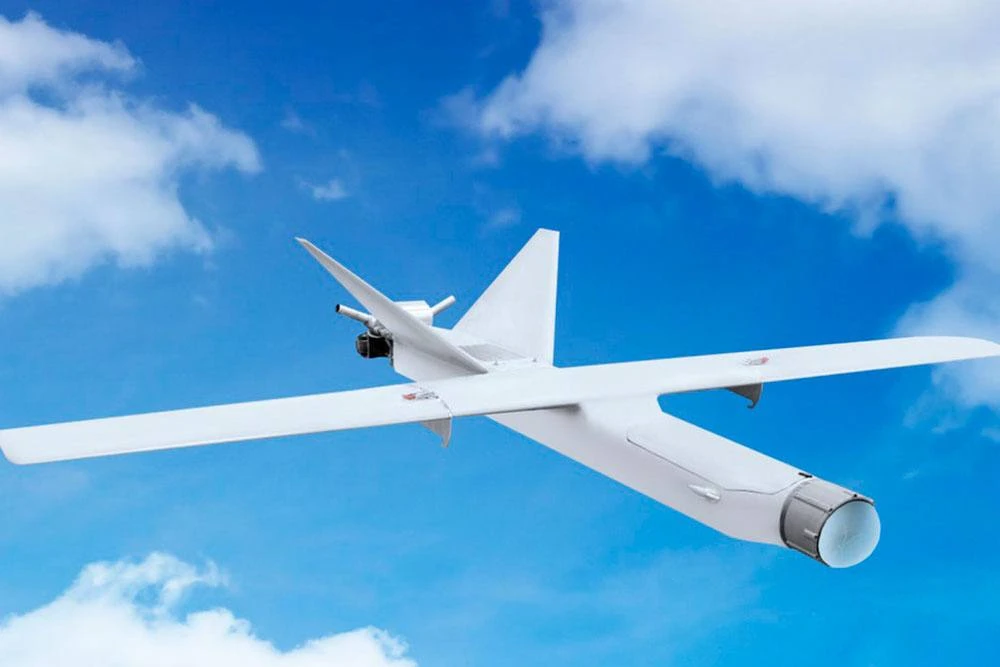
Tactical system KUB-10ME with a range of over 100 km
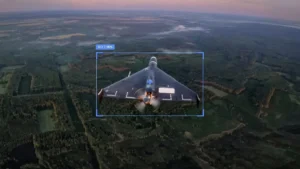
The Russian state concern Kalashnikov has announced the development of the KUB-10ME tactical system featuring guided munitions with a range exceeding 100 km. The munition is reportedly equipped with a multispectral thermal-TV seeker, a command-telemetry channel, and a video data link for engaging moving targets.
Technical specifications include an operational altitude of 80 to 1,800 m and speeds of up to 120 km/h. The system is designed for all-weather, day-and-night operations. The claimed engagement range of over 100 kilometres marks a significant extension compared to earlier iterations.
Serial production of the octocopter Vorobey-15
The Spektr design bureau has announced the commencement of serial production for the Vorobey-15 multipurpose octocopter. The platform is capable of carrying a 15 kg payload over distances of up to 25 km, reaching speeds of 90 km/h.
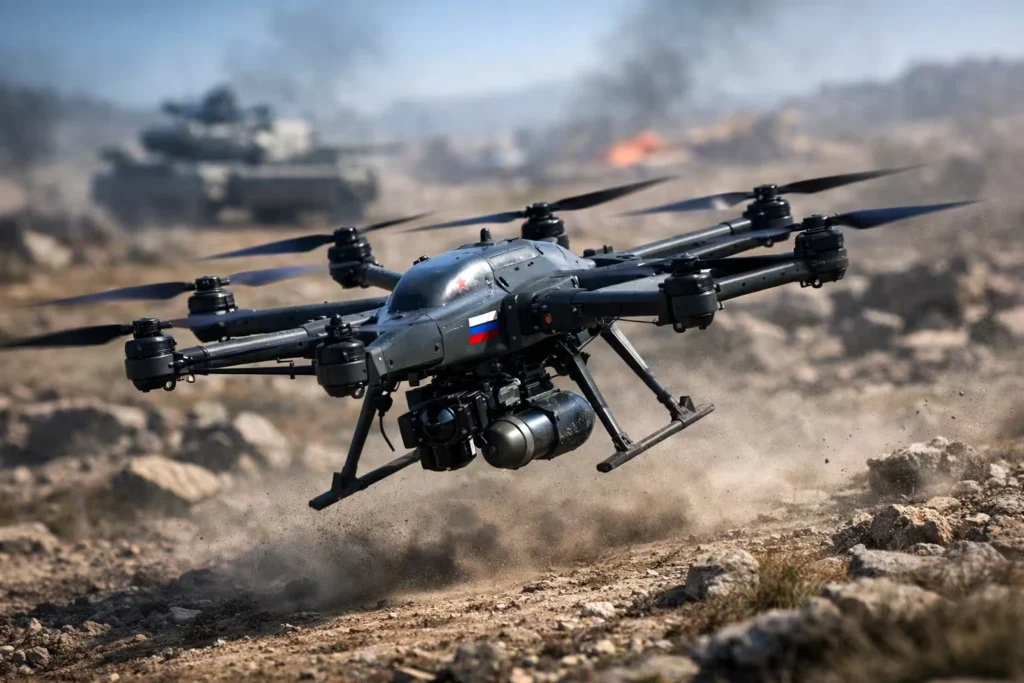
The octocopter utilises a serial 15x7x3 propeller developed in-house. The eight-engine configuration allows for the use of standard motors in a new high-capacity layout, significantly increasing the platform’s structural redundancy and survivability.
Reconnaissance drones Shtorm and Sibiryachok-5
The company Gaskar has delivered the initial batch of Shtorm fixed-wing UAVs. According to the manufacturer, the system is designed for aerial reconnaissance, target acquisition, and tactical situational monitoring. The airframe allows for the integration of various electro-optical payloads and signal relay modules.
Another Gaskar product, the Sibiryachok-5 reconnaissance copter, reportedly consists of 95% Russian-made components. The drone has an operational ceiling of 1 km and a range of up to 20 km. The Sibiryachok is intended for reconnaissance missions involving high-definition video recording, capable of identifying personnel and hardware while providing target designation.
Drone patented for crowd control
Specialists at the Volgograd Academy of the Russian Ministry of Internal Affairs have patented an unmanned aerial patrol complex for monitoring mass gatherings. According to the patent, the drone can issue warnings via a loudspeaker or deploy “active measures” to prevent offences.
The system is expected to be based on a quadcopter airframe equipped with standard navigation and control suites. Onboard equipment may include a projectile launcher, signal beacons, and laser designators. The proposed payload includes four aerosol canisters containing red pepper extract.
Ushkuynik develops new drone detector
The Russian Ushkuynik Research and Production Centre is preparing to unveil a new drone detector, the PC-3372 Piton. The device will feature expanded frequency ranges for intercepting video signals. Scanning is performed in 5 MHz increments, with the total scan time reportedly reduced from three minutes to 30 seconds.
In March, the release of the PC-3372 Efir+ is planned, alongside a vehicle-mounted version of the Piton capable of simultaneous monitoring across four frequency bands.
Reading now
1
Ukrainian Skyeton secures $10.6M US army contract
2
Canadian General Dynamics signs agreements with Ukrainian GreenTech
3
The Pentagon has announced the results of Drone Dominance Gauntlet II – announced Ukrainian companies did not make the top 5
4
Korven Systems project: How Teletactica co-founder is building an autopilot for interceptor drones
5

Ukrainian SkyFall again among winners of US Drone Dominance Program
By submitting this form, you give Defender Media consent to the processing of personal data.
Надсилаючи цю форму, ви надаєте Defender Media згоду на обробку персональних даних.

Latest news
1
12 British defence companies to gain access to Ukrainian AI platform Avengers Labs
2

Defence tech startup Zmiyar takes second place at IT Arena Startup Competition 2026
3

Mykhailo Fedorov launches ‘Army of Robots’ project to bring together venture fund, own companies and R&D for frontline robotics
4

Pentagon uses Ukrainian Unwave’s EW to test UAVs in Drone Dominance programme: details of cooperation
5