Black Mirror #47: Communication unification, new recon UAVs, the universal Kurier, and a stratospheric platform
A review of Russian military technology developments in the third week of February
Russian forces are actively seeking methods to restore high-speed communications across the frontline. Key developments this week include an unmanned platform designed for stratospheric operations and an accelerating trend toward unifying communications and control systems across diverse unmanned platforms. These and other Russian military innovations are detailed in Defender Media’s weekly review.
Kurier UGV with EW Payloads
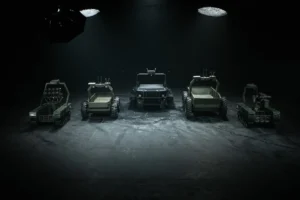
Russia is continuing the evolution of the Kurier UGV, transitioning it into a universal multi-role ground platform. Recent footage depicts the Kurier, reportedly equipped with electronic warfare (EW) modules, conducting amphibious training and crossing water obstacles.
The drills were designed to evaluate the platform’s buoyancy, antenna placement, and signal integrity under load. Tests also focused on power management during active jamming and recovery procedures for immobilised units. Mounting EW modules on such platforms enables forward electronic suppression without exposing crews to direct fire, allowing for a more mobile and distributed electronic warfare posture.
FPV carrier platform Muravey
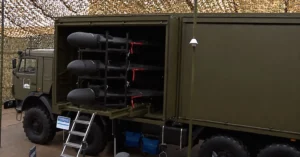
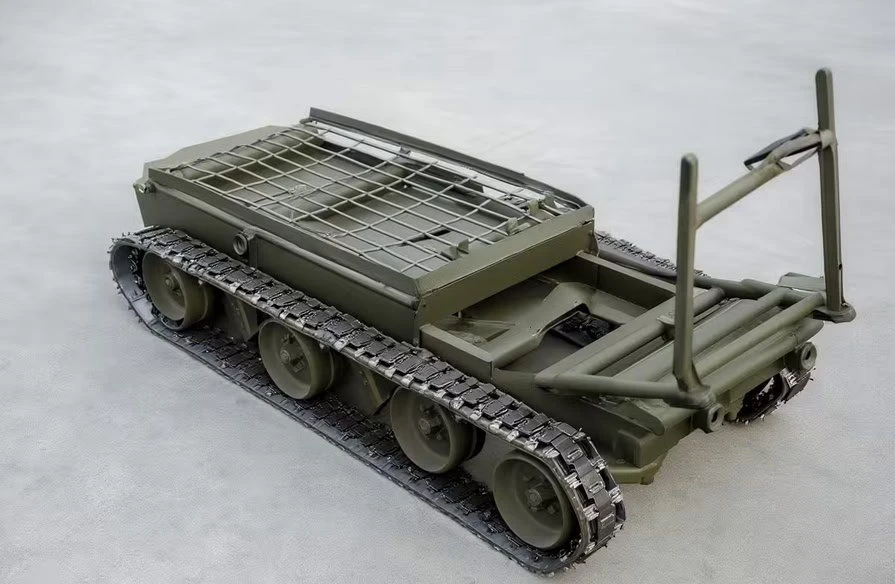
Russian developers are proposing the Muravey ground platform, designed to transit FPV drones to launch points with minimal human exposure. The drones are transported in a power-saving mode and only activated for combat sorties once they reach the designated deployment zone.
Stated capabilities include the ability to facilitate launches from hazardous or inaccessible terrain. The platform, which features camouflage paint and a compact profile to reduce its thermal and visual signature, can also be repurposed for the logistics of ammunition and supplies.
Stratospheric UAV Argus
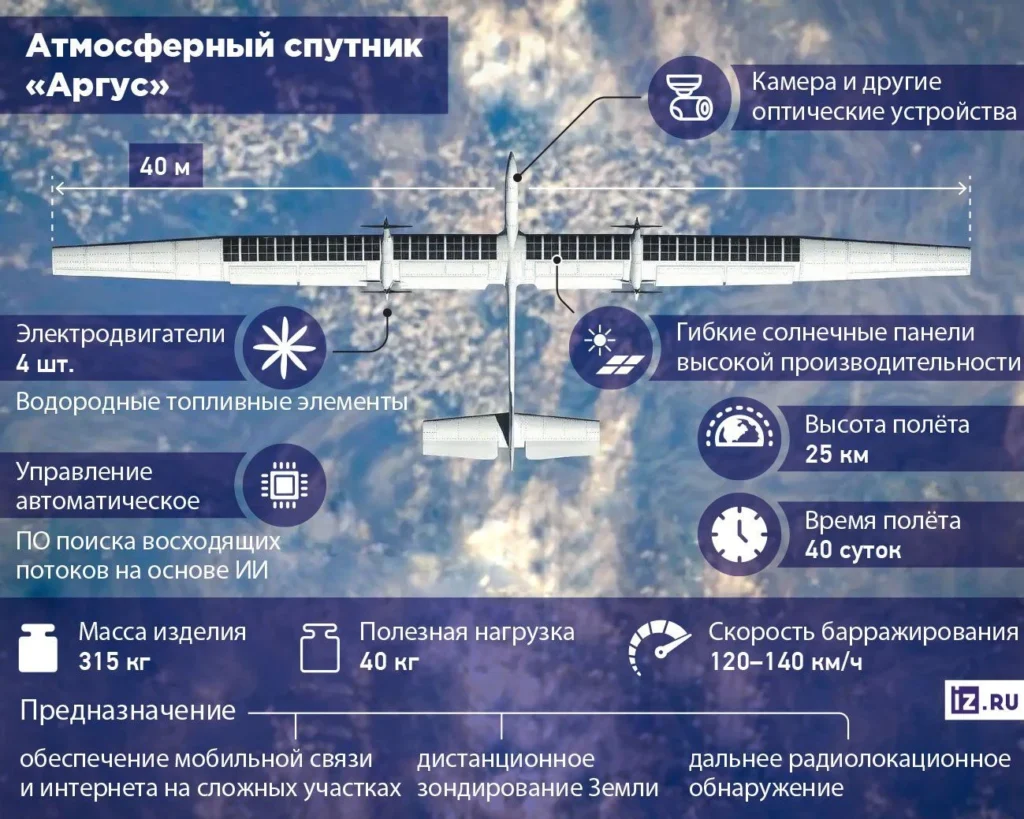
Russian state media have highlighted the development of the Argus stratospheric UAV. The platform is being positioned as a high-altitude persistent asset capable of providing high-speed internet—conceptually similar to Starlink—while also performing electronic intelligence (ELINT) and real-time surface monitoring.
The declared operational ceiling of 15 to 24 km places the Argus beyond the reach of conventional short-range air defence (SHORAD) systems. In March, the company Stratolink plans to flight-test a scaled-down prototype with a 7-metre wingspan to validate aerodynamics and control systems before moving to a full-scale 40-metre version.
Unification of UAV communications and Molniya upgrades
Russian forces are increasingly adopting standardised mounting fixtures for FPV drones across various aerial platforms. According to Serhii Beskrestnov, adviser to the Minister of Defence, identical hardpoints previously identified on the Molniya and Gerbera have now been observed on strike-variant Shahed UAVs. These mounts currently carry two FPV drones that reportedly use local LTE networks for connectivity at the launch site.
Furthermore, Ukrainian personnel have identified a mesh modem in the updated Molniya configuration, similar to units found in Shahed drones. The modem operates on two 5-watt channels within the 1300–1500 MHz band.
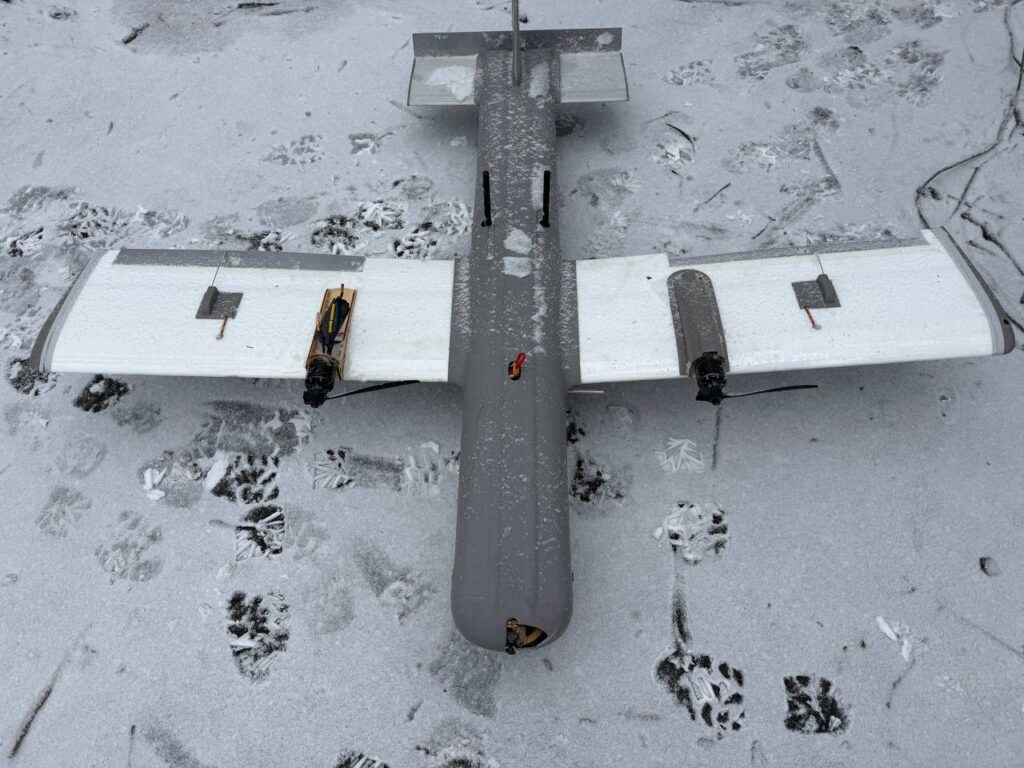
Beskrestnov suggests a concerted effort by Russia to consolidate control over disparate UAV types into a unified network, with ground robotic systems expected to follow.
UKBTM Patent for T-90M turret protection
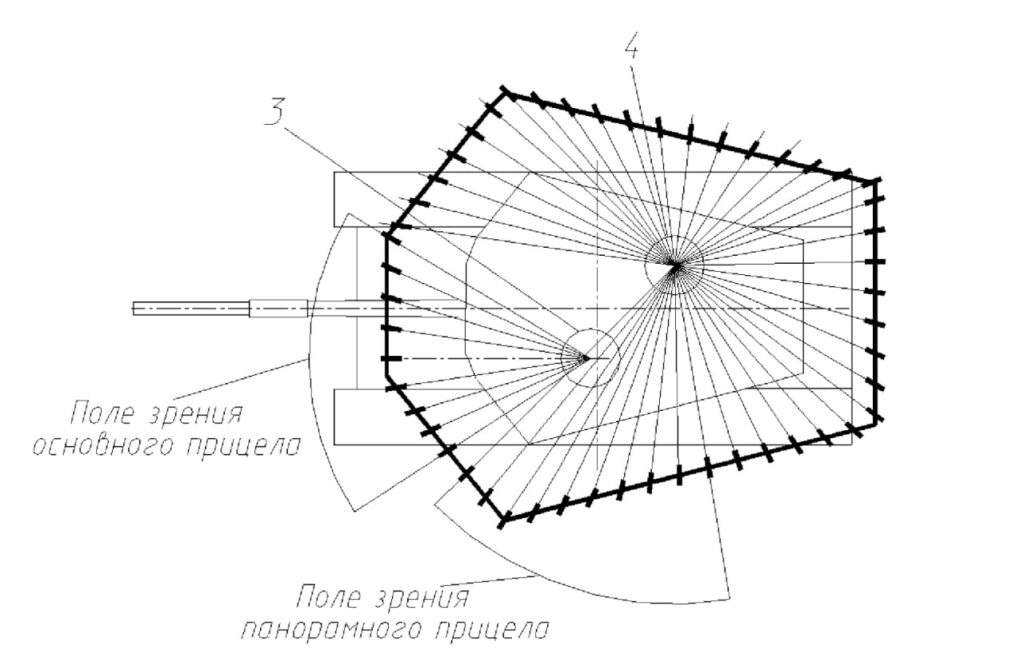
The Russian state design bureau UKBTM has patented a new protective structure for the T-90M tank turret, specifically designed to counter loitering munitions. The design comprises a framework of support struts with an upper frame carrying freely hanging rubber-fabric panels arranged in a fan configuration.
The spacing of these panels is calculated to be smaller than the typical loitering drones’ dimensions, forcing a standoff detonation of the shaped-charge warhead. This distance is intended to be sufficient to protect both the crew and the turret’s structural integrity. The panels feature perforations to mitigate weight and wind resistance.
FPV drone Artemida-10
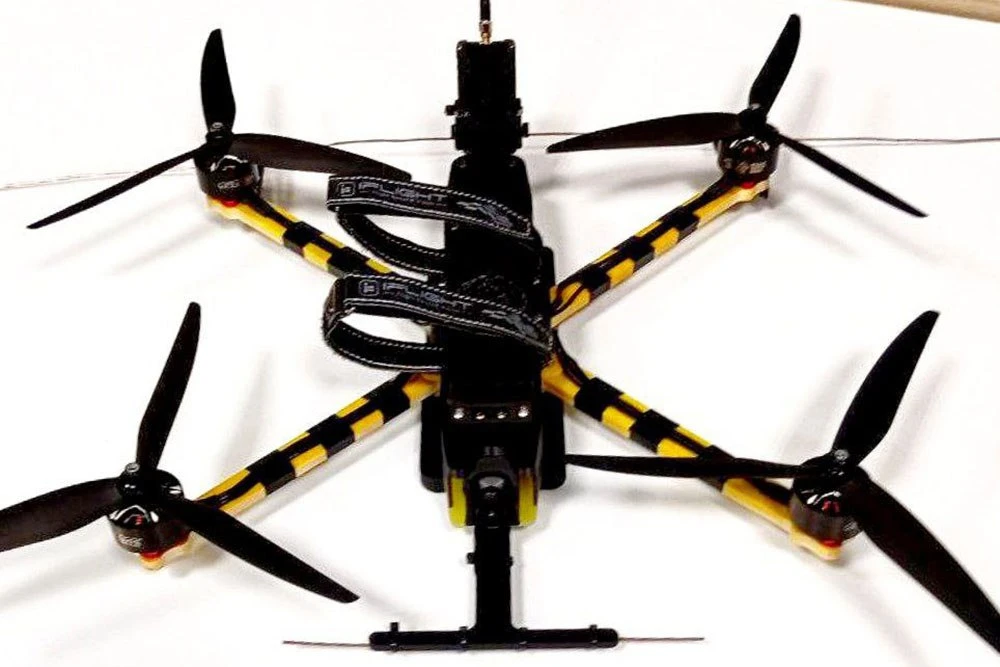
Military observers report that the Russian company Kaysant has launched serial production of the Artemida-10 FPV drone. Approximately 150 units are reportedly already operational in the combat zone following preliminary field evaluations.
The drone has a declared payload capacity of up to 4 kg and is equipped with a machine vision system for terminal guidance. It utilises an in-house communications suite designated Germes, which supports a “hibernation” mode and employs multi-channel signal resilience to counter EW interference.
Robotic MLRS Kultivator
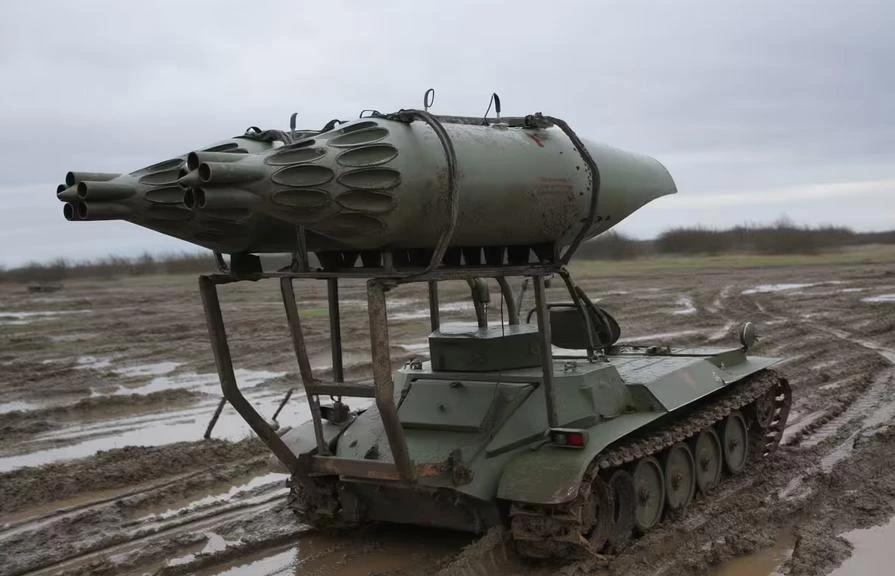
Russian forces have reportedly deployed the Kultivator, a ground robotic complex fitted with UB-32-57 rocket pods typically found on attack helicopters. The system carries two pods, each capable of firing 32 unguided 57-mm S-5 aerial rockets.
While the effective firing range is 2 km, the system can reach targets up to 4 km. The primary tactical advantage of the Kultivator is the ability to conduct indirect fire missions while the operators remain in protected positions.
Reconnaissance UAVs Oko-2 and Oko-3
New variants of the Oko-2 and Oko-3 reconnaissance UAVs have been identified in the combat zone. These systems utilise a VTOL configuration, eliminating the need for runways and reducing deployment time in the field.
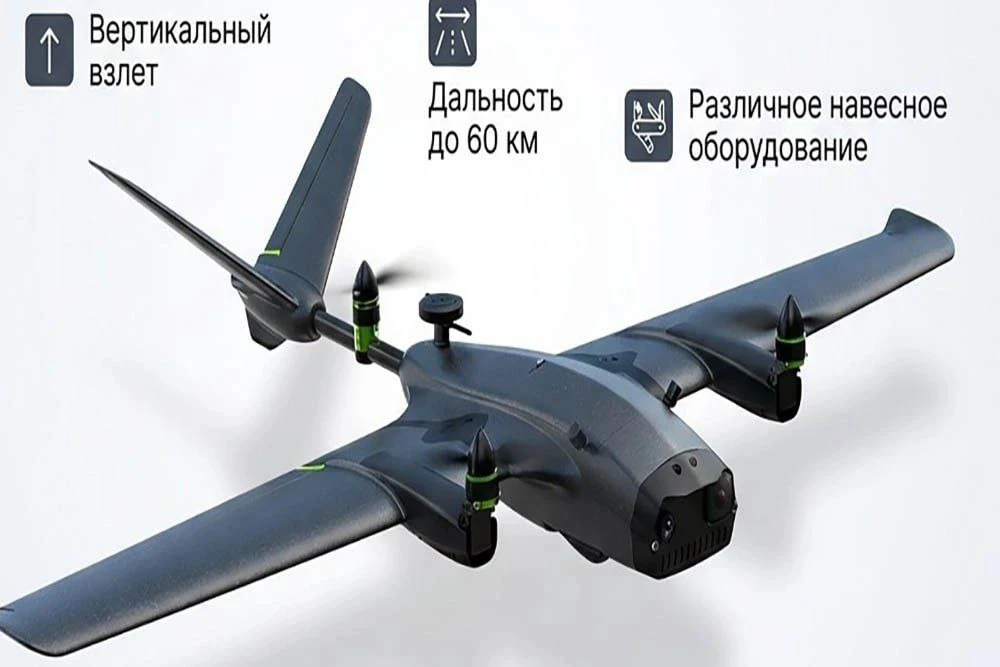
The Oko-2 reportedly has a flight range of 60 km, while the Oko-3 can operate up to 130 km. Both systems employ digital data links, enabling command and control over extended ranges and providing high-endurance surveillance capabilities.
Reading now
1
SkyFall officially unveils Thor Hammer mid-strike and announces 1,000+ km version
2

260+ vacancies in Ukrainian defence technology at BlueBird Tech, Sine Engineering, Buntar Aerospace and more
3
British-Ukrainian Occam Industries raises €3.8m. The funds will go towards scaling drone autonomy software
4
Terra Drone acquires 50% of Ukrainian Kurin Technologies for $3.5 million
5

Autonomous interceptor drones need radars to work. Why is there still a lack of them
By submitting this form, you give Defender Media consent to the processing of personal data.
Надсилаючи цю форму, ви надаєте Defender Media згоду на обробку персональних даних.

Latest news
1

Acoustic sensor developer Zvook raises investment from new Czech fund managed by DEPO Ventures
2

Denmark to hold first-ever Danish Defense Tech Week in four cities: what to expect
3
Forbes: Airlogix plans to raise $100m at a $2bn valuation
4
Tencore launches an ecosystem to bring together UGVs and components from several manufacturers
5