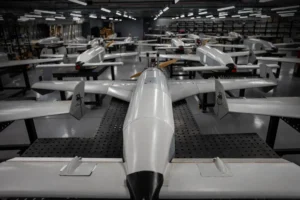
200,000 motors per month. How the founders of Motor-G built lean production of drone components
The story of Ukraine’s largest drone engine manufacturer, with more than 100 corporate clients and over 15% of the market
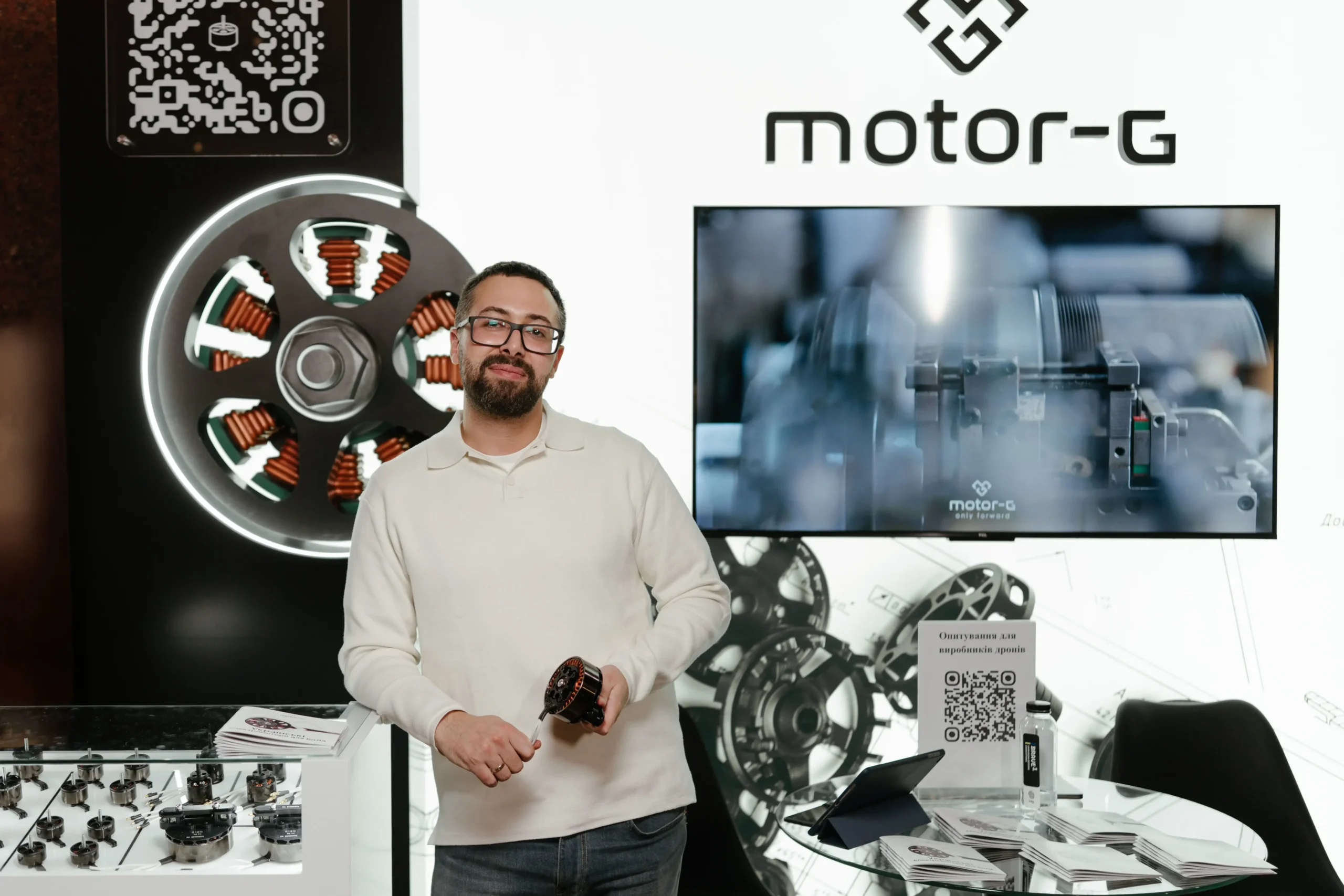
Oleksii Hrebin, CEO of Motor-G (Photo from the speaker)
Ukrainian company Motor-G launched mass production of drone motors in December 2024. That month, 181 units rolled off the assembly line. Within a year, output had grown to 200,000 motors per month, making the company the largest manufacturer of these components in Ukraine — by a wide margin over its market peers.
The company’s customers include over 100 drone manufacturers. How did the company build processes to meet the clients’ needs? Defender Media discussed this with Motor-G CEO Oleksii Grebin and asked his customers about the advantages and drawbacks of these motors.
Millions of dollars for launch, $10,000 for Chinese technology
Motor-G has four co-founders and hundreds of employees – the exact number is not disclosed. The idea to produce motors appeared in 2023, and a year was spent developing a prototype. After that, it took about nine months to build a production line and enter the market.
The co-founder says that mass production began in December 2024, with 181 motors produced, followed by 1,500 in January 2025, with the number growing every month thereafter.
One of the challenges at the beginning was a lack of expertise – it was not possible to find anyone on the market who had already made similar motors. “We were buying components in China, started talking to local manufacturers, and they themselves offered to tell us — for a fee — how to produce the motors,” Grebin recalls.
For $10,000, the Chinese shared documents and technology that helped them avoid going in blind. Although later it was changed several times.
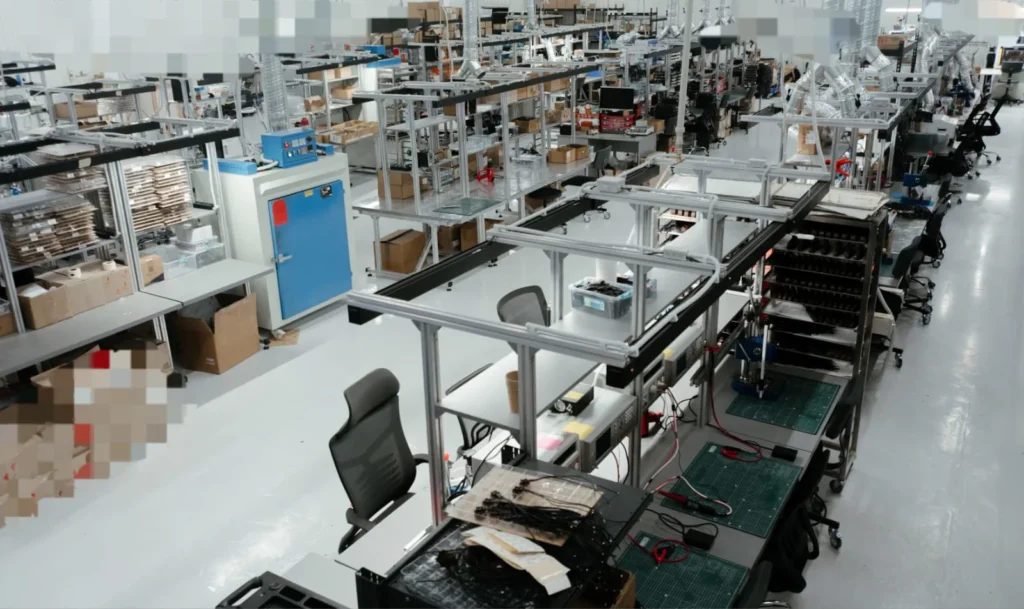
In total, millions of dollars were invested in the launch, attracting money from the founders. Oleksii and his partner had a civil business dealing with air conditioning, ventilation, heating, etc. Two other co-founders were involved in drone production. Grebin clarifies that no external investments or loans were used.
However, the example of Motor-G’s competitor, Aeromotors, shows that this area is also of interest to investors. At the end of 2025, Swedish company Front Ventures invested $550,000 in the manufacturer.
At the time, the CEO of Front Ventures told us that Aeromotors was of interest to the company because it manufactures all components in-house and can customise motors to customer specifications.
How Motor-G’s production is structured
The company currently assembles around 200,000 motors per month. The total volume of the Ukrainian drone motor market last year was about 9.6 million units, says Motor-G CEO. This year, he predicts more, but clarifies that this is a subjective assessment, not based on thorough research.
The Motor-G website states that production is structured according to the principle of lean manufacturing. The essence of this is to make what the consumer needs, when they need it, and without unnecessary costs.
One goal of this concept is to avoid overproduction. In the context of Motor-G, this means small delivery volumes. While in China, a drone manufacturer would pay for and wait for an entire batch of tens of thousands of motors, the Ukrainian company offers to ship them in parts, tailored to the customer’s actual production rate.
As Grebin explains, this allows his business to avoid product accumulation and keep up with orders from other drone manufacturers. Therefore, there are no motors in the warehouses – only their blanks, which are assembled to order.
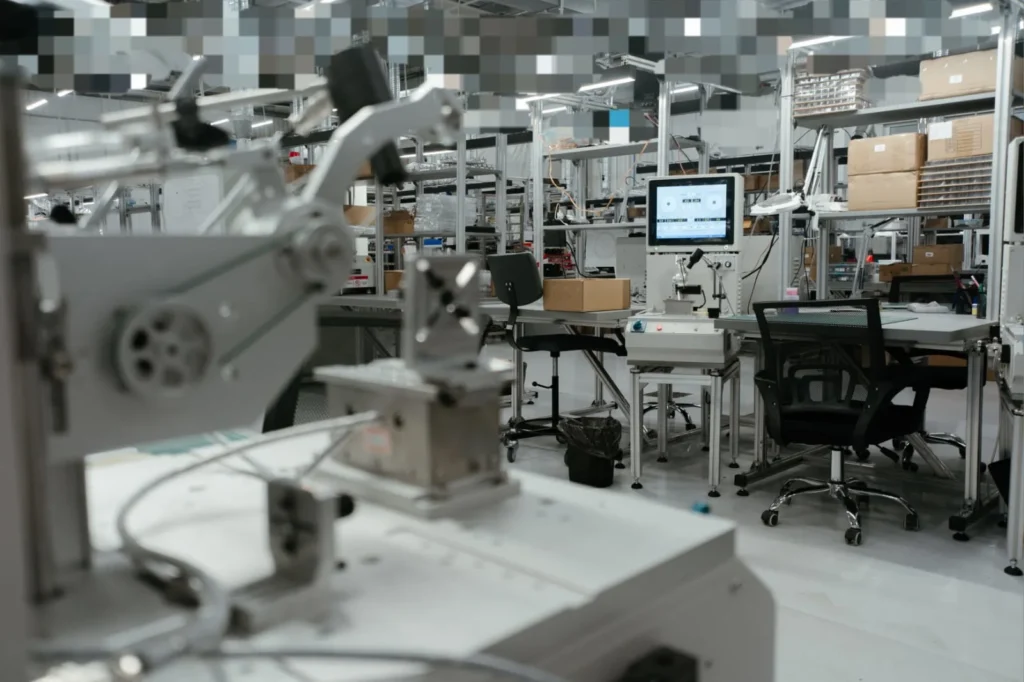
One of the principles of Lean is to identify customer values and incorporate them into the product. The Motor-G line includes nine motors of different sizes. And each size has at least 10 KV variations – the number of revolutions per volt. Grebin says they are ready to change this number at the customer’s request. He confirms that this is commercially unprofitable and that production has to reconfigure equipment for each nomenclature.
“Maybe it’s not right from a business point of view, but this is war, and we care,” the entrepreneur explains his motivation. The business’s margin is currently less than 20%.
Who uses the motors
Motor-G’s customers include over 100 drone manufacturers. These include General Cherry and Vyriy, with whom Defender Media discussed the quality of these motors. General Cherry uses the company’s products for its strike FPVs and interceptors. The advantages include stable production quality, consistent characteristics across the series, and direct technical support.
Vyriy has been working with Motor-G since February 2025. Their products are used on a number of platforms, including FPV drones. Both Vyriy and General Cherry note that the motor manufacturer can adapt solutions to their requests.
At the same time, General Cherry says there are alternatives on the market with a wider range or a longer history of serial production, which can sometimes affect the price or availability of large batches. In addition to Ukrainian engines, Chinese engines are also used to meet large market demand.
TAF Industries, another leading drone manufacturer, uses different motors for its products. The company says it has found an alternative with similar characteristics but at a more optimal price.
According to Oleksii Grebin, Motor-G has about eight competitors in Ukraine. These include the aforementioned Aeromotors, which, a few months ago, were assembling about 10,000 electric motors per month. They are also manufactured by Realgold, whose motors were used by Vyriy.
However, according to the co-founder of Motor-G, his company leads the local market by a wide margin. He says Motor-G currently holds around 17% of the market, while all other Ukrainian manufacturers combined account for about 10%. The remainder is still dominated by China.
6 stages of testing each motor
The company’s catalogue currently includes 9 motors, with another one in the prototype stage. The company’s website states that their motors are suitable for FPV, bombers and aircraft-type drones. In the spring of 2025, interceptors were added to this list.
Customised 3115 motors were used for them, but now the line includes a specialised Vandal engine at a price higher than Chinese ones. Ukraine’s Minister of Defence, Mykhailo Fedorov, wrote that Motor-G equipment enabled an anti-aircraft drone to accelerate to 400 km/h. Grebin clarifies that it was not a Vandal and that this case was not widespread.
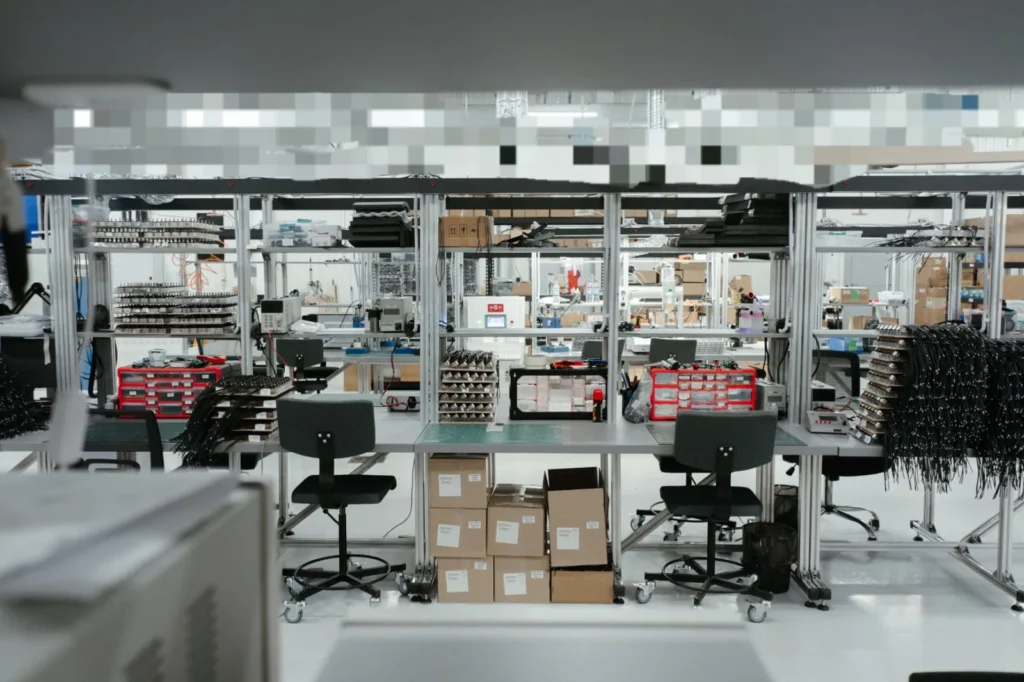
To monitor the quality of the motors, six stages of blank inspection were organised at the production facility: in particular, stators and rotors are tested, the product is balanced, and assembled motors are checked. Several times a day, the outgoing inspection department takes random motors from the line and tests their performance. The acceptable defect rate is two motors per 1,000, the co-founder clarifies.
The maximum possible share of localisation of the motor is 85%, says Grebin. But this does not apply to all products – some motors have to be assembled with Chinese parts if there are not enough Ukrainian ones.
What they are focusing on this year
This year, the company plans to focus on R&D and expand its motor line. In particular, they plan to develop motors for UGVs and heavy bombers. The company’s analytics are based on conversations with drone manufacturers about what they will need in the future.
“Every two weeks, the sales department provides analytics on which motors are likely to be needed by someone in the future,” says the CEO.
At the same time, Motor-G does not plan to expand into other component niches. The main goal, Grebin says, is to increase the company’s market share from the current 17% to 20–30%.
The company also plans to enter foreign markets. It is currently working on international partnerships, with interest in its motors coming from Europe and America. Letters of intent have already been signed with some parties, but no details are being disclosed yet.
Reading now
1
Ukrainian Skyeton secures $10.6M US army contract
2
Ukrainian SkyFall again among winners of US Drone Dominance Program
3
Pentagon to hold Drone Dominance trials for bomber drones, with UFORCE, Gurzuf Defence, Grim Tech and others taking part
4

Frontline Robotics CBDO Mykyta Rozhkov: Ukraine and Norway are working on an autonomous system to protect maritime infrastructure
5
KARA UAV can deliver FPV drones behind enemy lines and operate as a relay
By submitting this form, you give Defender Media consent to the processing of personal data.
Надсилаючи цю форму, ви надаєте Defender Media згоду на обробку персональних даних.

Latest news
1
Lithuania deploys Ukrainian SkyFortress air target detection system
2
Ratel Robotics and General Dynamics Mission Systems to jointly produce UGVs for Ukraine in Canada
3
DevDroid partners with Italy’s ABET HTS as Italian Army tests Ukrainian UGVs
4
Sights, radar systems and UAV components now available to the military through Prozorro Market
5