Black Mirror #45: Drone carriers in the air and on the water, monitoring systems, guided munitions, and other Russian miltech updates
A review of new developments in Russia’s military-industrial complex during the first week of February
In the first week of February, Russian military experts devoted considerable attention to ways of bypassing restrictions on Starlink and lamented that Russia has still not developed its own satellite communications technology capable of outperforming the American system. At the same time, a significant number of publications focused on the military technology exhibition, where various developments were presented in Moscow at Drontech 2026.
Geokosmos communications and navigation platform
The Geokosmos platform for providing communications and navigation is based on ground-based communications systems and onboard equipment that form a proprietary distributed secure network. Each element of the system functions as a signal repeater for other participants in the network, ensuring extended coverage and increased resilience of communications.
It is claimed that the system supports the joint use of both unmanned and manned aircraft within a single airspace. The platform is designed to operate without direct dependence on satellite navigation systems GPS/GLONASS and cellular networks.
It is separately noted that Geokosmos implements an algorithm for determining the location of system participants even using the signal of a single base station. The system also provides automatic detection and maintenance of operational communication channels within its own network.
Airspace monitoring system
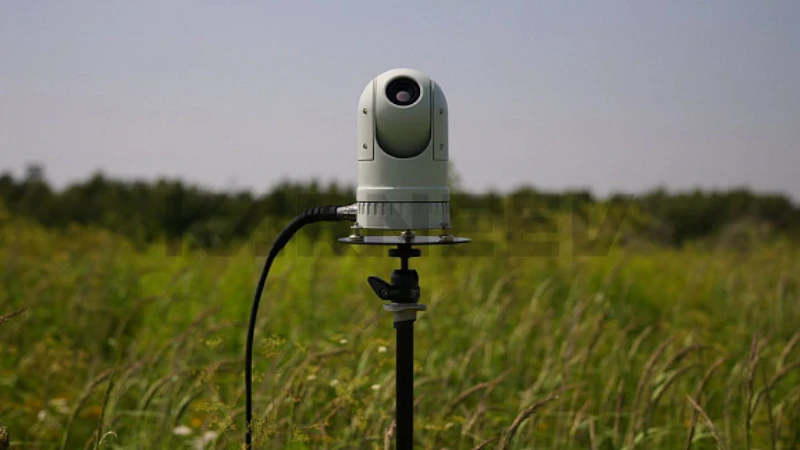
The new security-oriented system called Chasovoi Neiro is a complex for automated airspace monitoring and protection of territories from small airborne threats, including UAVs.
Descriptions of the system in Russian sources indicate that Chasovoi Neiro is capable of automatically detecting and tracking unmanned aircraft without constant human involvement, which, according to the developers’ concept, may facilitate the protection of both critical infrastructure and areas with increased security requirements.
The system consists of a rotating thermal imager, an AI module and an Android-based control tablet. Human recognition range is about 1,400 m, vehicle recognition range about 1,800 m. The developer claims that the system is effective in darkness, fog and difficult weather conditions.
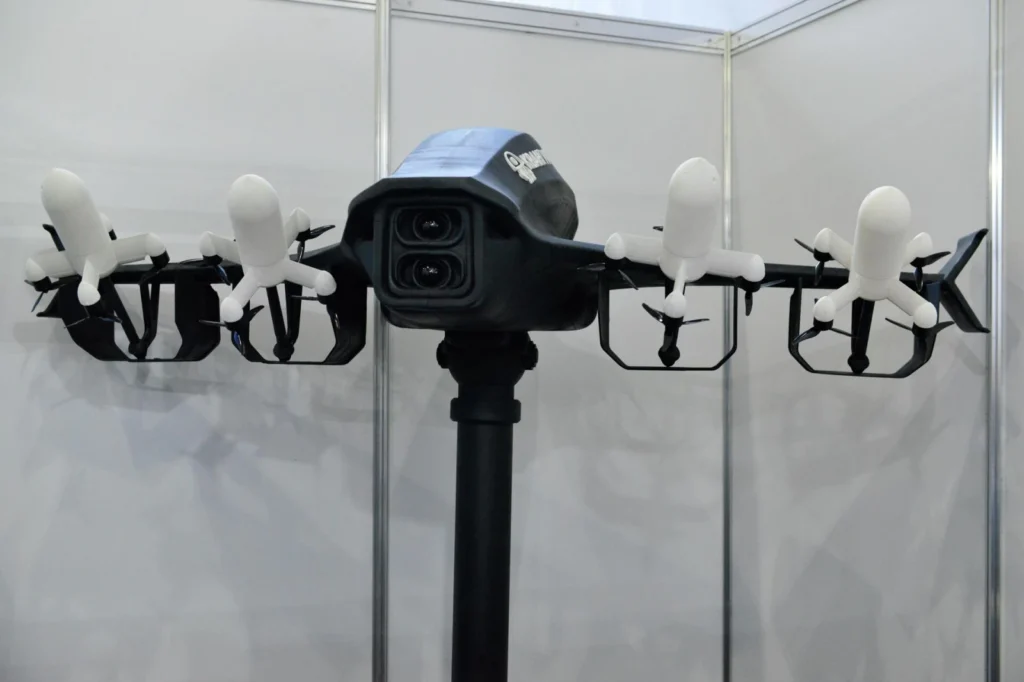
Kvantum drone interceptor
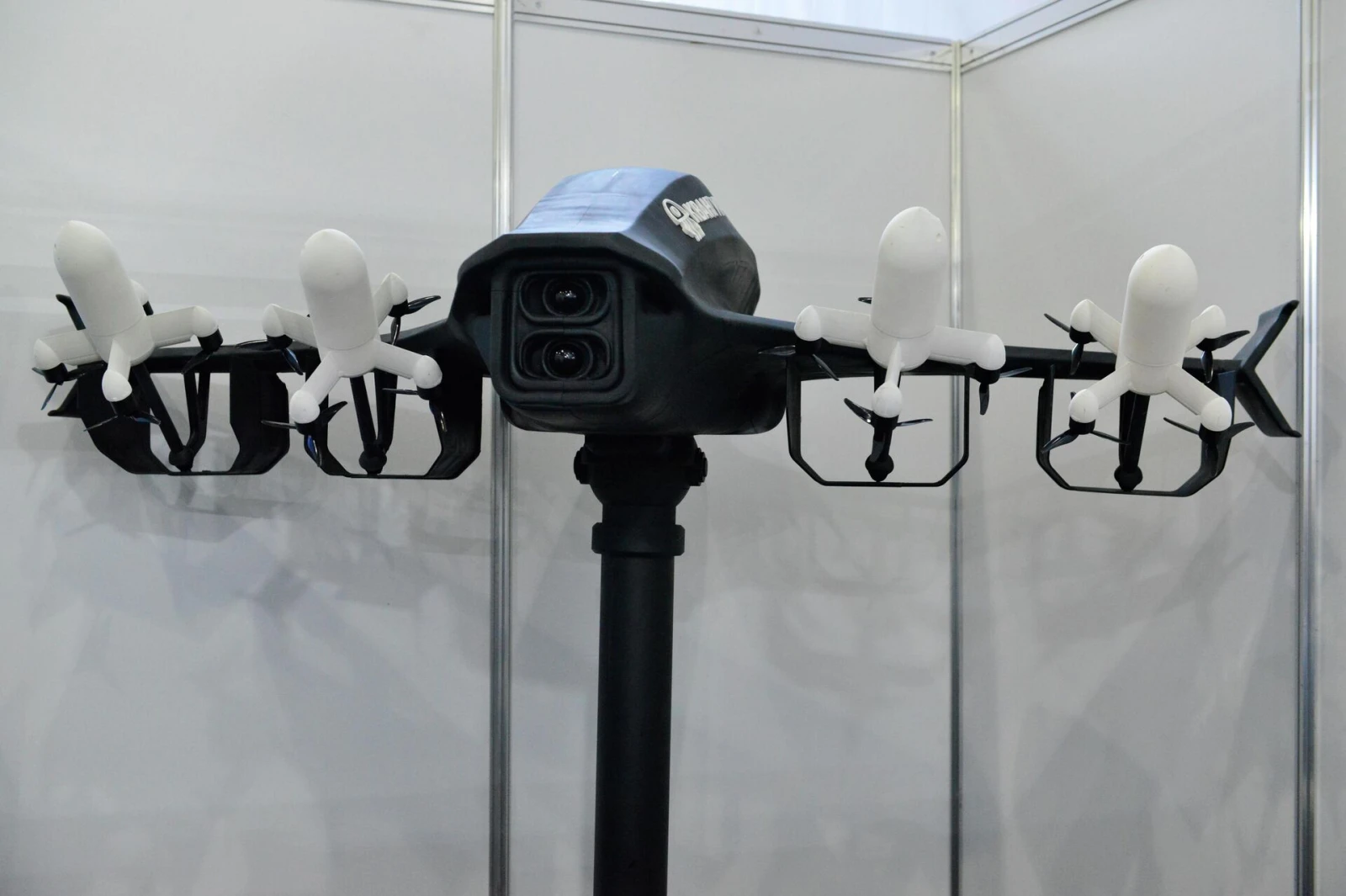
The Kvantum carrier platform is equipped with interceptor drones and operates using elements of artificial intelligence. The AI allegedly assists in detecting the target, while the interceptor drones are capable of reaching speeds of up to 350 km/h. Other characteristics of the system have not been disclosed.
The manufacturer estimates the probability of neutralising small UAVs and FPV drones at 99%. The cost of the system amounts to tens of millions of rubles, and its monthly maintenance costs 1–1.5 million rubles.
Ushkuinik launched fibre-optic drones from an unmanned boat
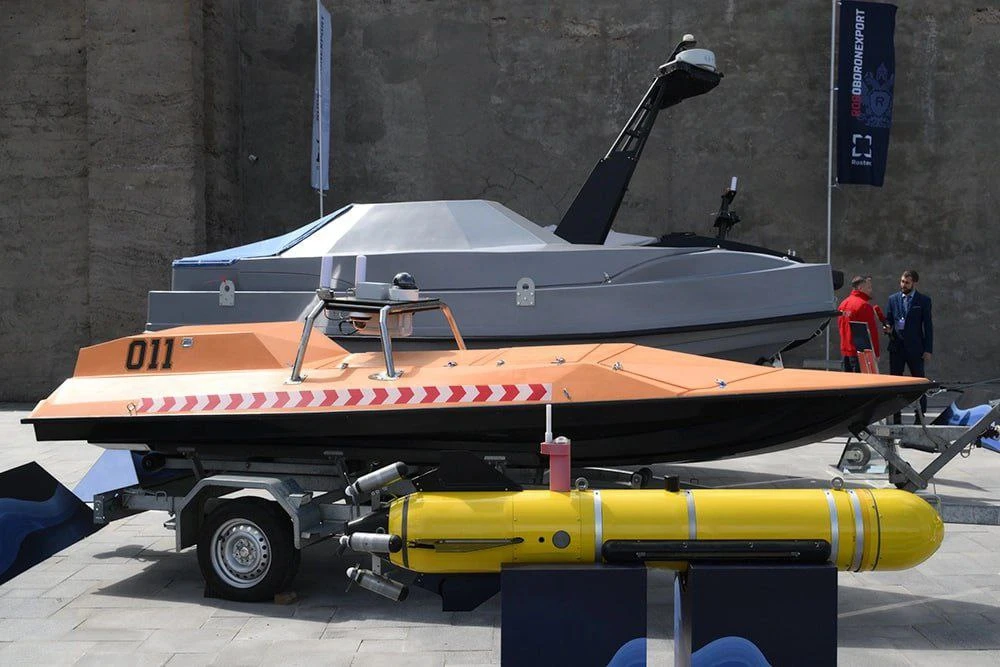
In the waters of the Black Sea, the first tests were conducted of launching the fibre-optic drone Kniaz Vandal Novogorodskiy from the unmanned boat Skorlupa. Skorlupa itself is positioned as Russia’s first serial unmanned boat with a fibre-optic control channel.
The boat can be used as an independent platform for reconnaissance, patrol and other maritime tasks, as well as a mobile base for launching and controlling other systems, extending their operational range in the maritime domain.
It is claimed that production of Skorlupa reaches hundreds of units per month.
Software for detecting and countering UAVs
The software package Spektroskop, developed by OKB Dronoskop, is intended for integrating radio electronic intelligence (REI), electronic warfare (EW) modules and distributed sensors. According to reports, the system’s architecture is conceptually similar to NATO’s integrated protection system known as the “Drone Wall”.
It is claimed that the system consists of a network of radio-channel, optical and acoustic sensors, as well as specialised radars. Spektroskop allows operators to analyse signals from drones and other sources of radio emissions using available equipment in the combat zone, measure signal parameters and determine their type for early UAV detection.
A separate function of the system is the analysis of “radio weather”, that is, the frequency ranges in which the adversary’s EW systems operate, enabling UAV operators to select spectrum segments not suppressed by electronic warfare.
Rostec presented the R-SAVER-1 maritime robotic complex
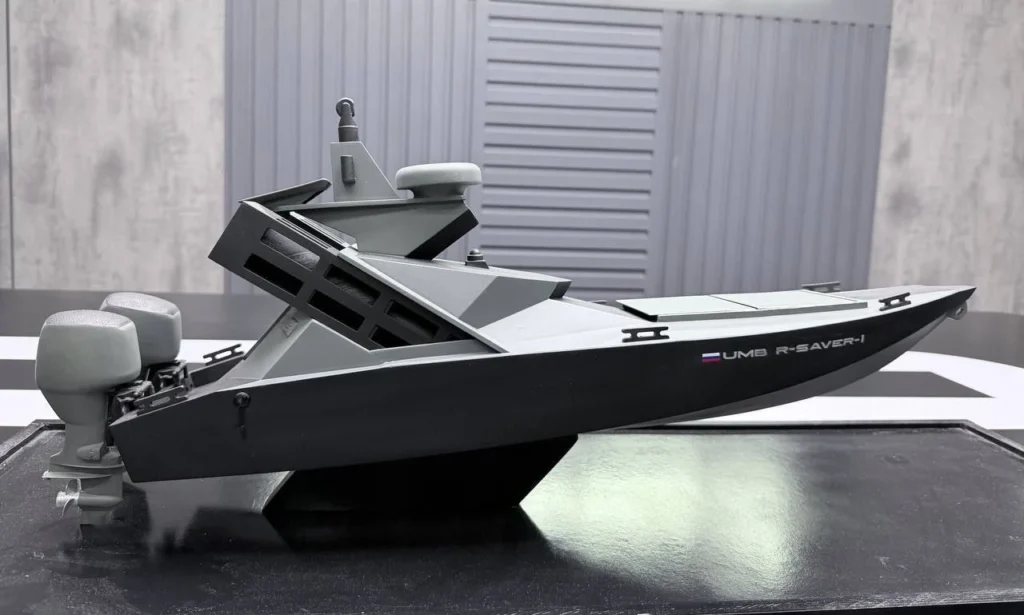
At the World Defense Show in Riyadh, a model of the R-SAVER-1 robotic maritime rescue complex was presented for the first time. The complex is designed for the rapid delivery of rescue equipment and special tools to the site of emergency situations.
In particular, the complex can be used to deliver cargo to vessels in distress or to offshore oil and gas facilities. It is reported that the unmanned boat is capable of transporting cargo weighing up to 600 kg over a distance of up to 800 km at a speed of up to 50 km/h.
Garuda intelligent headset
Russia has announced the development of a new “intelligent active headset” named Garuda. According to the developers, the first prototype has already been delivered for testing to military and security structures.
The headset provides hearing protection against impulse noise (gunshots, explosions) while simultaneously amplifying useful environmental sounds. Support for two-way radio communications is also declared, along with compatibility with helmets and operation in conditions of high humidity, dust and extreme temperatures.
Heavy strike drone Provod with fibre-optic link
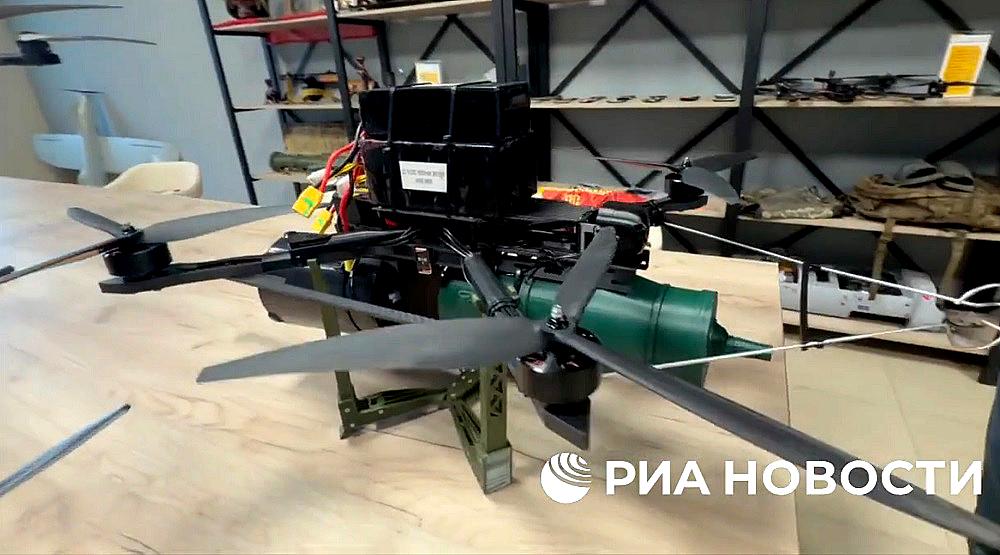
Engineers in Tula have developed and launched serial production of a heavy strike drone with a fibre-optic link called Provod (Ovod-Pro). According to the developers, the drone has a 25–30 km spool and can carry a payload of up to 4.5 kg. For long-range operations, proprietary software solutions are used: the signal is processed via a media converter and transmitted through a fibre-optic channel.
Portable RUS-PE system with guided munitions
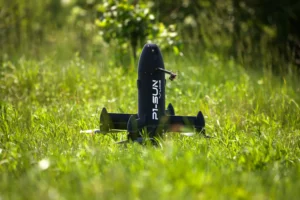
The Kalashnikov Concern has presented the portable reconnaissance and strike system RUS-PE for high-precision engagement of single stationary and moving targets or groups of targets using a guided munition.
The guided munition is a carrier with an X-shaped configuration of aerodynamic surfaces, equipped with a warhead, control equipment and a homing seeker.
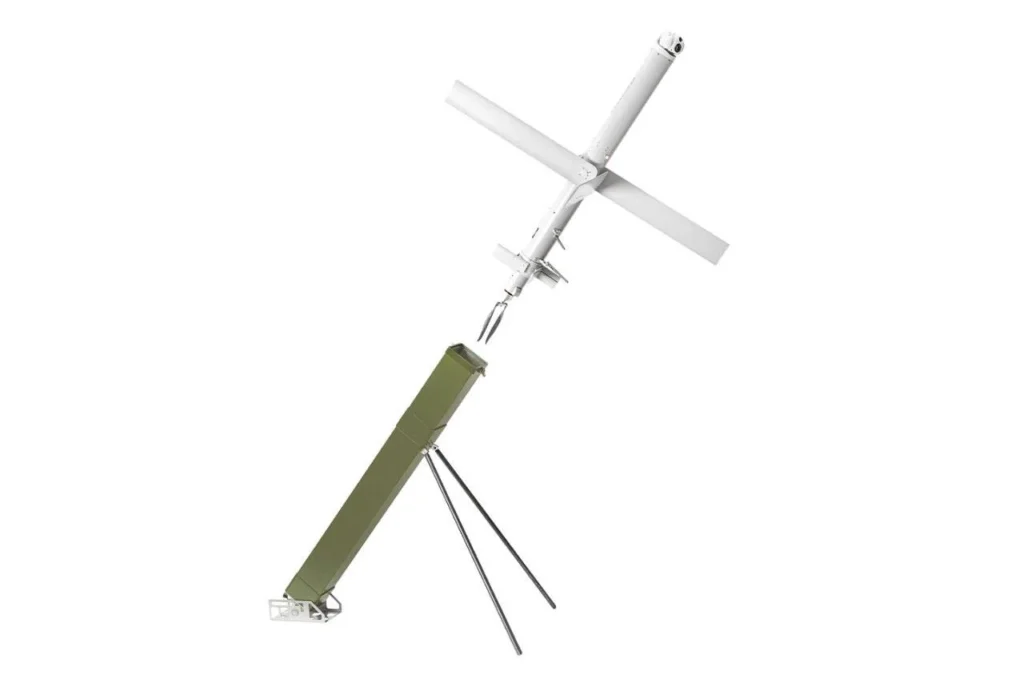
The munition is launched from a portable transport and launch container using a pneumatic старт. The system can operate in autonomous, semi-autonomous and manual modes. The dual-channel gyro-stabilised optical system allows for automatic detection and identification of targets using artificial intelligence technologies.
The flight duration of the munition is up to 30 minutes, with a cruising speed of about 140 km/h.
Chinese scientists created a compact microwave device to affect satellites
Chinese scientists at the Northwest Institute of Nuclear Technology in Xi’an, Shaanxi province, have reported the creation of a compact device for high-power microwave weaponry capable of affecting satellites in low Earth orbit, including those of the Starlink system. The development is named TPG1000Cs.
According to the researchers, the device can generate microwave pulses with a power of up to 20 gigawatts for 60 seconds, which could disrupt or damage navigation and telecommunications satellites.
Chinese experts note that a ground-based microwave installation with a power of more than 1 GW would be sufficient to affect satellites in low orbit, while the TPG1000Cs exceeds this by a factor of 20 and can operate for a significantly longer period than previously known systems.

The disclosed specifications indicate that the device is approximately 4 metres in length and weighs around 5 tonnes, allowing it to be deployed on mobile platforms, including trucks, naval vessels, aircraft, or even spacecraft.
For comparison, earlier microwave systems could operate continuously for only a few seconds and were considerably larger. For instance, the Russian Sinus‑7 system reportedly delivered around 100 pulses per cycle, operated for roughly one second, and weighed about 10 tonnes.
Reading now
1
SkyFall officially unveils Thor Hammer mid-strike and announces 1,000+ km version
2

260+ vacancies in Ukrainian defence technology at BlueBird Tech, Sine Engineering, Buntar Aerospace and more
3
British-Ukrainian Occam Industries raises €3.8m. The funds will go towards scaling drone autonomy software
4
Terra Drone acquires 50% of Ukrainian Kurin Technologies for $3.5 million
5

Autonomous interceptor drones need radars to work. Why is there still a lack of them
By submitting this form, you give Defender Media consent to the processing of personal data.
Надсилаючи цю форму, ви надаєте Defender Media згоду на обробку персональних даних.

Latest news
1

Denmark to hold first-ever Danish Defense Tech Week in four cities: what to expect
2
Forbes: Airlogix plans to raise $100m at a $2bn valuation
3

Tencore launches an ecosystem to bring together UGVs and components from several manufacturers
4

Defense companies may see staff deferrals cut from 100% to 85%
5