Black Mirror #44: BM-35 over Kyiv, the Sarma MLRS, a self-loading mortar and other new Russian miltech systems
A review of new developments in Russia’s military-industrial complex during the final week of January
One of the most widely discussed topics among Russian military commentators this week has been the use of Starlink terminals on drones that managed to reach Kyiv. In addition, Russia continues to present updated and modernised systems for international defence exhibitions — this time, the 300 mm Sarma multiple launch rocket system will be showcased in Saudi Arabia. These and other Russian developments are covered in Defender Media’s weekly review.
Italmas / BM-35 with Starlink
Russian forces have begun using the BM-35 combat UAV, also known as Italmas, with online control enabled by Starlink satellite communications. According to military analyst and adviser to the defence minister Serhii Beskrestnov, this drone is the second most frequently used, but rarely appears among captured trophies, as it is equipped with a detonation system.
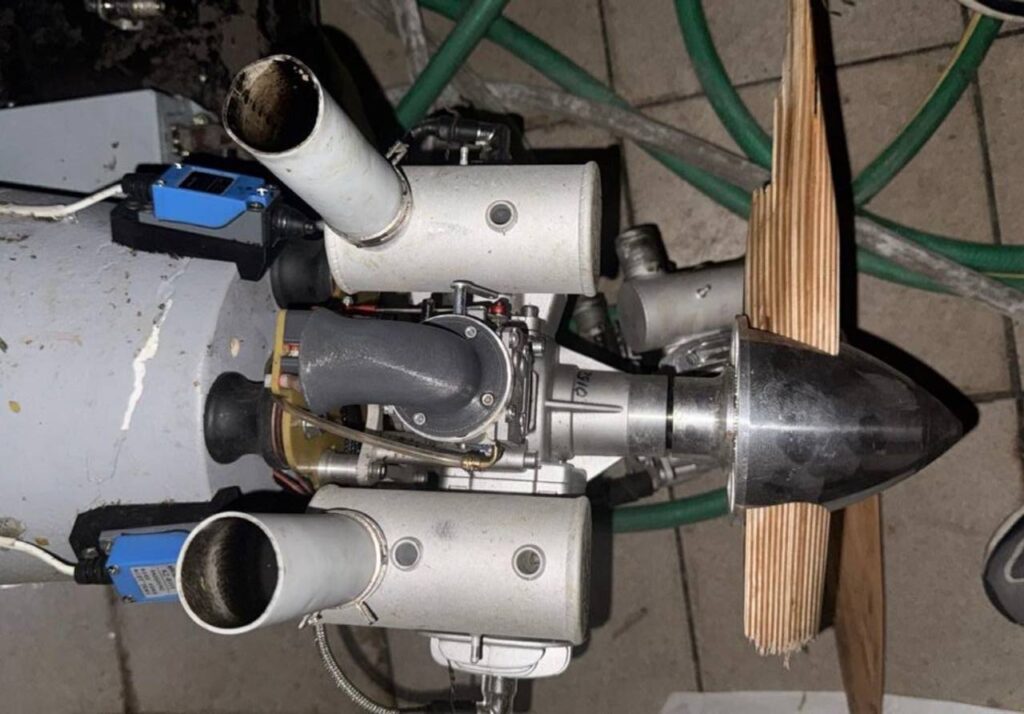
The BM-35 exists in two versions within the same airframe:
- a variant with a two-cylinder engine capable of carrying up to 15 kg of warhead, which may consist of one to three munitions;
- a variant with a four-cylinder engine capable of carrying a 27 kg warhead.
According to open-source data, the BM-35 is a fuel-powered kamikaze drone with a nose-mounted engine, a wingspan of approximately 1.8 m and a length of about 2 m. The UAV is equipped with a two-stroke petrol DLE engine with a tractor propeller, while a forward-facing camera provides video feed and targeting. The manufacturer is Aeroscan, part of the ZALA Aero group. According to the War&Sanction portal, these drones contain at least 41 foreign-made components.
Developers claim the BM-35 has a flight range of up to 500 km, an operating altitude of up to 4 km and a cruising speed of up to 120 km/h.
As of 31 January, it is known that Starlink operator SpaceX, together with Ukraine’s Ministry of Defence, is working to restrict the use of its communication terminals on Russian drones.
Mesh radio modem for UAVs
Videos have appeared online showing a compact mesh radio modem similar in design to those used on Shahed-type strike drones. The key difference is the miniature size of the casing, which makes the device suitable for installation on smaller UAVs. Russian sources estimate its operating range at 50–100 km, while the frequency band does not differ from that of Shahed modems.
According to Serhii Beskrestnov, this type of modem enables the creation of a distributed mesh network that can serve as a data transmission channel between drones within a single network. He also notes that after restrictions on the use of Starlink satellite communications, the adversary may return to using mesh-based communications.
Robotic mortar system on the Kurier platform
The Kurier robotic platform has gained significant popularity among Russian forces, and new weapon configurations continue to be developed on its basis. The developer does not report new patents or tests, but military observers regularly publish new examples of how the platform is being used, although there is no data on how widespread each specific solution is.
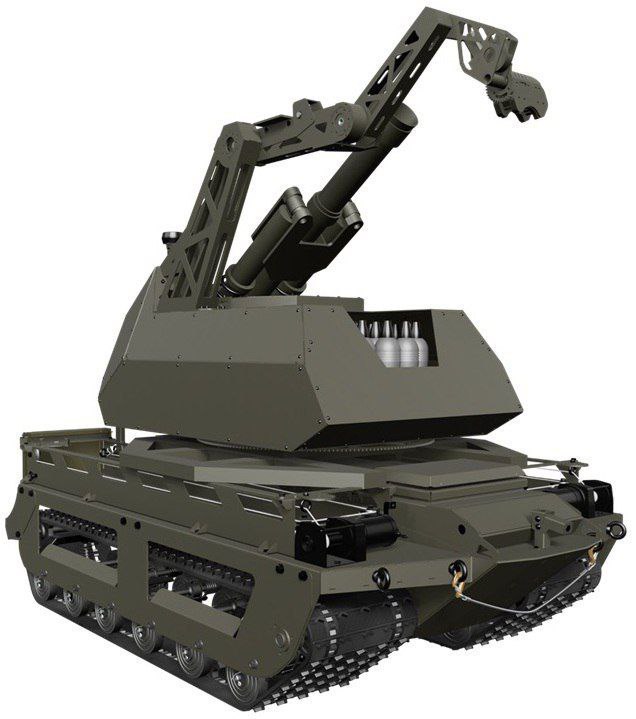
This time, NRTK Kaps LLC has mounted a remotely controlled mortar on the Kurier, equipped with a manipulator that loads rounds through the barrel. It is claimed that the mortar can engage targets at a distance of around 4 km and uses a wide range of 82 mm mortar rounds.
Sarma MLRS at the Saudi Arabia exhibition
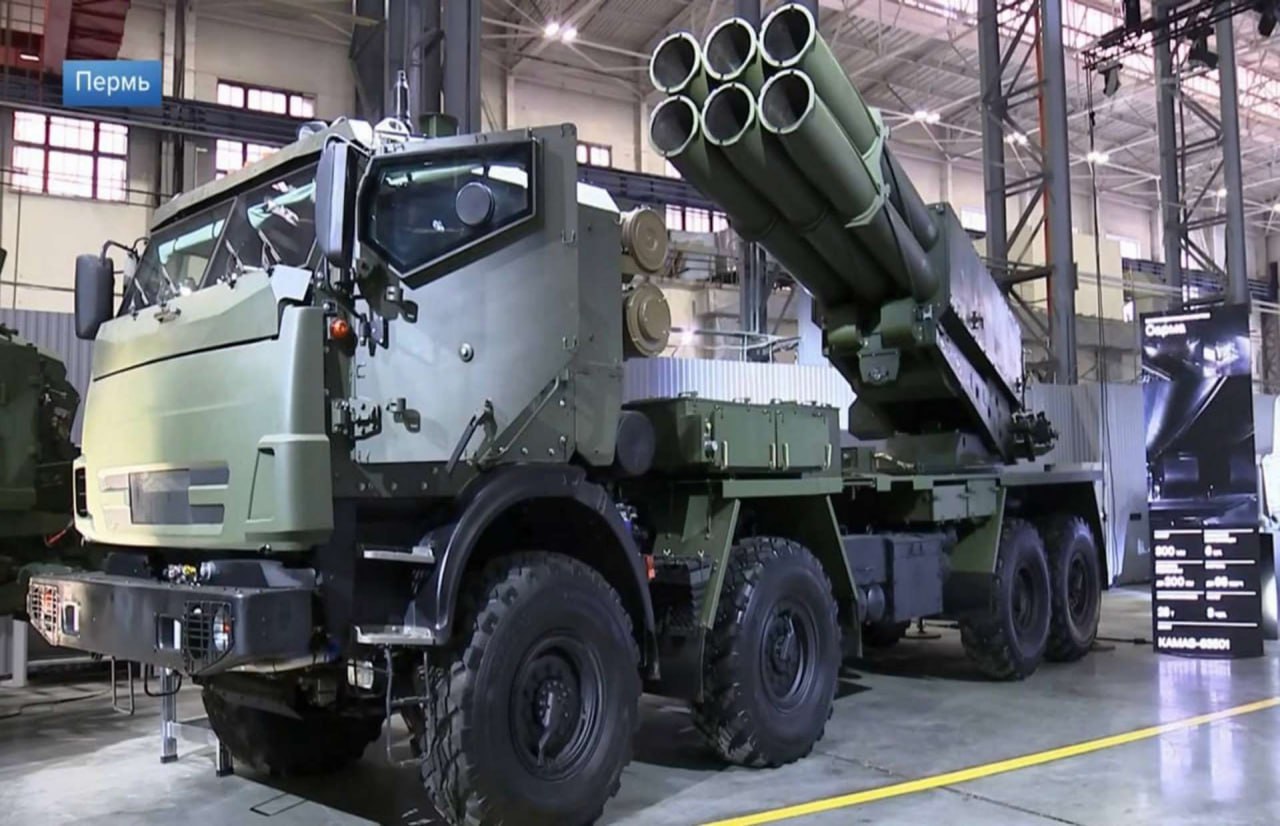
Ahead of the World Defense Show 2026 in Saudi Arabia, Russia’s state arms exporter Rosoboronexport presented a new 300 mm multiple launch rocket system, Sarma. Images published on social media on 29 January 2026 show the system mounted on a KamAZ-63501 chassis with an armoured cab, as part of a campaign to promote the new MLRS on the Middle Eastern market.
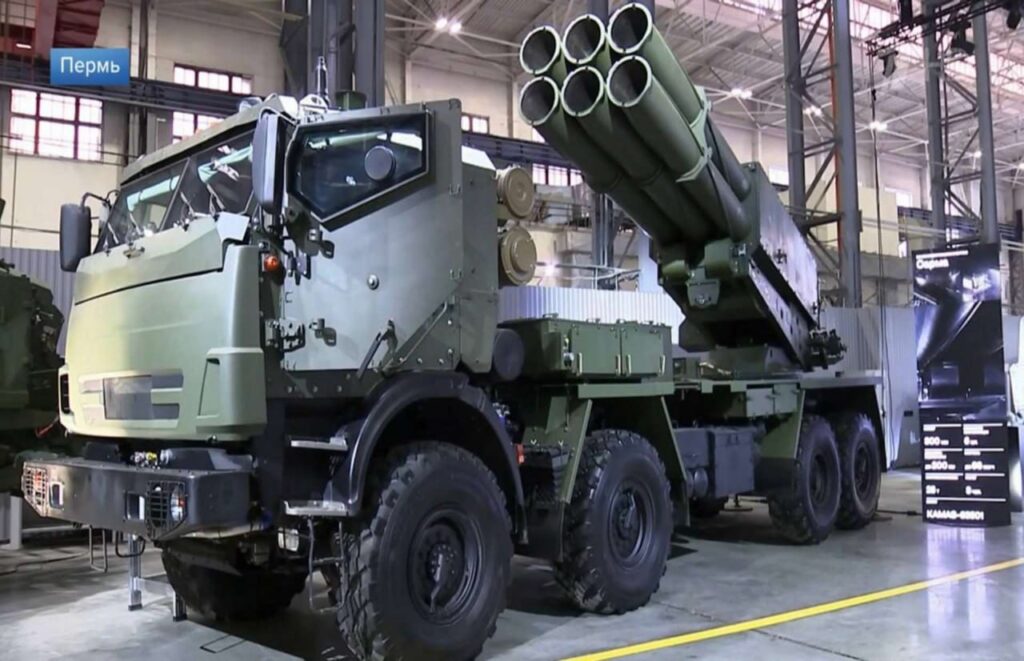
Sarma is equipped with a six-tube launcher for 300 mm rockets and integrated with an automated digital fire control system. Thanks to its lower weight and reduced number of launch tubes compared to heavy systems such as Tornado-S, the platform is designed for high mobility and rapid deployment, enabling “shoot-and-scoot” tactics.
The system is compatible with the full range of 300 mm rockets from the Smerch and Tornado-S families, including unguided rockets with a range of up to 90 km and guided munitions with a range of up to 120 km.
Zubr robotic air defence system
Russian military units have received automated robotic air defence systems known as Zubr, designed to detect, track and engage manoeuvrable and small-sized UAVs. It is claimed that the systems have already been deployed on combat duty to protect critical rear-area facilities.
According to the developers, the complex can independently detect a drone and take it under automatic tracking. The operator’s role is limited to making the decision and issuing the command to engage. The system uses machine vision algorithms and trajectory prediction to respond to threats in real time.
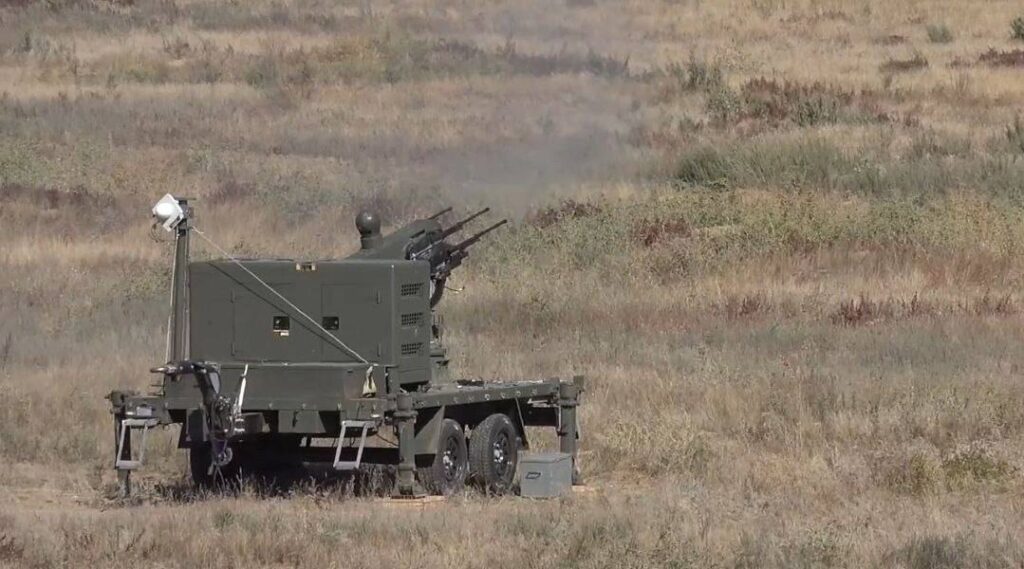
In its basic configuration, Zubr includes four combat modules armed with small arms, a command post, and its own radar with an active phased array antenna. The radar provides target detection at ranges of up to 10–15 km, depending on terrain and interference levels, with angular positioning accuracy of up to 0.5–1 degree, enabling operation against low-altitude and low-observable UAVs.
It was previously reported that the combat modules can be equipped with GShG-7.62 or PKT machine guns adapted for anti-aircraft use. The system has a modular architecture and can be integrated with other air defence systems.
Handheld net launcher Pauk-30B
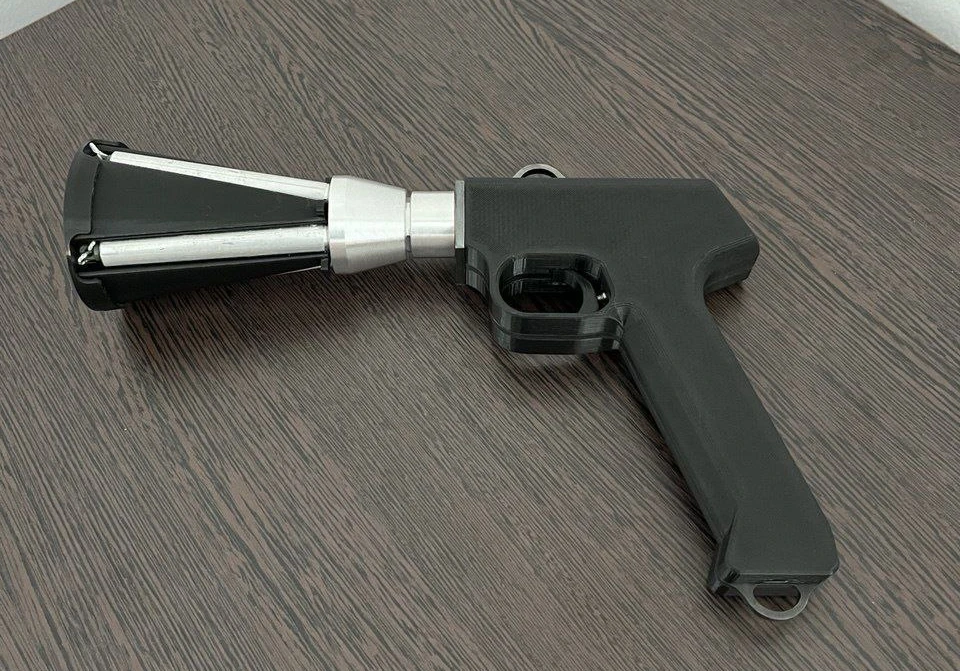
Russia is starting trials of a new portable counter-FPV system — the Pauk-30B net launcher. The development has reportedly already been sent to the combat zone.
Pauk fires a nylon net at a claimed distance of up to 30 metres. The key feature is said to be its high reload speed — up to 10 seconds. The net projectile is designed as a disposable magazine.
Armoured personnel carrier BTR-22
The BTR-22 armoured personnel carrier by Rostec is being taken to the World Defense Show 2026 in Saudi Arabia.
The vehicle’s design has undergone significant modernisation compared to previous models. The engine and transmission compartment has been moved to the front of the hull, while the troop compartment is located in the rear, with two doors for dismounting.
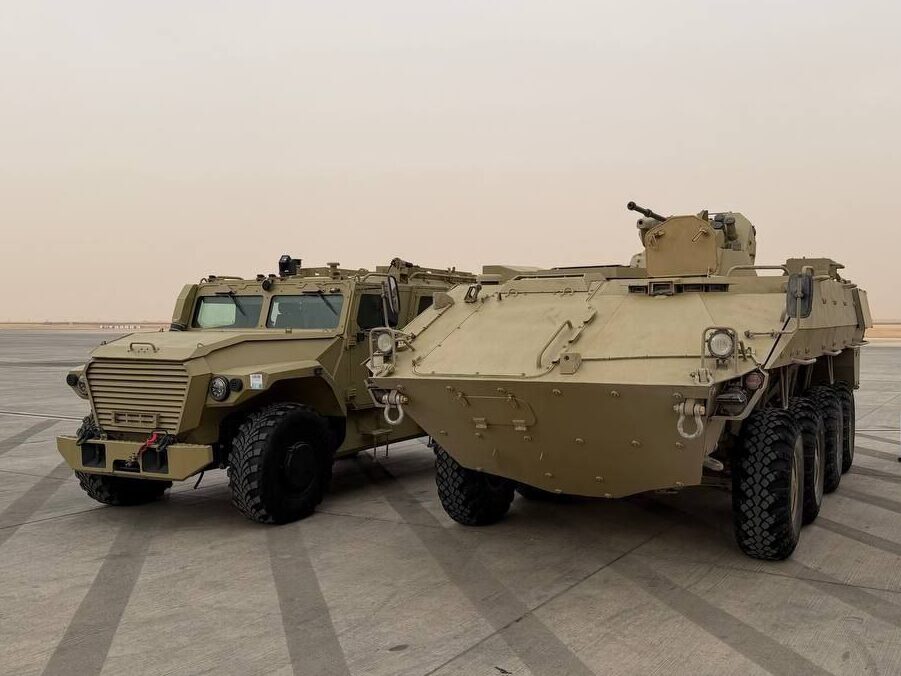
The BTR-22 is armed with a 30 mm 2A72 automatic cannon capable of firing ZBM8 Kerner armour-piercing sub-calibre rounds with penetration of up to 55 mm of steel at a distance of 500 metres, as well as a coaxial 7.62 mm machine gun. Crew and troop protection has been enhanced through the use of modern steel grades and spaced armour, providing resistance to heavy-calibre weapons, including 12.7 mm B-32 armour-piercing incendiary rounds.
The vehicle’s maximum road speed is up to 100 km/h. The platform allows for the installation of add-on armour, anti-drone “canopies” and anti-aircraft machine gun modules.
Ronin-3 AI turret control module
Russia has tested a new control and targeting unit for turrets equipped with artificial intelligence, capable of autonomously engaging aerial targets. This was reported by the Tallamkho design bureau.
The system can operate in manual, semi-autonomous and autonomous modes. In semi-autonomous mode, the AI detects the target, while the operator decides whether to open fire. In autonomous mode, the turret operates fully independently without human involvement.
Developers state that the system allows fixed positions to be defended without personnel present, reducing the risk of casualties from artillery fire. The AI model can also recognise aircraft-type drones and operate at night under certain configurations.
A turret equipped with the Ronin-3 unit can be mounted both on pickup trucks and on ground robotic platforms, including tracked and wheeled vehicles.
Yastreb 1.0 electronic warfare system
Russia is beginning trials of the Yastreb 1.0 electronic warfare system designed to counter UAVs. Developers report that they have “abandoned the classical architecture based on multiple jamming generators”. Instead, the system is “built on an intelligent principle” and is claimed to be able to simultaneously suppress UAV control and navigation channels while automatically identifying their operating frequencies.
It is stated that the system provides accelerated scanning of the 100 MHz to 6 GHz radio spectrum compared to existing solutions. This allows it to respond quickly to changes in signal parameters, including when drones use pseudo-random frequency hopping. The system can operate in a traditional jamming mode, as well as selectively suppress only active frequencies, while the rest of the spectrum continues to be monitored for new signals.
Reading now
1
SkyFall officially unveils Thor Hammer mid-strike and announces 1,000+ km version
2
Pentagon to hold Drone Dominance trials for bomber drones, with UFORCE, Gurzuf Defence, Grim Tech and others taking part
3

Terra Drone acquires 50% of Ukrainian Kurin Technologies for $3.5 million
4
British-Ukrainian Occam Industries raises €3.8m. The funds will go towards scaling drone autonomy software
5

Frontline Robotics CBDO Mykyta Rozhkov: Ukraine and Norway are working on an autonomous system to protect maritime infrastructure
By submitting this form, you give Defender Media consent to the processing of personal data.
Надсилаючи цю форму, ви надаєте Defender Media згоду на обробку персональних даних.

Latest news
1

Nataliia Mykolska to become VP of Growth and Affairs at Sine Engineering
2
Black Mirror #79: What’s inside Geran-4, unmanned tanks, balloon barrages and more of a new russian miltech
3

6,000 lives saved by replacing people with robots. “Makar” on the ground strike drone unit NC13 and its role in Operation Vivaldi
4
M-Fly and Dwarf Engineering announce partnership: what it involves
5