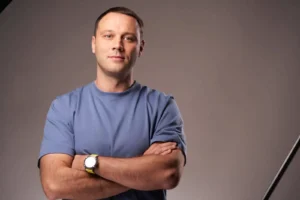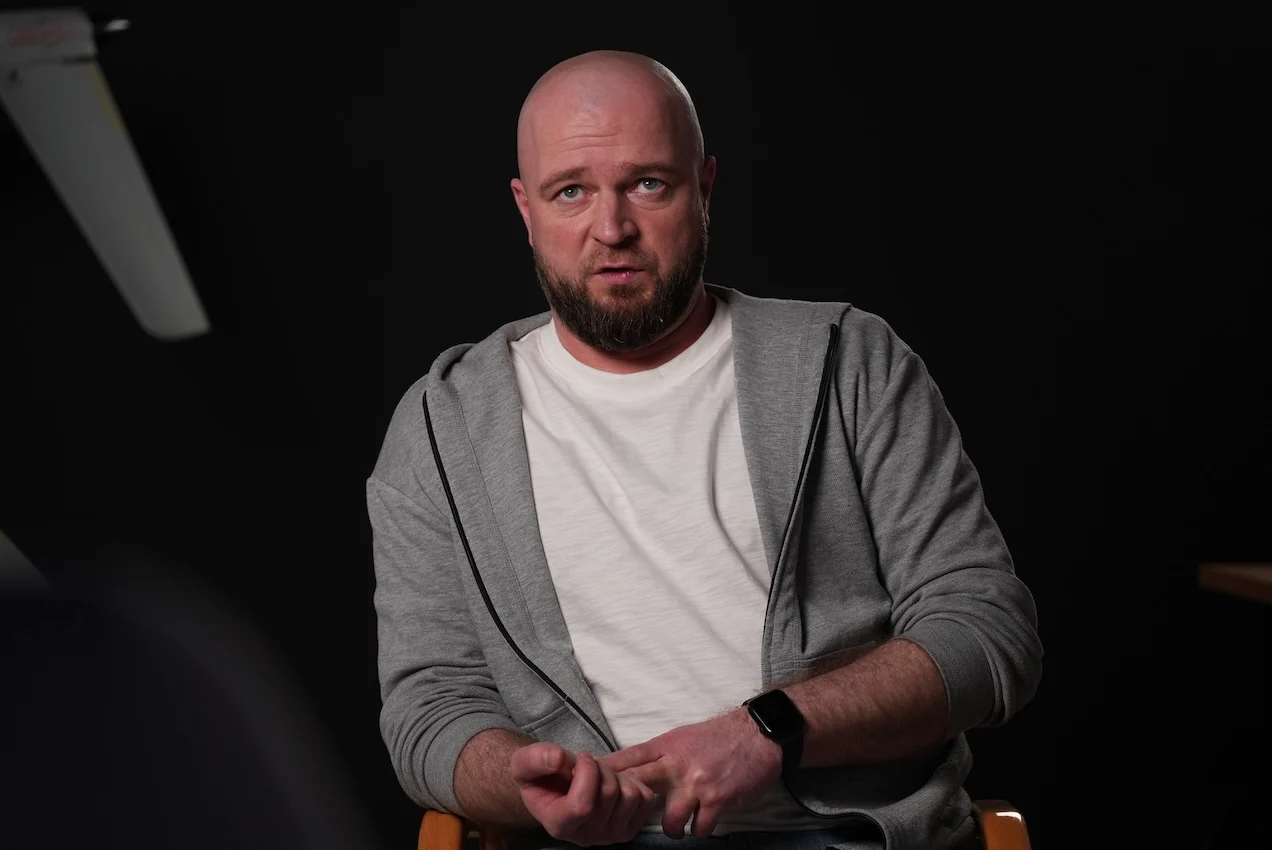
A full-cycle unmanned business: Drone Fight Club founder Vladyslav Plaksin on manufacturing, pilot training, and investment
On the potential deal with Ondas, transforming frontline combat experience into a curriculum, and why investing in simulators is more cost-effective than field-based training

Ukrainian entrepreneur Vladyslav Plaksin has built a group of companies comprising several startups focused on unmanned technologies. In December 2025, the American fund Ondas Capital announced plans to invest up to $11 million in his projects. Plaksin and his team at Drone Fight Group have constructed a “full-cycle” model: from designing combat bombers to creating virtual training ranges. However, the primary deficit in this system remains the lack of qualified pilots rather than “hardware.”
In a conversation with Defender Media, Plaksin discusses the potential deal with Ondas and his proprietary drones. He also analyses how to transform frontline combat experience into a curriculum, why investing in simulators is more cost-effective than “disposable” field training, and why UAV operator training is becoming a basic survival skill for an entire generation.
Defender Media: At what stage is your deal with Ondas Capital, which announced plans to invest up to $11 million in your group of companies?
Vladyslav Plaksin: Overall, I can only say what is in the press release: we are collaborating and exploring investment opportunities for various projects we will develop together, as well as for our own ongoing projects. The main goal of all this is to expand our expertise. We aren’t looking for just money, but “smart money”—access to technologies available in America and beyond our borders, as well as to the opportunities there. One of the key issues everyone is currently working on is the localisation of production to eliminate dependence on Chinese components.
Drone Fight Club was registered after the invasion. Did you immediately see the potential in pilot training and simulators, or has your vision evolved over the years?
Our group of companies covers the full cycle: from training to creation and simulation. We have Drone Fight Club (training and R&D on the front line—we observe new problems and adapt), Bat Drones (drone development specifically), and Simtech Solutions (simulator development).
In the spring of 2022, we started as volunteers, and no one took us seriously. By September, drawing on my marketing background, I conducted some analytics: we had trained 100 pilots and decided to look at the results. We called everyone. It turned out that 95% of them were actively “using a shovel” instead of flying. We had invested about 500,000 UAH to effectively train only 5 pilots. The rest of the money went nowhere. That’s when we realised something had to change, and we began looking toward development and integration with the General Staff.
In November 2022, we met a top-tier military specialist, a colonel in the AFU Ground Forces at the time. Once he saw the potential of drones, he organised the first strike unmanned systems company—the first “RUBpAK” (Strike Unmanned Aerial Systems Unit) — within a month. We began training in December 2022. It was difficult: 80% of the students were over 45, with vastly different educational backgrounds. Out of a group of 20, we effectively trained 7–10 people. Then, in 2023, came the first 40 “RUBpAKs.”
By the end of 2023, we realised that changing things through the Ministry of Defence would be extremely difficult. We couldn’t adapt all the programmes for the military on our own, so we decided to create a tool to standardise training.
We saw horrific things at the training ranges: someone hadn’t checked the propellers, someone hadn’t tightened an antenna—and suddenly a drone is flying back at you. Instructors were often just volunteers without real competence. All our instructors have proper certification. We come from aviation, where all the rules are “written in blood.” Protocols like “check the battery” and “check the propeller” are mandatory to ensure nothing goes wrong mid-air. We wanted to scale this approach across the entire army. Unfortunately, to this day, there are no unified standards and protocols that all pilots must follow. This is one of the main causes of frontline losses and friendly fire incidents. I’ve seen dozens of videos where guys carry a drone to a position, make standard mistakes, and after take-off, the drone flies back to them with an explosive—resulting in casualties.
Tell us about the drones you manufacture. Is the training built around them?
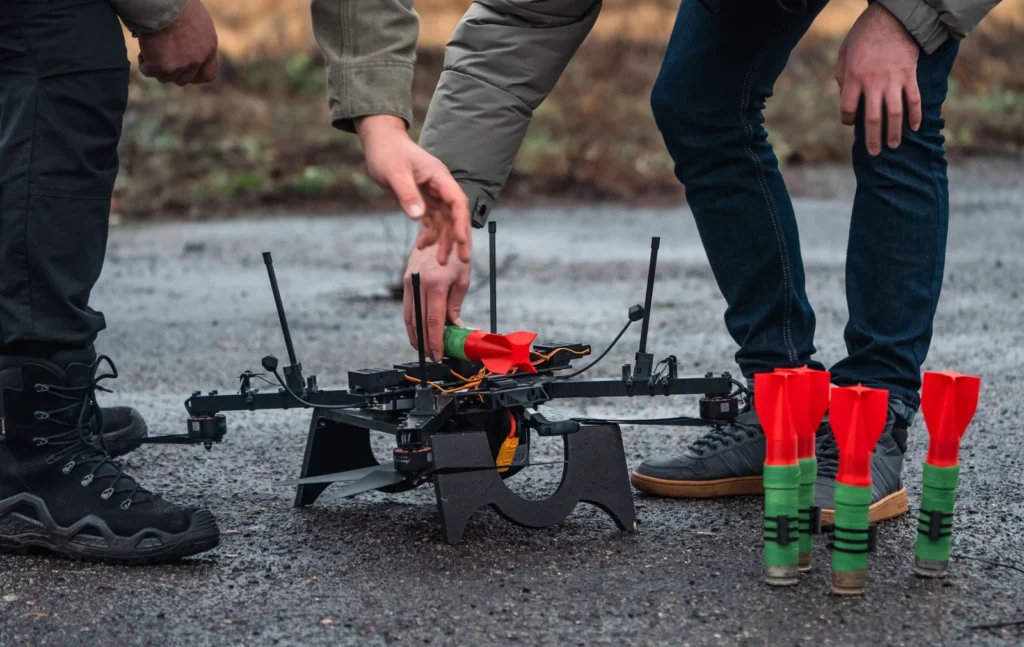
Our first mass-produced drone was the Lucky Strike, which was my design. Currently, Bat Drones focuses on solving pressing frontline issues. The 2023 version of the Lucky Strike no longer meets all requirements—distances and electronic warfare (EW) conditions have changed. We have released the Lucky Strike 2 (a powerful scout with bomber capabilities) and the Angel Arrow line (13, 15, and 22 inches). These are affordable bombers costing between $1,000 and $3,000, capable of carrying up to 5kg (with the Angel Arrow 22 carrying even more) over distances of 10–15km. There are day and night models. They are smaller than “Vampires” or “Bats,” making them harder to shoot down. The average lifespan of such a drone is 60 sorties. Strike efficiency is 5–10%. The maths shows that hitting a single target costs about $500—which is more cost-effective than kamikaze drones if the pilot is a professional.
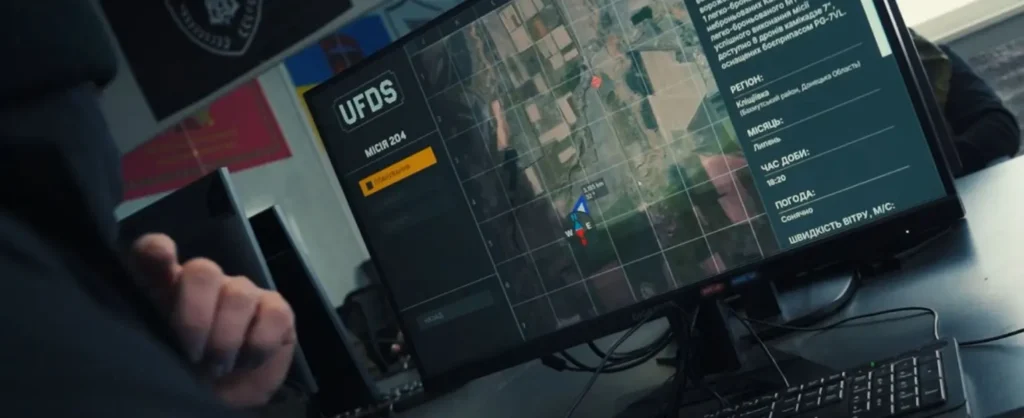
Was this the goal—standardising knowledge—behind the creation of the Ukrainian Fight Drone Simulator (UFDS)?
Yes, UFDS is essentially a visual reference guide. Then a collaboration emerged between Drone Fight Club and the simulator: our graduate pilots share their real-world mission experiences, and we incorporate these scenarios into the software. Currently, UFDS is split into two versions: military and civilian. The military version is a “distillation” of expertise from many pilots. If you complete all the missions, you gain immense tactical experience. Gamers find the military version boring; there might be a mission where you fly for 30 minutes following landmarks to a target, and the goal isn’t just to “hit the tank” but to navigate the route correctly, account for the terrain, and plan the flight.
The civilian version is simpler, featuring game modes. Its purpose is to provide a baseline level of skills for Ukraine’s youth—so that schools don’t waste time explaining what sticks, controllers, or propellers are. It’s the “Gran Turismo” principle: learn in a virtual game, and you’ll drive better in a real race. Currently, the civilian version has been downloaded by over 10,000 people.
Does 10,000 meet your expectations?
The developers are satisfied, but I am not. I want more Ukrainians to have this foundation. I believe that in the next 20–30 years, piloting skills will be mandatory for every young man. So that he can join the army and say: “Why should I go into a trench if I have 500 or 1,000 hours in a simulator? I know exactly where to hit the equipment.” We are providing a foundation that the country can use to train hundreds of thousands of specialists.
Is access to the programme restricted for Russians? And why do only a third of your students complete the course?
Regarding security: even our state structures aren’t secure enough to prevent Russians from copying something. We use French cryptography systems for each individual copy of the military version. The civilian version is available on Steam, but it is blocked in Russia and Belarus. Although there’s nothing there they wouldn’t already know—it’s just “hype” for the youth.
Regarding the dropout rate: I spent six months studying just the theory to become an aircraft pilot. Training someone in 2–3 weeks is a challenge. Our training runs from 8 am to 8 pm. It’s an enormous mental load. By the end of the first week, we can see during exams who isn’t making the cut. We used to try keeping them for a second or third week, but those people hold back the entire group. If you separate them, the strong pilots “run” three times faster. Now is not the time to be overly tolerant—our knowledge either saves lives or leads to fatal errors. We invest in the best so they can go on to spread this knowledge. Some people simply need 6 weeks instead of 3, and that’s fine.
What is the cost of training one person?
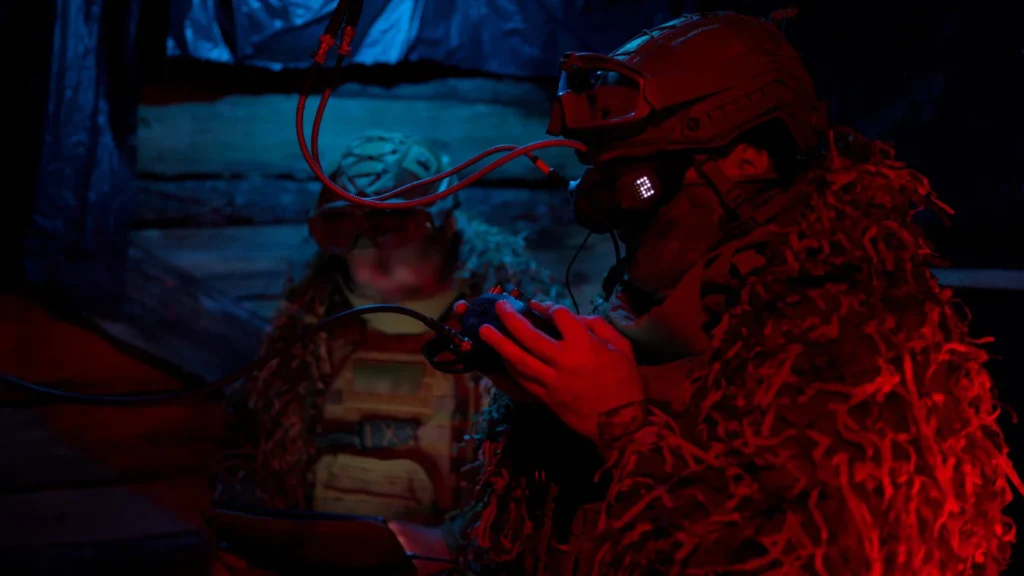
About 15,000 UAH for three weeks—that’s “all-inclusive.” We are currently taking groups of 12 people. We don’t train from scratch; we take those who already have a foundation, so we lose fewer drones. Most importantly, we weed out those who create problems during the exam stage. We put students through stress tests: for example, we cut the video signal, and the pilot must land a drone carrying an explosive visually. If a person panics, they aren’t ready.
Do you provide a certificate of completion? How important is it for the military’s reputation?
The brigades and commanders we work with value our certificates highly. If a person fails the exam, they only receive a certificate of attendance. That’s fair. We also maintain a statistics log for every pilot: if a commander wants to know how someone studied or if they “killed” a bunch of drones, we provide all the information.
At what point in the training do you give a student a real drone?
The first week is simulators and small Chinese drones. They are very flexible, though they need repairing after every two pairs of “student hands.” We work in pairs: one flies, the other reloads. This provides massive experience. In the second week, we have competitive speed games to get the adrenaline pumping. The third week is strictly combat missions. We no longer prompt them on which way to move the stick. The person has to be a professional. We have an exam: a pilot flies a mission, and afterward, we ask not about the flight, but about the environment—for instance, what number was written on the targets. This is a test of the ability to analyse the situation while piloting.
With the current pace of development, where do you see yourself and the company in three years? What are your goals?
Firstly—to survive. Secondly—the global integration of our training centres worldwide. Thirdly—autonomy. We are developing systems that will handle 70–80% of the tasks instead of the pilot. This isn’t a “rise of the machines,” but the creation of a psychological shield. If there are 500,000 semi-autonomous drones at the border, the enemy will understand there is a 95% probability of death if they attempt to attack. This is a security weapon. We want to be like Switzerland—a country that is dangerous to attack.
To use Serhiy Sternenko’s words, “a drone in the face for every Russian”?
Something like that. Actually, you mentioned Sternenko, and we have a specific history of cooperation. If you remember, in 2024, Serhiy reported that as part of his massive fundraisers for strike assets, several targets in Crimea were successfully hit. It was a major news story. Well, I can now say openly: those strikes were carried out using the drones we created, by the hands of the guys we trained. For our team, this is the best confirmation that this entire system—from the simulator to mass production—delivers real results.
You recently returned from the US. Did you adopt any American expertise? Or perhaps it was the other way around—were they impressed by your achievements and looking to learn from us?
We have connections with many people in this field. I am close friends with the company Skydio and with Shield AI (which currently has a capitalisation of over $100 million and launched in 2023). We actively support them and collaborate on both simulators and engineering. We are also friends with Eric Schmidt’s team. In 2023, we demonstrated to him in Ukraine how the drones work. We work within this entire ecosystem, exchanging information and sometimes taking a peek at what they are doing. But what’s cool from the Ukrainian side: the same thing they do for $10,000, we do for $1,000. Sometimes they don’t even understand how it’s possible.
Secondly—and most importantly—is the application expertise. They create products for a specific request, but since modern warfare is very dynamic, the combat environment is constantly shifting: usage tactics, enemy behaviour. Some developments they make (for instance, reconnaissance drones) might be great for the police, but for the army, they are ineffective in most situations. It’s a question of who uses it and how. If it’s the SBU for special operations—yes, it might work, but not as a mass-produced combat asset.
Americans sometimes position a small drone as a means to destroy armour, but they don’t understand where to find that armour at a distance of 5km in real frontline conditions. For example, many companies outside Ukraine continue to produce 7-inch drones. Now they are sitting in warehouses in massive quantities, almost unused because the range is too small. That’s why these trips are useful. And one should travel not only to America but also to China while the opportunity exists. I’ve been there too, seeing what they do. They are completely different worlds.
Are you saying the Chinese understand the Russo-Ukrainian war and the technologies involved better than the Americans?
You see, in America, I am close to the military, so I understand their perspective. In China, I wasn’t close to the military—perhaps they were close to me, but I wasn’t close to them (laughs). In terms of technology and capacity, China is several orders of magnitude ahead of everyone in understanding how to make, for example, a million drones a month.
If we ask whether it’s possible to make a million drones a month in Ukraine—well, perhaps if everyone pushes themselves to the limit, something like that might happen. But for that, you need “a million Chinese people,” because they understand which tools and machines to work with. I was at a factory that produces over 100,000 motors a day. The huge difference is that our ratio of people to one produced motor would be much higher. Everything there is optimised, they have all the resources, and the prices are significantly better than ours or America’s.
Reading now
1
Ukrainian Skyeton secures $10.6M US army contract
2
The Pentagon has announced the results of Drone Dominance Gauntlet II – announced Ukrainian companies did not make the top 5
3
Korven Systems project: How Teletactica co-founder is building an autopilot for interceptor drones
4
Ukrainian SkyFall again among winners of US Drone Dominance Program
5
Frontline Robotics CBDO Mykyta Rozhkov: Ukraine and Norway are working on an autonomous system to protect maritime infrastructure
By submitting this form, you give Defender Media consent to the processing of personal data.
Надсилаючи цю форму, ви надаєте Defender Media згоду на обробку персональних даних.

Latest insights
1
Everything about the RAM-2X mid-strike drone: interview with Ukrspecsystems deputy director Andrii Rymaruk
2

A demo is not demand: How to prove the value of a defence tech product. Column by Tekever Ukraine Director Kateryna Bezsudna
3
How to choose the right video link for an FPV drone: analogue, digital, or fibre-optic?
4
How a frontline signal becomes an engineering task. A column by Defence Builder Accelerator Director Yana Shkvarovska
5