Kyiv International Cyber Resilience Forum 2026: key takeaways
The most notable panel discussions, international partnerships, as well as cybersecurity competitions and the Bug Bash in DOT-Chain Defence
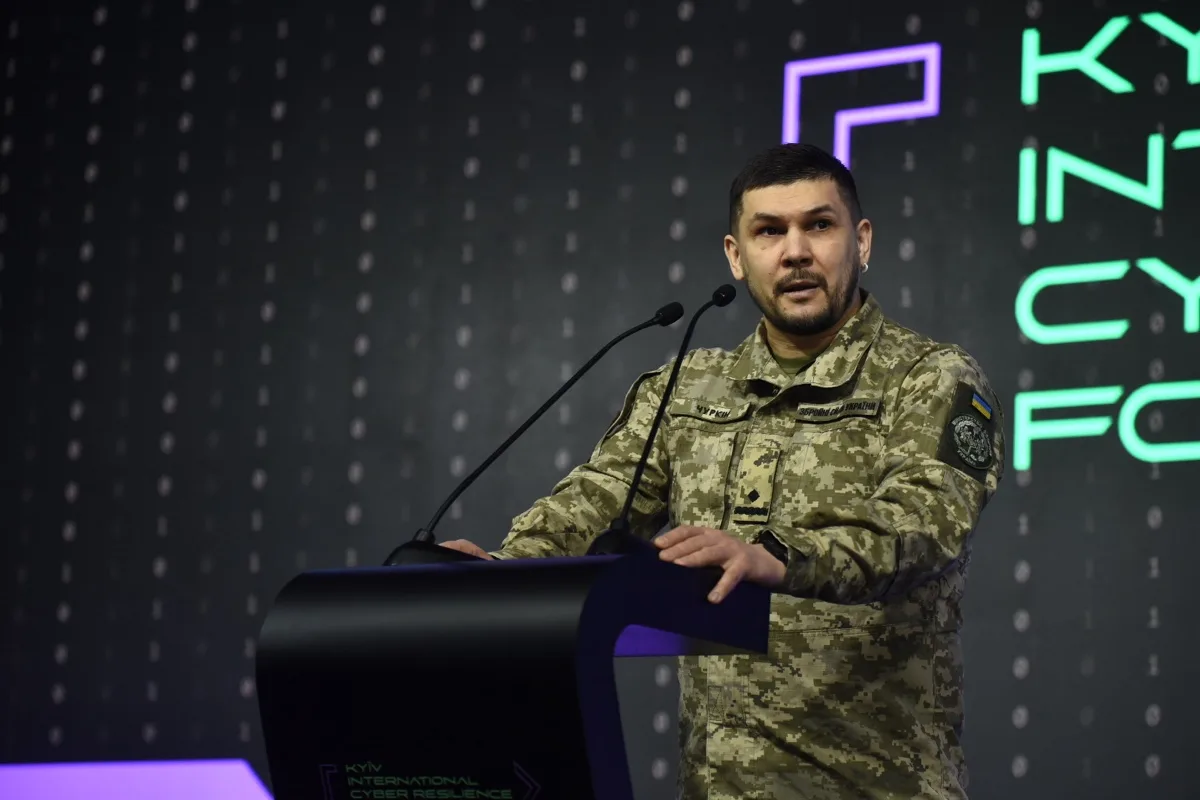
Valerii Churkin, authorised adviser to the Secretary of the National Security and Defence Council on digitalisation, AI and cybersecurity, opens KICRF 2026. Photo provided by the KICRF organisers
On February 19-20, 2026, Kyiv hosted the Kyiv International Cyber Resilience Forum (KICRF 2026) – a key international event in cybersecurity that brought together representatives of governments, business, tech industry, and academia to seek solutions for global digital and hybrid threats.
KICRF 2026 welcomed around 2000 participants from 37 countries for a two-day program featuring 50 keynote speeches and panel discussions. Defender Media was the event’s media partner and reported on its key takeaways.
The two-day KICRF programme featured strategic sessions, discussions and hands-on formats. Among the panel discussions at KICRF 2026, several were closely tied to defence tech, including:
- Cyber-Physical Frontline: Defending Critical Infrastructure in Hybrid Warfare;
- Dual-Use Evolution: Secure-By-Design Technologies And Trusted Supply Chains;
- AI-Native Warfare: Securing Autonomous Systems and Precision Weapons.
163 speakers took the stage at KICRF, including Oleksandr Potii, Head of the State Service of Special Communications and Information Protection of Ukraine; Volodymyr Karastelov, Head of the Cyber Department of the Security Service of Ukraine; Moxie Marlinspike, Founder of Signal; Valerii Churkin, Authorized Advisor to the Secretary of the National Security and Defense Council of Ukraine on digitalization, AI, and cybersecurity; Serhii Beskrestnov, Adviser to the Minister of Defence; Yurii “Phoenix” of Lasar’s Group; Taras Rokoshevskyi, co-founder of Roboneers; as well as the ambassadors of United States, Canada, United Kingdom, Estonia, Netherlands and Poland.
Ecosystem of Solutions and International Cooperation
Kyiv International Cyber Resilience Forum moved beyond discussion: several international agreements and initiatives aimed at strengthening regional and global cyber resilience were initiated and signed.
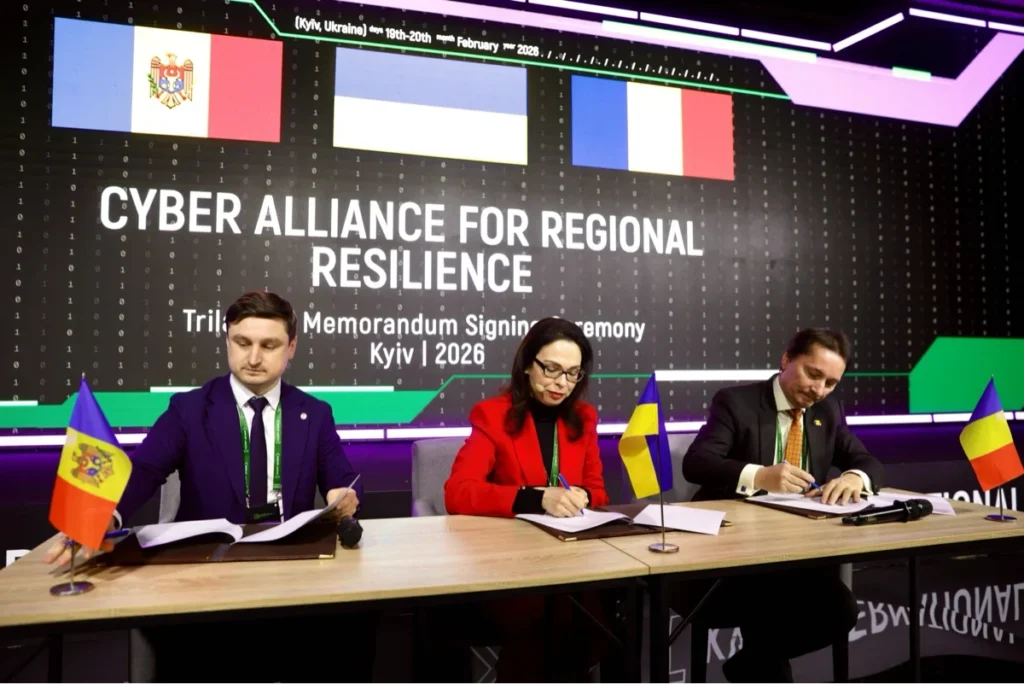
In particular, the trilateral Memorandum of Understanding was signed by the National Cyber Security Coordination Centre under the National Security and Defence Council of Ukraine (NCSCC), the Romanian National Directorate for Cyber Security (DNSC), and the Cyber Security Agency of the Republic of Moldova (ASC).
The document launches the Cyber Alliance for Regional Resilience initiative – a structured regional cooperation mechanism in cybersecurity. Its purpose is to strengthen states’ capabilities for coordinated responses to cyber and cyber-enabled hybrid threats, coordination during cross-border incidents, exchange of analytics and practices, and integration of modern technological solutions into protection systems. The Memorandum establishes strategic coordination between the three countries and provides for the use of Ukraine’s practical experience gained during the full-scale armed aggression of the Russian Federation as an element of strengthening collective regional resilience.
During KICRF, the launch of a Netherlands–Ukraine B2B platform was announced, backed by a €2.5 million fund. The initiative was launched by the Ministry of Foreign Affairs of the Netherlands and the National Coordination Center for Cybersecurity of Ukraine. The goal of the Netherlands–Ukraine Cybersecurity Fund is to develop joint innovative cybersecurity products and solutions for the global market.
Cybersecurity competitions and DOT-Chain Defence’s Bug Bash
A new format for Ukraine was the Collegiate Cyber Defense Competition (CCDC), where cybersecurity expert teams competed in defending real infrastructure under conditions closely simulating real cyber operations.
The competition involved 30 teams and a total of 142 specialists from the private, financial, and public sectors, critical infrastructure operators, and university students. Alongside the human teams, a team of AI agents also competed – marking the first time in Ukraine humans and artificial intelligence faced off in the same arena.
Following the results of the first day, AI agents surged to the top of the leaderboard. However, by the end of the final round, the first and third prize places were claimed by human teams – dotXYZ (a team of the State Border Guard Service of Ukraine) and 38007 (a team of the Cyberpolice Department of the National Police of Ukraine), respectively. The AI-agent team ARIMLABS secured second place, trailing dotXYZ by 865 points.
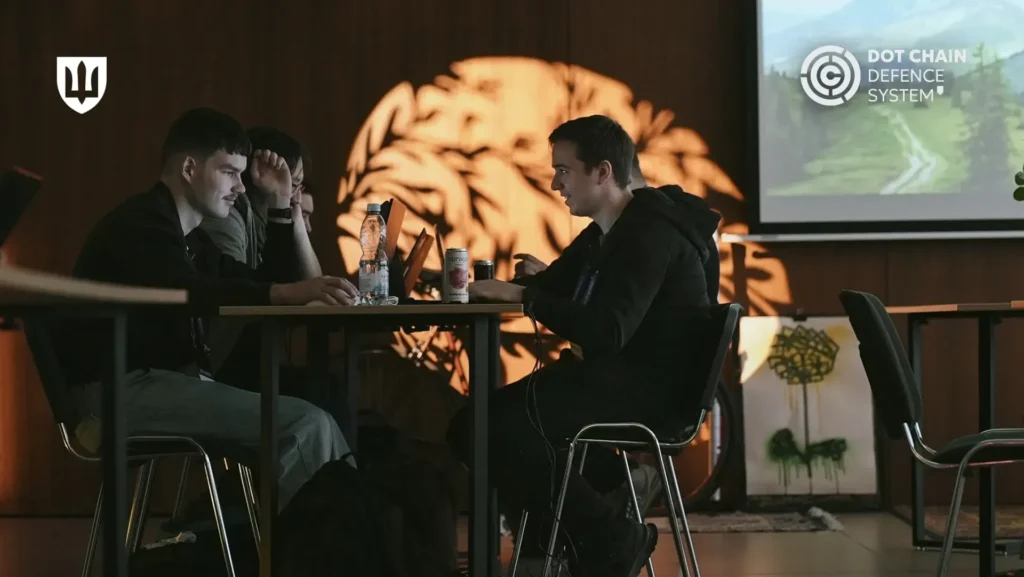
Bug Bash is a two-day vulnerability discovery marathon during which more than 20 ethical hackers searched for security flaws in the web resources of the Defense Procurement Agency (DOT) and Prozorro, as well as the authorized e-procurement platforms E-Tender, SmartTender, and Zakupivli.PRO. The BugStream team received and validated the identified vulnerabilities.
Competing alongside the bug hunters was AI BugHunter, an autonomous AI model designed to automatically detect vulnerabilities.
The testing was conducted in an isolated environment with no access to real data. For each identified bug or vulnerability, participants received points and competed for the title of the most effective security researcher. No critical vulnerabilities were found in DOT-Chain Defence, and the identified issues were passed on to the DOT development team for prompt remediation.
About the Organizers
KICRF was founded in 2023 by the National Cybersecurity Coordination Center under the NSDC of Ukraine, together with CRDF Global, with the support of the U.S. Department of State. Key institutions of Ukraine’s security and digital transformation sectors have been involved in organising the Forum, ensuring its cross-sectoral and international character from its early years.
Among KICRF partners are leading global and Ukrainian companies, international technology corporations, and public sector representatives, including Mastercard, Kyivstar, Bakotech, Fortinet, WithSecure, Tet, MHP, Sheriff, the Ministry of Defense of the Republic of Latvia, CoreWin, PrivatBank, CyberLab, CrowdStrike, Cloudflare, Commvault, iIT Distribution, Amonsul, ESET, Ambassadors, SANS, Hideez, MOWA, IT Specialist, TrendAi, BAE SYSTEMS, Prodefence, and Protagonist.
The event’s Global Resilience Partner – the Tallinn Mechanism – shares practical cases and experience gained during the war.
The technological partners of the events are Cyber Unit Technologies and the Institute for Cyber Warfare Research.
Reading now
1
Ukrainian SkyFall’s drone wins at Pentagon’s Drone Dominance selection
2
Black Forest Systems raises $400,000. Here’s what drones the startup is building
3
Sting interceptor by Wild Hornets downs costly Russian Granat-4 reconnaissance drone
4
UForce unveils Bucha middle-strike drone with a 200 km range
5
The F10 drone becomes the second Ukrainian finalist in the Pentagon’s Drone Dominance Program
By submitting this form, you give Defender Media consent to the processing of personal data.
Надсилаючи цю форму, ви надаєте Defender Media згоду на обробку персональних даних.

Latest news
1

DPA to diversify drone and ammunition orders among multiple suppliers
2
‘Ukrainska bavovna’ and Czech company Pavetra Aerospace to produce Shuhay UAV through joint venture
3
59th Assault Brigade downs Russian Ka-52 helicopter with General Cherry OPTIX FPV drone
4
Tencore develops evacuation module for TerMIT UGV
5