Beetroot Defence: First сlients, сourses and partnerships. A blitz Interview with Andreas Flodström and Oleh Krisenko
How the new unit will integrate Beetroot’s education, engineering, advisory and investment services in defence domain
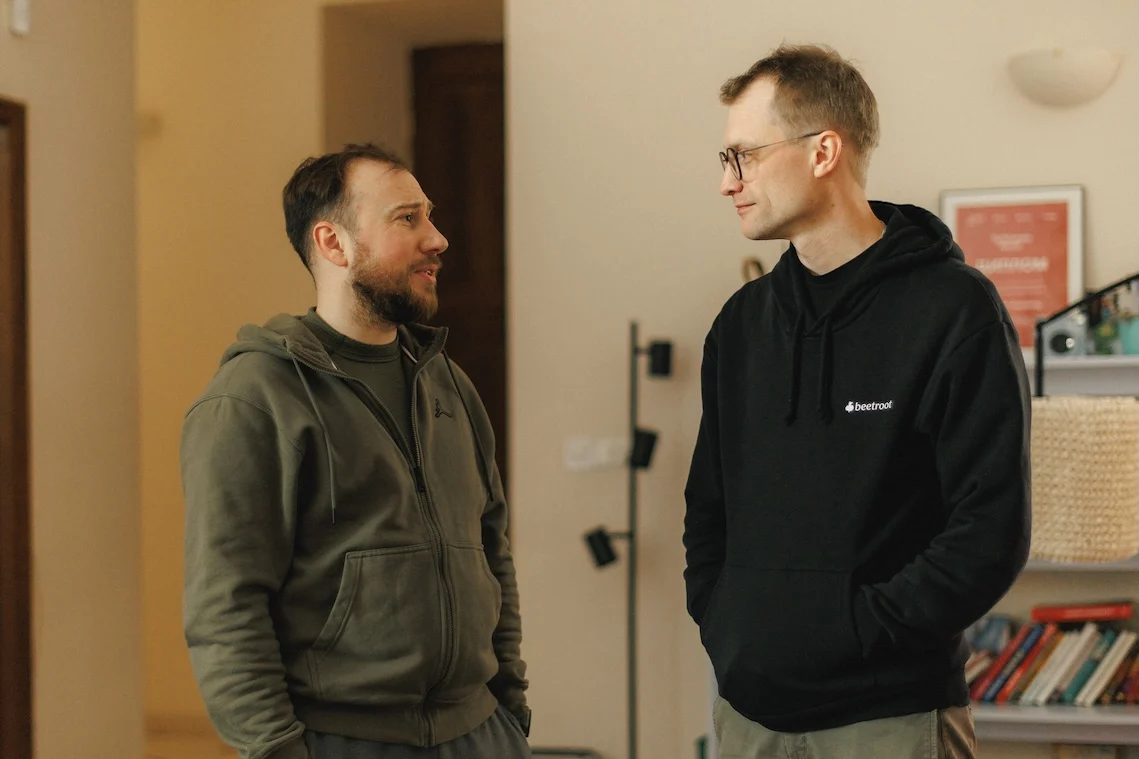
Oleh Krisenko and Andreas Flodström. Photo provided by Beetroot
Today, the Beetroot announced the launch of a defence vertical within its ecosystem. Beetroot Defence will combine several tracks: training defence tech specialists through Beetroot Academy, engineering and R&D services provided by Beetroot Tech, and an investment track by Varangians. The new division will be headed by Oleh Krisenko, a veteran with more than ten years of service in the Armed Forces of Ukraine.
Beetroot founder Andreas Flodström says the group’s core mission has remained unchanged for nearly 14 years — to create a positive impact in Ukraine. “Today, we see the greatest opportunity to make a truly meaningful impact in defence tech,” the entrepreneur says. “Our key focus is strengthening the long-term defence capabilities of Ukraine and Europe as a whole.”
Ahead of the launch of Beetroot Defence, Defender Media recorded a short interview with Flodström and Krisenko.
Is Beetroot Defence already working with any international defence companies?
Oleh: Yes, we are already working with such companies. Due to security and confidentiality considerations, we can disclose the name of only one — Stridar, a manufacturer of unmanned ground vehicles for defence and dual-use purposes.
As for the other projects, we can only share that they relate to aerial systems, hardware, and specialised software solutions.
Andreas: Yes, we work with Western companies of various sizes, with the majority currently being Nordic startups and primes.
In Ukraine, we collaborate with Brave1, IronTech, 15 brigades, several special units, Victory Drones and other entities. We also work with dozens of Ukrainian defence tech suppliers, including several of the top players, but we will not announce their names for now.
Ukrainian military knowledge and experience have strong export potential in the West — how do you think Ukraine and the veteran community could monetise this?
Oleh: Indeed, our experience and knowledge are in very high demand, and knowledge exchange is already happening. One way to monetise this expertise is through the creation of training centres. There are many of them in the United States and the United Kingdom — they come to Ukraine to recruit Ukrainian veterans to help design training programs and build structured learning systems.
I would like to see more such companies established in Ukraine, founded by Ukrainian veterans, focused specifically on operational and tactical training for infantry and other units.
It is also worth noting that many professionals engaged in DefenceTech, including within Beetroot Defence, are veterans. They apply their military experience in building tech solutions and training teams, both in Ukraine and abroad.
Andreas: When the full-scale war started, the collective West underestimated Ukraine and overestimated Russia. Now, in 2026, too many still underestimate Ukraine, but also underestimate Russia. Some believe that if Russia cannot defeat Ukraine, it poses no real threat to Europe. That is a dangerous illusion. European countries have no experience operating in the transparent kill zones of today’s frontline. Ukraine does.
This is not only about how much GDP Europe spends on defence. It is about how intelligently that money is used. Ukraine has learned how to do it efficiently, through platforms such as Brave1 and decentralised procurement. Europe urgently needs to adapt to this mindset. Large defence companies have their order books full now with big expensive equipment, while the battlefield is increasingly shaped by fast and cost-efficient production.
The most direct way to translate Ukrainian experience into long-term value is through structured cooperation between Ukraine and Europe. When we combine our strengths, the value creation is organic. For example, Ukraine is quick, agile, and innovative; its expertise is shaped by the battlefield context. At the same time, Sweden is super strong in deep tech. So if we stimulate cooperation in this space, we can make a real difference in the defence of Ukraine and the rest of Europe.
Beetroot Defence’s work includes consulting, engineering, testing, and auditing technology solutions — could you illustrate each of these areas with real or hypothetical examples?
Oleh: We primarily advise defence companies that want to enter, or are planning to enter, the Ukrainian market, but do not know where to start or who to approach. We explain the landscape and support our clients through this stage and the ones that follow. I must admit that we are very selective. We carefully assess the companies we work with, both in terms of values and product quality. Our first responsibility is to ensure that Ukraine receives solutions that are reliable, relevant, and truly useful – now and in the long run.
On the engineering side, we provided these services to Stridar. Other projects have involved improving and testing clients’ existing solutions, both hardware and software.
In another case, an investment firm approached us to conduct a product audit of a company they were considering investing in. They did not fully understand the technology and needed a professional assessment. We provided detailed feedback based on current operational experience.
What defence-related courses does Beetroot Academy currently offer, and what new ones are planned?
Andreas: Currently, more than 100 students are enrolled in the Embedded Development course — a comprehensive five-month program focused on microcontrollers, hardware integration, and real-world applied tasks. It provides a solid foundation for engineers who want to work with hardware and in the miltech domain.
Enrollment is now open for the first cohort of the Drones Firmware course, which focuses on programming and the operational logic of unmanned systems.

In the coming months, the Intro to Miltech course will be launched for non-technical professionals who want to work in the defence sector: HR specialists, project managers, marketers, and operations professionals. Demand for these roles is also growing, but effective work requires a deep understanding of the industry’s specifics.
Courses in Cybersecurity for Embedded and Computer Vision are also in development — both critical defence tech areas. All of these programs are planned to launch by the summer.
DefenceTech in Ukraine is evolving at unprecedented speed. If we want it to scale, training must scale with it. That is why this is a strategic direction for the development of engineering education. It will shape not only individual careers, but also the country’s long-term technological resilience. If we want it to scale sustainably, talent development must scale with it.
Does the Academy plan to collaborate with Ukrainian defence companies — for example, by training specialists for them or upskilling their teams?
Andreas: Ukraine’s defence ecosystem is showing impressive results, which almost nobody expected. But there are still some bottlenecks and we’re working to solve them. First of all, it’s the lack of funding. It’s gradually changing, which will eventually transform into a lack of the right competence. Until this point Ukraine has had skilled engineers with fairly relevant experience to quickly switch focus. But now, most of those are already involved in DefenceTech and considering investment volumes that are coming from inside and outside of Ukraine, my rough calculation indicates that we’ll need another 15 000 to 20 000 software engineers in DefTech in Ukraine in the coming 12 to 18 months.
Where are they going to come from? Well, Beetroot Academy is working in that direction. We’ve transformed our methodology we’ve used to train over 15 000 IT specialists to reskill talent from the existing tech industry. Our learning programs include military context, technical nuances, and the tech specifics like embedded systems, computer vision/ai, radio technology, and project management in defence tech.

We are already working with Ukrainian defence and dual-use companies, and the number of collaboration requests is growing. For security and confidentiality reasons, we do not disclose the names of the companies.
We operate in several formats: training and strengthening existing engineering teams, as well as providing companies with access to graduates of our programs. This allows businesses either to systematically develop their own specialists or to quickly fill engineering roles.
How will Beetroot Defence work with Varangians and its portfolio companies?
Andreas: Beetroot Defence is a dedicated direction at Beetroot Tech. Together with other parts of the Beetroot ecosystem – Varangians and Beetroot Academy – we cover three core needs of the Ukrainian and broader European DefenceTech sector. Varangians creates investment opportunities, Beetroot Tech enables R&D and field testing through Beetroot Defence, while Beetroot Academy ensures talent development. Each direction strengthens the others.
Reading now
1
Ukrainian SkyFall’s drone wins at Pentagon’s Drone Dominance selection
2

Black Forest Systems raises $400,000. Here’s what drones the startup is building
3

Sting interceptor by Wild Hornets downs costly Russian Granat-4 reconnaissance drone
4
UForce unveils Bucha middle-strike drone with a 200 km range
5
The F10 drone becomes the second Ukrainian finalist in the Pentagon’s Drone Dominance Program
By submitting this form, you give Defender Media consent to the processing of personal data.
Надсилаючи цю форму, ви надаєте Defender Media згоду на обробку персональних даних.

Latest news
1
DPA to diversify drone and ammunition orders among multiple suppliers
2
‘Ukrainska bavovna’ and Czech company Pavetra Aerospace to produce Shuhay UAV through joint venture
3
59th Assault Brigade downs Russian Ka-52 helicopter with General Cherry OPTIX FPV drone
4
Tencore develops evacuation module for TerMIT UGV
5