Mykhailo Fedorov on Mission control for drone crews, replacing the Mavic, an AI polygon for partners, and more
Selected quotes from Mykhailo Fedorov’s closed-door meeting with journalists

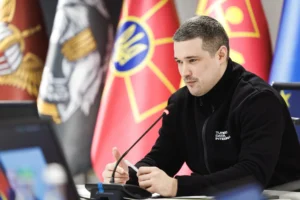
Ukrainian Minister of Defence Mykhailo Fedorov. Photo from Volodymyr Zelenskyy’s Telegram channel
A few days ago, Ukraine’s new Minister of Defence, Mykhailo Fedorov, held a meeting with journalists, during which he outlined his plans in the new role and his priorities for 2026. The discussion took place off the record. From the quotes cleared for publication by the press service, Defender Media selected those most likely to interest the defence tech market.
On the math of war
Thanks to ePoints, we fully understand what is happening with drones. Soon, we will launch a revolutionary project, Mission Control: each crew will enter into the system the UAV type, destination, launch location, and more. This allows us to better understand the situation along the line of battle and the effectiveness of drone use.
With Mission Control, we will close the entire drone cycle: procurement, delivery, and then battlefield employment. Through ePoints, we currently see only mission execution reports, while it is important for us to have the full picture, including results and accumulated experience. We worked on Mission Control functionality for two years. The next step is to launch Mission Control for artillery.
It is very important that we have begun to calculate everything systematically. Soon, we will have complete information on drone crews: commanders, their monthly ratings, and statistics for the entire corps. We need to see the full picture to simplify and speed up management decision-making.
On interceptor drones
As early as February last year, we began working on interceptor drones. We even created a real-time R&D format: in the Chernihiv direction, we allowed all companies developing interceptors and paid them $20,000 for each downed Shahed. They began to scale, and the money “followed” each destroyed Shahed. At the time, no one believed in it. But already this month, 40,000 interceptors will be delivered to the military.
On replacing Mavic drones
It is important to find a replacement for Mavics and other Chinese drones. As early as this month, we are testing a solution. We will have our own Mavic analogue: the same camera, but with a longer flight range. This direction must be developed.
On working with partners
We will strengthen cooperation at all levels, seek additional funding, and offer our value.
We will more actively integrate partners into projects. They must feel that this is their war as well. Partners want our data. We will build a system on which they can train their software products using our data. Today, frontline data has extraordinary value. That is why we will build a data polygon to train their AI models.
In fact, partners are already providing us with substantial support, but organization remains the key issue, and that is exactly what we will focus on. We don’t expect anyone to save us – we are relying on our own strength. If we stop the enemy in the air and on the ground and deliver a devastating blow to its economy, we have every chance to end this war.
On Russian drone operators
Our task is to remove Russian drone operators from the battlefield. To form units that specifically hunt drone operators. These units are already being created, but we need to scale the experience gained.
On creating drone-assault units
Creating drone-assault units is an important initiative. They have a different staffing structure and doctrine for drone employment. Recently, Code 9.2 carried out a unique operation in Kupiansk. This tactic works, so the future belongs to drone-assault units. You will hear more about them.
On objectives in the war
The president set a clear task: build a system capable of stopping the enemy in the air, halting advances on the ground, and intensifying asymmetric and cyber strikes against the enemy and its economy. Make the cost of war for Russia one it cannot sustain, thereby forcing peace through strength. Diplomats are pursuing their own track, but in parallel, we must do our part.
There are key stages that will lead to this. The first is rebuilding management. We want to change the paradigm that the Ministry of Defense is only about procurement and supply. It is also about civilian oversight and coordination. We need the right dialogue and the right synchronisation.
We must set the right tasks. A system without them begins to fail. That is why management is the first priority. Management must be built around those capable of achieving defined goals. If people don’t demonstrate measurable results, they can’t remain in the system.
The second strategic objective is to kill 50,000 Russians per month. Last month, 35,000 were killed; all these losses are verified on video. If we reach 50,000, we will see what happens to the enemy. They view people as a resource, and shortages are already evident.
Reading now
1

Ukrainian SkyFall’s drone wins at Pentagon’s Drone Dominance selection
2
Black Forest Systems raises $400,000. Here’s what drones the startup is building
3
Sting interceptor by Wild Hornets downs costly Russian Granat-4 reconnaissance drone
4
UForce unveils Bucha middle-strike drone with a 200 km range
5
The F10 drone becomes the second Ukrainian finalist in the Pentagon’s Drone Dominance Program
By submitting this form, you give Defender Media consent to the processing of personal data.
Надсилаючи цю форму, ви надаєте Defender Media згоду на обробку персональних даних.

Latest news
1
DPA to diversify drone and ammunition orders among multiple suppliers
2
‘Ukrainska bavovna’ and Czech company Pavetra Aerospace to produce Shuhay UAV through joint venture
3
59th Assault Brigade downs Russian Ka-52 helicopter with General Cherry OPTIX FPV drone
4
Tencore develops evacuation module for TerMIT UGV
5