Dorozvidka #41: Defence City, Fedorov at the Ministry of Defence, Fire Point, SkyFall, Azhniuk, Khmara, Fedirko and Chmut
A weekly overview of noteworthy defence tech publications from social media, official announcements and the media
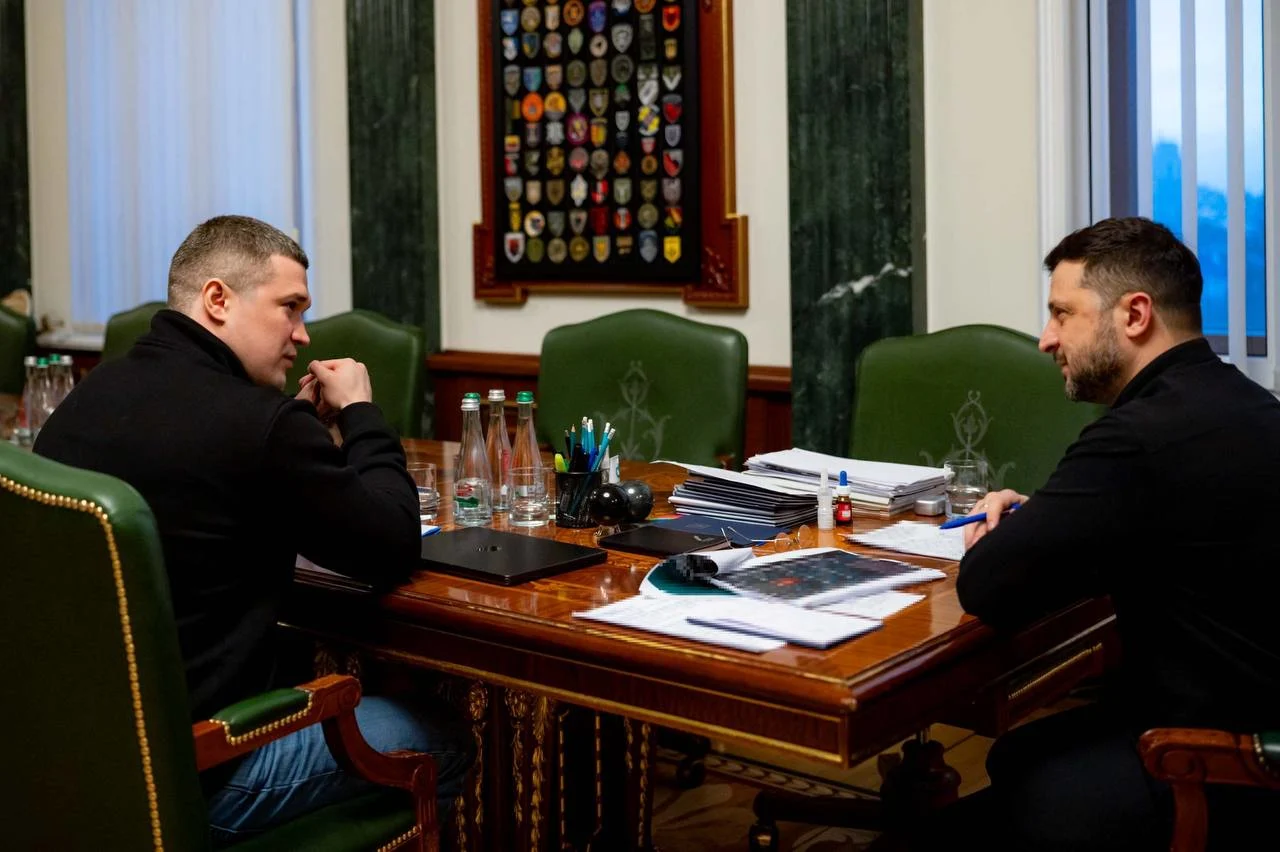
On January 5, Volodymyr Zelensky and Mykhailo Fedorov discussed the new working format of the Ministry of Defence / Photo from the Telegram channel of the President of Ukraine
In the first Dorozvidka of 2026:
- Personnel changes at the Ministry of Defence that could significantly affect Ukraine’s domestic defence tech;
- Two interviews with the founders of Fire Point – and Taras Chmut’s special view of the company;
- The official launch of Defence City and the first resident of the legal regime;
- An analysis of changes in Ukraine’s defence industry by Ihor Fedirko, CEO of the Ukrainian Council of Defence Industry;
- Yaroslav Azhnyuk on the year’s results at The Fourth Law and Odd Systems.
The Defence City legal regime has launched, with SkyFall becoming the first resident
On 2 January, Defence Minister Denys Shmyhal announced the official launch of the Defence City legal regime. He also said that the first Defence City resident is SkyFall, the manufacturer of Shrike and Vampire drones.
The minister also outlined the instruments available to residents of the legal regime to develop their production:
- Exemption from corporate profit tax provided profits are reinvested into development;
- Exemption from land, property and environmental taxes;
- Simplified customs procedures;
- Special guarantees for information protection and data confidentiality during the period of the regime;
- State support for relocation and enhanced protection of production facilities if necessary.
The Ministry of Defence invites Ukrainian manufacturers to join Defence City. The onboarding algorithm has been published on the ministry’s website.
Significant personnel reshuffles in the defence industry
In a video address on 2 January, President of Ukraine Volodymyr Zelensky announced large-scale personnel reshuffles. He proposed Mykhailo Fedorov, currently head of the Ministry of Digital Transformation of Ukraine, as the new Minister of Defence. The president expects that under Fedorov the Ministry of Defence will become more technology-driven.
On January 5, an official meeting took place between Fedorov and Zelensky, during which they discussed the format of the Ministry of Defence’s work. “The key principle is that the technological nature of our defence must save the lives of our soldiers,” Zelensky noted.
Within a week, Fedorov plans to present draft solutions needed to improve the ministry’s work. “We are preparing new special formats to strengthen the drone component of our defence,” the president emphasised.
Fedorov’s candidacy still needs to be approved by the Ukrainian parliament. Denys Shmyhal, the former head of the Ministry of Defence, will become Minister of Energy. Zelenskyy has also decided to replace the head of the Security Service of Ukraine: instead of Vasyl Maliuk, who will remain within the structure and focus on asymmetric operations such as “Web”, the president wants to appoint Yevhen Khmara, head of the SBU’s Alpha Special Operations Centre. In the spring, Khmara was a secret guest at a public interview during one of the Brave1 events – virtually the only interview with him available online.
How did Ukraine’s defence industry change in 2025? Ihor Fedirko’s analysis
Ukrainian Forbes published a concise overview of changes in Ukraine’s defence industrial complex in 2025 by Ihor Fedirko, executive director of the Ukrainian Council of Defence Industry. Where production reached repeatable serial output, how cooperation works under the Build with Ukraine logic, what changed in management and procurement, which investment instruments proved effective and where bottlenecks remain – read the column.
Two interviews with the founders of Fire Point
Forbes also published a conversation with Fire Point founders Denys Shtilerman and Iryna Terekh. They discussed how, over three years since its founding, the company had evolved from a little-known long-range drone manufacturer to a potential unicorn, the role of Tymur Mindich, and the current status of the NABU case against the company. Read the interview.
In addition, Iryna Terekh spoke with Xavier Tytelman, editor-in-chief of the French aerospace publication Air & Cosmos. Among other things, she said that Fire Point has established in-house production of more than 97% of engine components for its FP-1 and FP-2 strike drones.
The most interesting points from Taras Chmut’s interview
On the eve of the New Year, Ukrainska Pravda published a video interview with Taras Chmut, head of the Come Back Alive foundation. In this conversation, Fire Point was also discussed. According to Chmut, Come Back Alive does not cooperate with the company because he considers it “murky”. At the same time, he noted that many units are satisfied with Fire Point’s strike drones, which can carry a large warhead and, in some cases, serve as an alternative to guided aerial bombs.
In the same interview, Taras Chmut expressed the opinion that around 70% of Ukrainian defence companies will cease to exist after the end of the full-scale war.
Yaroslav Azhnyuk on the year’s results for The Fourth Law and Odd Systems
Yaroslav Azhnyuk, co-founder of defence startups The Fourth Law and Odd Systems, published several posts on his social media accounts summarising the year for the two companies.
“2025 became a turning point in the use of autonomous systems in combat conditions. For many units, autonomous terminal guidance is no longer a novelty but an everyday reality,” he wrote in a post about The Fourth Law. He added that throughout the year, the company worked not only on guidance. “Autonomous Shahed detectors, autonomous bombing on the fly, and many other things that start with the word ‘autonomous’, produced by The Fourth Law, are already being used or will soon be used on the battlefield,” Azhniuk wrote.
In a post about Odd Systems, he stressed that in 2025, the company launched the Kurbas-640, a camera that “is now widely used in drones by many manufacturers and helps intercept Shaheds”. He also reminded readers that the company has begun work on an interceptor drone together with the Danish defence company Terma.
Reading now
1
Ukrainian SkyFall’s drone wins at Pentagon’s Drone Dominance selection
2
Black Forest Systems raises $400,000. Here’s what drones the startup is building
3
Sting interceptor by Wild Hornets downs costly Russian Granat-4 reconnaissance drone
4
UForce unveils Bucha middle-strike drone with a 200 km range
5
The F10 drone becomes the second Ukrainian finalist in the Pentagon’s Drone Dominance Program
By submitting this form, you give Defender Media consent to the processing of personal data.
Надсилаючи цю форму, ви надаєте Defender Media згоду на обробку персональних даних.

Latest news
1
DPA to diversify drone and ammunition orders among multiple suppliers
2
‘Ukrainska bavovna’ and Czech company Pavetra Aerospace to produce Shuhay UAV through joint venture
3
59th Assault Brigade downs Russian Ka-52 helicopter with General Cherry OPTIX FPV drone
4
Tencore develops evacuation module for TerMIT UGV
5