Black Mirror #40: autonomous ocean drone, laser hits at 1 km, and reconnaissance satellite launch
A review of Russian military technology developments in the first week of 2026
At the start of the year, Russia is taking stock of its achievements and is less eager to boast about new inventions. One of the key takeaways from Russian reporting is a 40% reduction in funding for the national “UAS” (unmanned aerial systems) project in 2026, with similar cuts expected in subsequent years. Russian analysts have named the Knyaz Vandal Novgorodsky drone as the “unmanned vehicle of the year” and note expectations for significant deliveries of heavy drones at the front. More on Russian military technology developments is provided in Defender Media’s weekly review.
LaserBuzz hits a drone at 1 km
The Russian combat laser system LaserBuzz, part of the Posokh project, has reportedly destroyed an FPV drone at a range of one kilometre for the first time.
The system is said to have a power output of around 3 kW. This level of energy reportedly allows it not only to damage structural elements of large drones but also to disable their electro-optical sensors at significantly longer distances.
According to Russian media, another laser system is also being tested near the Ukrainian state border, with a claimed engagement range of up to 1.5 km. Russian sources report that “over 500 Ukrainian drones” have been destroyed during these trials.
Russia develops unmanned ocean-going boat
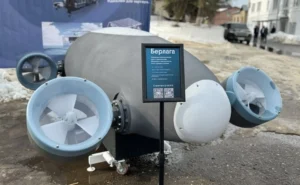
The Russian Centre for Integrated Unmanned Solutions has created an autonomous unmanned vessel, the Yunost-82, capable of multiple unrefuelled circumnavigations. The vessel reportedly navigates by exploiting ocean current maps and uses engines only to correct its route. During transit, it remains semi-submerged, complicating detection.
Developers say the vessel is low-cost and suitable for mass production, intended to “maintain a constant presence of a significant number of such units in the oceans and to combine them rapidly for large-scale tasks.”

In 2024–2025, Russian ships reportedly damaged deep-sea communication cables in the Baltic Sea, most recently being intercepted by Finnish border guards just before the New Year.
Updated Plastun‑TTM all-terrain vehicle completes trials
St Petersburg-based company Russkiye Vezdekhody Plastun has completed testing of the new two-axle, high-mobility Plastun‑TTM vehicle. The vehicle is designed to replace the “Bukhanka” vans used by assault groups in conflict zones, with roles including troop and cargo transport, casualty evacuation, and the installation of anti-aircraft weaponry.
The Plastun‑TTM features an articulated two-unit design, the rear unit serving as a multifunctional platform. There is provision for mounting additional armour screens, while key components are adapted from serial “Niva” and “Gazelle” vehicles, simplifying production and maintenance.

Krona short-range air-defence system enters final trials
Kalashnikov Concern reports that trials of the Krona short-range air-defence system are in their final stages, with serial production planned for 2026.
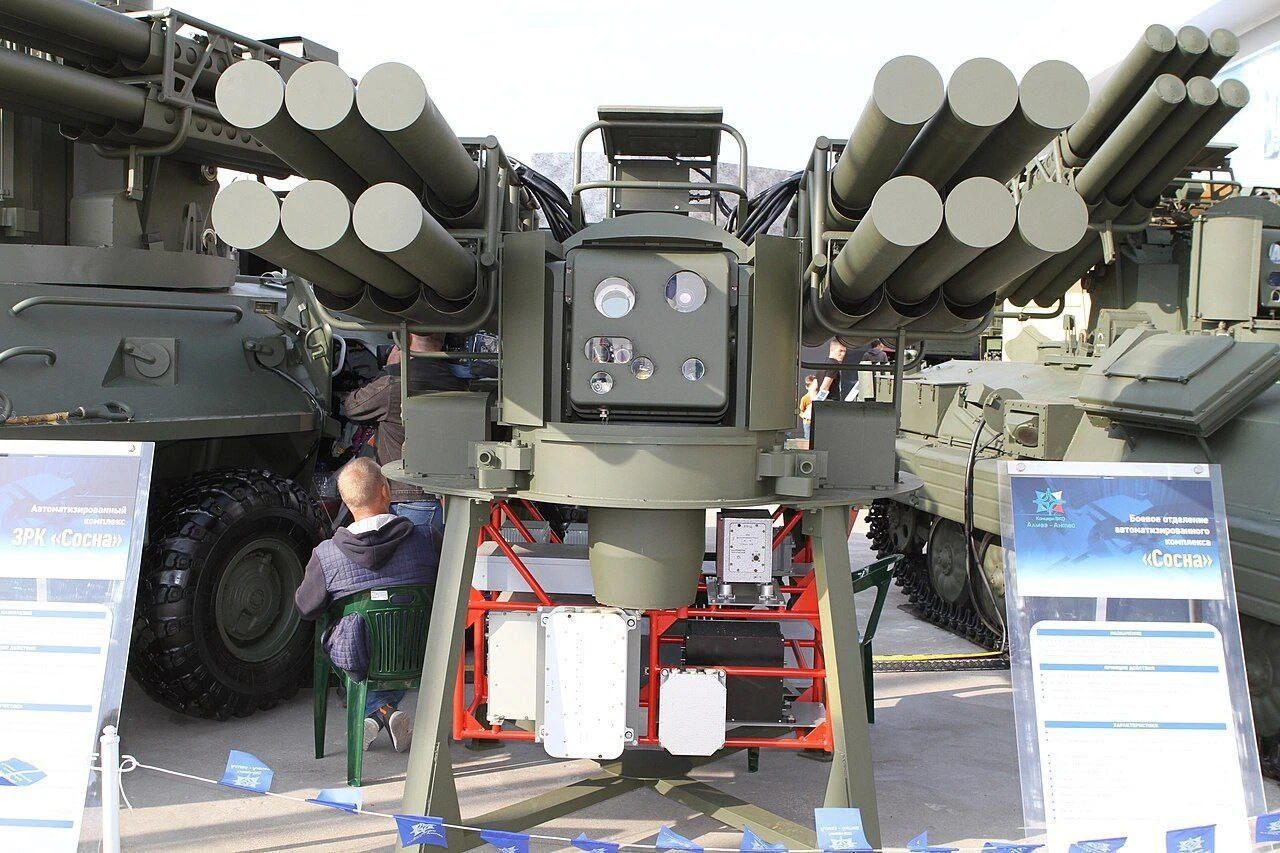
The system builds on the Strela-10 concept and modernises the experimental Sosna system, with target engagement via optical channel rather than radar. Serial production of the new 9M340 missile for Krona has also been prepared. These two-stage missiles reportedly have an engagement range of up to 10 km, intended for use against UAVs and other missile threats.

T-90M tanks receive upgraded active protection against drones
Uralvagonzavod reports that Arena-M active protection systems on T-90M tanks have been adapted to counter not only anti-tank projectiles but also low-speed FPV drones.
The system can detect small radar cross-section UAVs using an alternative mode, in which the radar periodically switches to a short-range scan and identifies drones via the micro-Doppler effect from spinning propellers. This enables target tracking and interception. In standard configuration, Arena-M can engage targets moving at 70–1,200 m/s within a sector of –5° to +20°.
Russia launches its own reconnaissance satellite with 2 m resolution
On 25 December, a Soyuz-2.1a rocket was launched from Plesetsk Cosmodrome carrying a satellite into orbit. Western sources report that this mission deployed the first Obzor-R ground-based radar reconnaissance satellite.
Developed by RSC Progress, work on the satellite has been underway since at least 2012. It carries the domestically produced Kasatka-R radar system.
The radar uses an X-band active phased-array antenna measuring approximately 4 × 1.7 metres. It is reported to provide high-resolution radar imaging at about 1 m, as well as strip-map imaging with resolutions from 2 to 500 m. Previously, Russian forces had relied on Chinese satellite data.
Reading now
1

Ukrainian SkyFall’s drone wins at Pentagon’s Drone Dominance selection
2

Black Forest Systems raises $400,000. Here’s what drones the startup is building
3
Sting interceptor by Wild Hornets downs costly Russian Granat-4 reconnaissance drone
4
UForce unveils Bucha middle-strike drone with a 200 km range
5
The F10 drone becomes the second Ukrainian finalist in the Pentagon’s Drone Dominance Program
By submitting this form, you give Defender Media consent to the processing of personal data.
Надсилаючи цю форму, ви надаєте Defender Media згоду на обробку персональних даних.

Latest news
1

DPA to diversify drone and ammunition orders among multiple suppliers
2
‘Ukrainska bavovna’ and Czech company Pavetra Aerospace to produce Shuhay UAV through joint venture
3
59th Assault Brigade downs Russian Ka-52 helicopter with General Cherry OPTIX FPV drone
4
Tencore develops evacuation module for TerMIT UGV
5