OPPND opens call for second accelerator batch: who they’re looking for and what they offer
The second cohort will focus on solutions in the field of air defence, in particular anti-Shahed projects
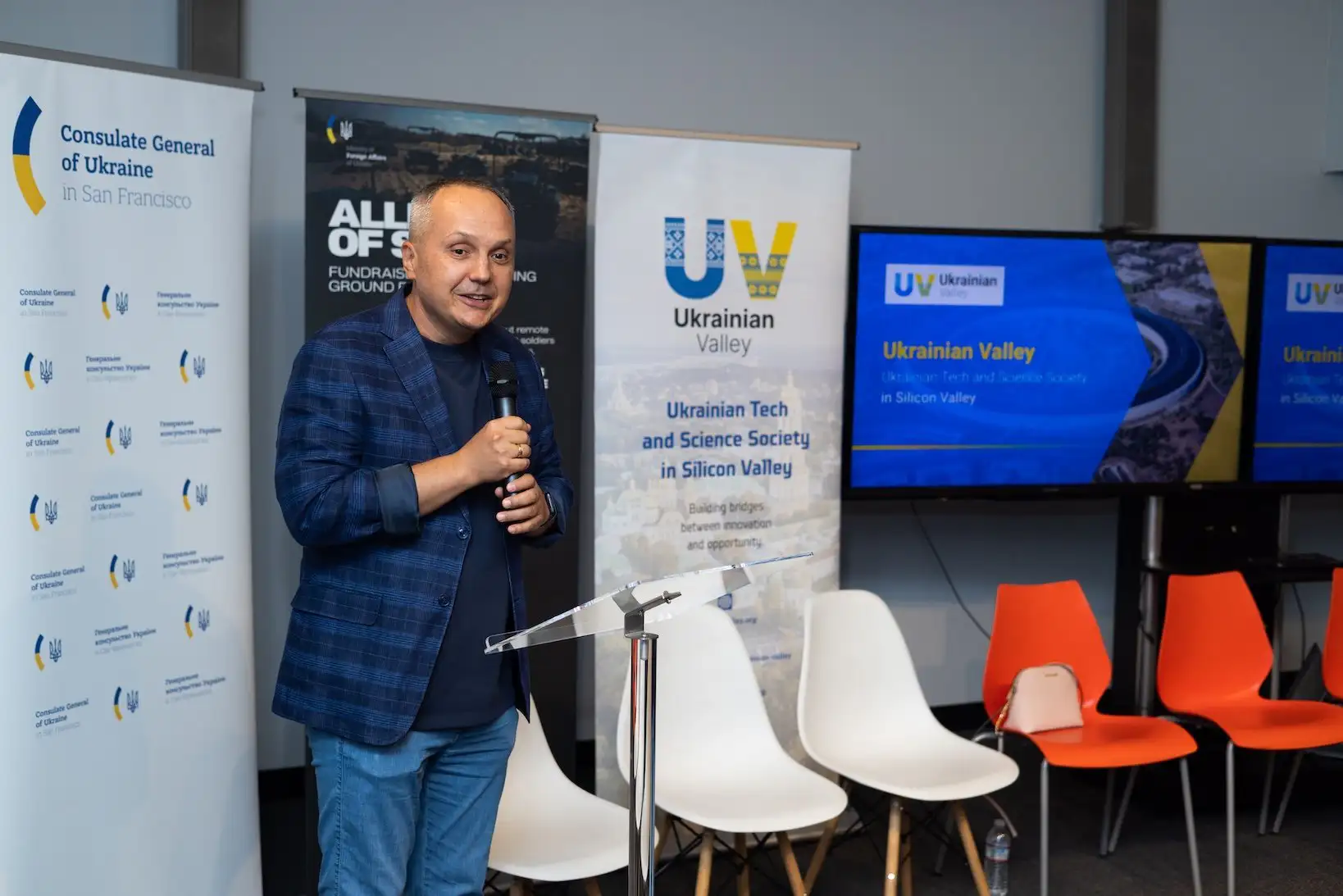
Alexander Soroka, Managing partner USA. Image Credits: Network VC
The Ukrainian-American venture fund, OPPND (formerly Oppenheimer Acceleration Fund), has announced the launch of the second cohort of its defence tech acceleration program for Ukrainian startups. This was announced by Alexander Soroka, the fund’s managing partner in the US, during a video presentation of the new batch.
The program includes an initial investment of $25,000, a month of online acceleration, and offline events in Silicon Valley in early 2026. Upon completion, participants will have the opportunity to attract additional funding in the range of $100,000–$500,000.
To take part in the accelerator’s demo days and invest in Ukrainian defence tech alongside the fund’s partners, the OPPND team invites interested participants to join its community via the link. Defender Media breaks down the details of the accelerator programme in a partner article.
Program format and investment logic
The OPPND Acceleration Program is designed for early-stage startups with a finished or nearly finished product, but without established large-scale sales. According to the fund’s representatives, these are most often teams with a prototype or first MVP that have not yet undergone complete testing.
The program consists of:
- a month of online training and mentoring;
- coaching and networking sessions with industry representatives;
- offline events in Silicon Valley, including investor demo days.
Last time, the program’s demo day attracted about 300 registrations, most of which were from venture capital funds, business angels, and specialised investors in the defence sector.
The offline part of the program will be held with the participation of the community around the Stanford Research Institute, one of the key players in the American defence ecosystem and the main contractor of DARPA (Defense Advanced Research Projects Agency).
The focus of the second batch is air defence
The key priority of the second batch is air defence, but not in the narrow sense of a separate means of destruction. The fund emphasises that it is interested in the entire technological chain — from target detection and tracking to guidance and neutralisation.
Among the areas that the fund considers a priority are:
- Directed energy systems, including laser and microwave solutions
- Air target detection and tracking technologies
- Guidance and targeting systems
- Components that can reduce the cost and scale of air defence solutions.
The fund explicitly states that it is focused on cheaper, scalable alternatives to large, extremely expensive Western air defence systems. They cite the Israeli microwave system, Leonidas, as an example, while emphasising that they are looking for teams capable of creating functionally similar yet significantly more affordable solutions.
The program pays special attention to countering Shahed drones, given that jet-powered versions of these UAVs are already appearing on the battlefield. According to the fund’s analysts, this significantly changes the requirements for interception, making sensors, targeting speed, and the integration of various subsystems critically important.
Other solutions for battlefield “bottlenecks”
Despite the priority given to air defence, the OPPND Fund emphasises that it is open to other defence tech solutions if they address real “bottleneck” problems of modern warfare.
These include, in particular:
- Communication and video communication systems between units;
- Navigation solutions;
- Software and hardware components for military systems;
- Technologies that increase the effectiveness of units faster, cheaper, or on a larger scale than existing analogues.
The fund emphasises that if a solution does not fully fit into the stated areas, but the team considers it relevant to defence, it is still worth submitting an application.
What teams is the fund looking for
A separate focus of the program is team structure. According to Oleksandr Soroka, mixed teams perform best when one of the founders or key participants is in Ukraine and the other in the US or Europe.
The reason for this is simple: attracting investment in the West is primarily based on trust, personal contacts, and local presence. Teams that can pitch their product directly to investors in the US or EU usually move faster.
Basic requirements include:
- Engineers must be included in the cap table (capitalisation table);
- At least one founder (preferably the CEO) must be fluent in English;
- The focus must be on technology, not just on ideas or business models.
The fund’s track record and previous investments
According to representatives of the OPPND, they have already invested in 13 defence tech startups, most of which are Ukrainian. The fund has invested in some of them repeatedly, supporting subsequent rounds.
One example is the Ukrainian startup Swarmer, which is working on drone swarm technology. According to the fund, they have invested in this startup three times, and in the last round, the company raised $15 million.
In addition to the acceleration program, the fund is also developing OPPND SYNDICATE CLUB, an investment club focused on later-stage defence tech startups with sales and scaling.
Ukrainian Valley and the broader ecosystem
Earlier, Oleksandr Soroka also announced the launch of Ukrainian Valley, a technology and science community in Silicon Valley that aims to bring together Ukrainian engineers, entrepreneurs, scientists, and venture investors.
The fund emphasises that it sees its role not only in financing startups, but also in integrating Ukrainian defence tech into the global ecosystem, particularly through ties with universities and research centres such as MIT, Harvard University, and Stanford University.
How to apply
Apply to participate in the second round of the OPPND Fund acceleration program via the fund’s website. The team also encourages investors interested in Ukrainian defence tech to contact the OPPND SYNDICATE.
As part of the first round, the fund has already invested in Ukrainian and American projects, including PanoptesAI, an AI system for network air monitoring, and Sierra Turbines, a platform for turbojet engines for UAVs and missiles.
Additionally, as part of its early investments, OPPND has invested in startups BabAI and RightSpot.AI, which are developing active protection and navigation systems for UAVs and autonomous systems.
Reading now
1
Ukrainian SkyFall’s drone wins at Pentagon’s Drone Dominance selection
2

Black Forest Systems raises $400,000. Here’s what drones the startup is building
3
Sting interceptor by Wild Hornets downs costly Russian Granat-4 reconnaissance drone
4
UForce unveils Bucha middle-strike drone with a 200 km range
5
The F10 drone becomes the second Ukrainian finalist in the Pentagon’s Drone Dominance Program
By submitting this form, you give Defender Media consent to the processing of personal data.
Надсилаючи цю форму, ви надаєте Defender Media згоду на обробку персональних даних.

Latest news
1
DPA to diversify drone and ammunition orders among multiple suppliers
2
‘Ukrainska bavovna’ and Czech company Pavetra Aerospace to produce Shuhay UAV through joint venture
3
59th Assault Brigade downs Russian Ka-52 helicopter with General Cherry OPTIX FPV drone
4
Tencore develops evacuation module for TerMIT UGV
5