Dorozvidka on components. Cameras, acoustic systems, jet engines, and automated interception modules from Brave1 Components
The most notable products from the Brave1 conference, which brought together over 200 component manufacturers
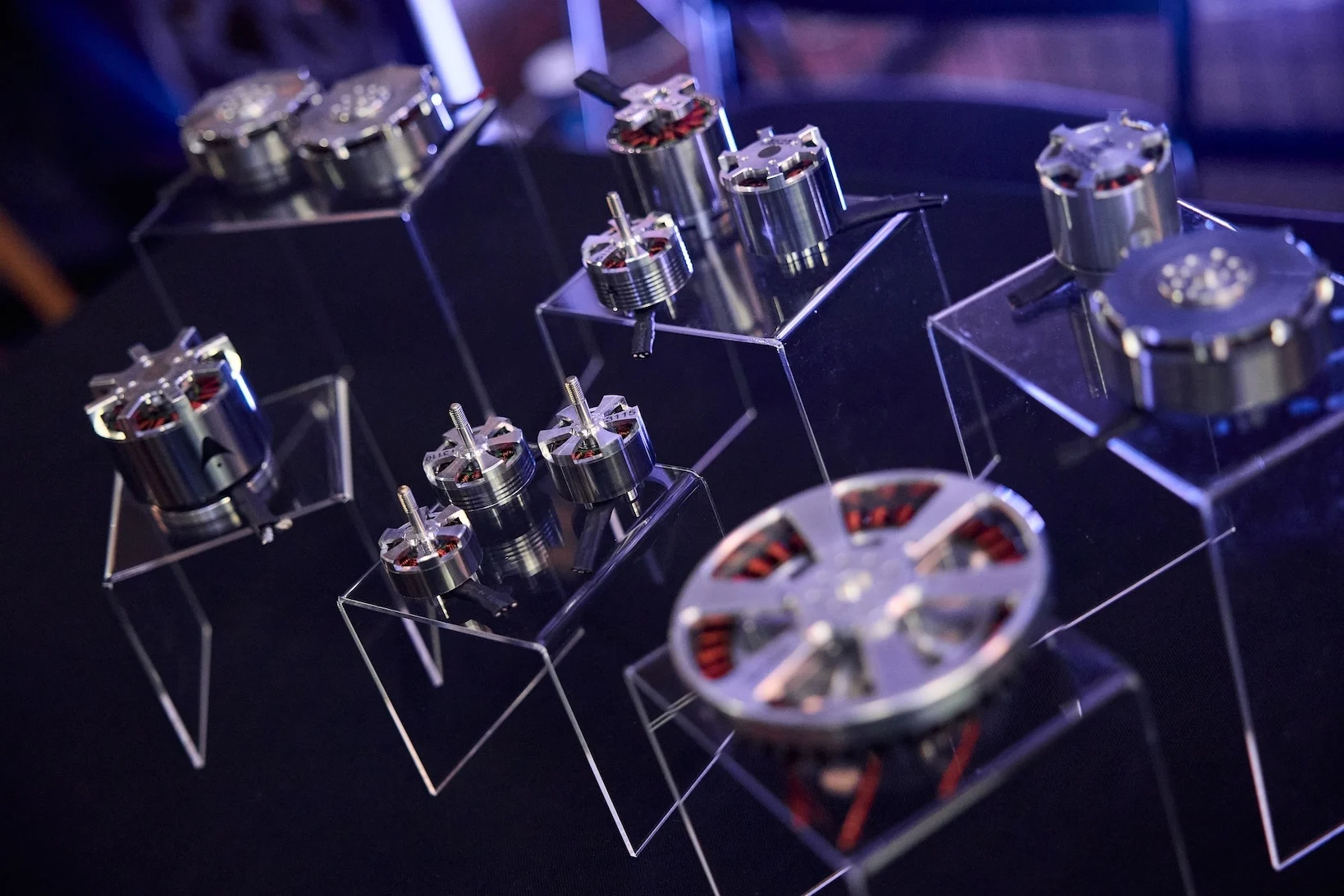
Image source: Brave 1
The main topic in Ukrainian defence tech last week was the defence components market. Several specialised events took place in Kyiv, featuring research presentations, panel discussions, launches of specialised grant programs, and exhibition areas where developers showcased their latest products. In a separate issue of Dorozvidka, Defender Media compiled the most interesting publications about the developments presented at the main event of the week — Brave1 Components.
Automatic guidance module for intercepting Shaheds from The Fourth Law and Odd Systems
Oboronka reports that Yaroslav Azhnyuk’s companies, The Fourth Law and Odd Systems, presented a new camera for interceptor drones at Brave1 Components. The system automatically guides a UAV toward airborne targets such as Shahed-type kamikaze drones.
Key features:
- target detection — up to 1,000 m (depending on weather);
- operating altitude — up to 5,000 m;
- detection accuracy — 80%;
- cost: $800 (camera with module) or $300 (module only).
According to the developers, the system independently detects moving thermal targets and assists the interceptor operator in locating a Shahed more quickly. Currently, the camera’s detection function operates stably, enabling the operator to identify enemy drones in the sky on time. The system autonomously detects a drone in a thermal image by analysing the object’s movement, thermal signature, and other parameters using artificial intelligence.
The Shepit pulse jet engine from Scopa Industries
According to Militarnyi, the Ukrainian company Scopa Industries is preparing its pulse jet engine Shepit, made entirely from Ukrainian components, for flight tests.
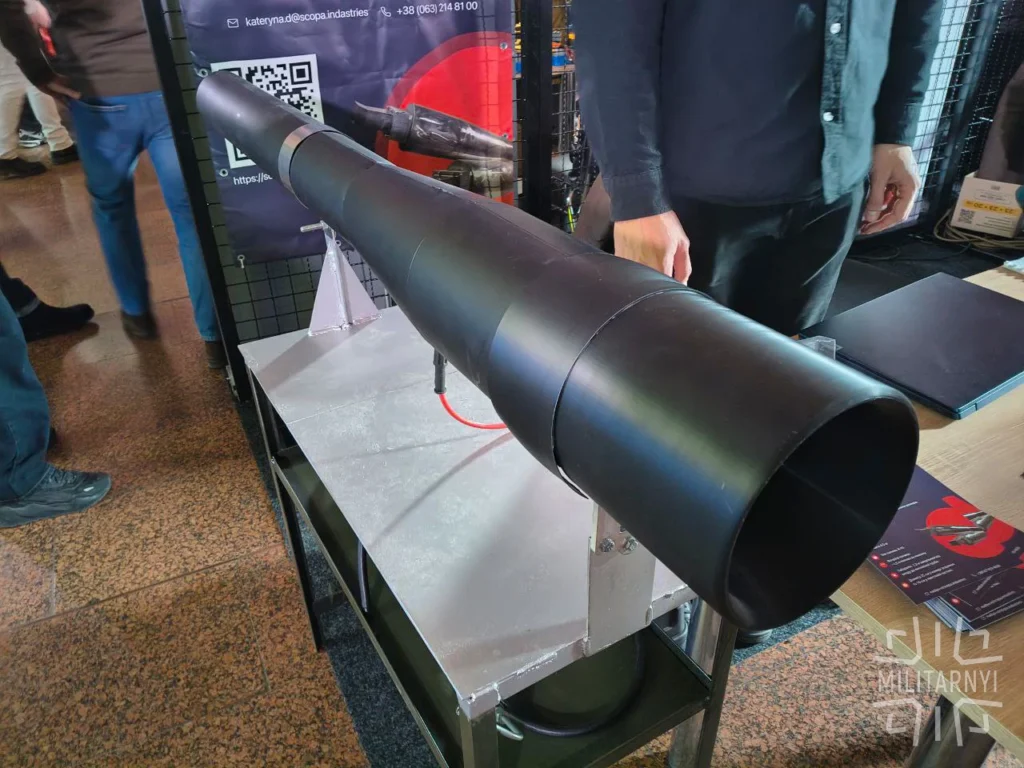
The team has already conducted a series of ground tests that demonstrated the system’s baseline capabilities but also revealed a key issue — overheating in static conditions. In the air, a significantly longer operating cycle is expected due to the cooling effect of airflow.
Shepit specifications:
- stable operation time on the ground — ~5 minutes;
- approximate speed — around 700 km/h (depending on the airframe);
- thrust — 18 kg;
- weight — 6.5 kg;
- dimensions — length 1.3 m; combustion chamber diameter — 25 cm; tail section — 16 cm;
- fuel — regular A-95 gasoline; consumption — ~1.5 l/min.
The engine has scalable thrust, allowing it to be adapted to a wide range of UAVs — from lightweight reconnaissance drones to medium-class strike UAVs. Simplicity of design and maintenance is one of the key advantages highlighted by the manufacturer.
The Hrim-17 pulse jet engine: a new “heart” for high-speed interceptors
Oboronka reported on another Ukrainian jet engine developed by the KB Nezalezhne. The Hrim-17 is a prototype pulse jet engine for small fixed-wing UAVs.
Technical specifications of the Hrim-17:
- weight — 2 kg;
- thrust — 6 kg;
- operating time — 15 minutes;
- potential range — up to 100 km;
- expected system speed — up to 450 km/h;
- cost — up to $800 (engine + valve set + fuel system + ignition).
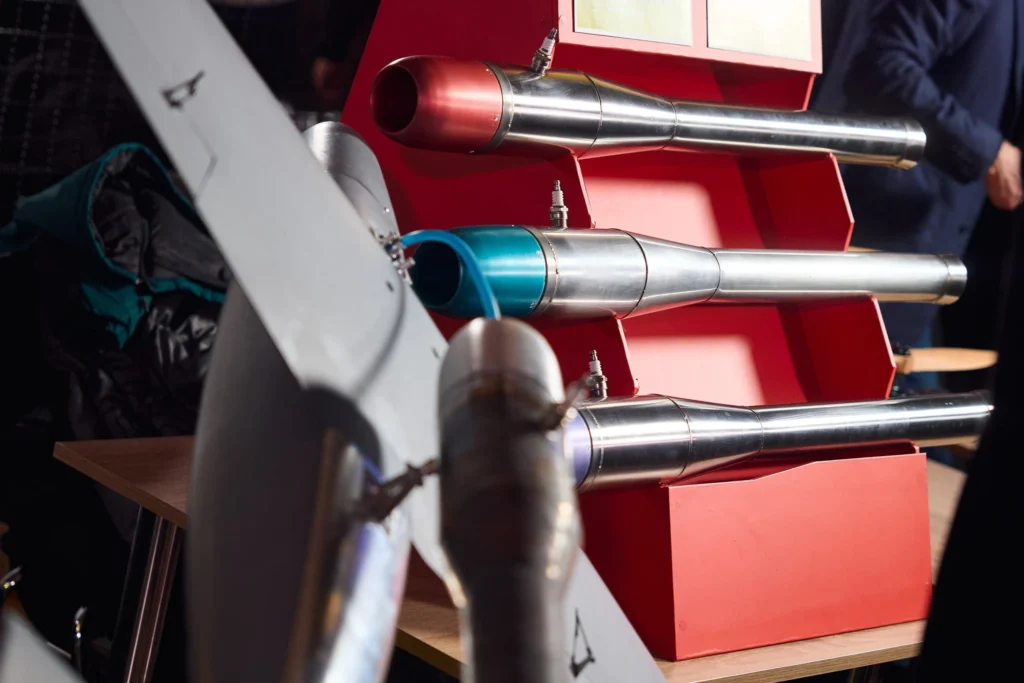
Nezalezhne has also developed its own UAV, the Myt-2, which is currently being integrated with the Hrim-17. The solution is positioned as optimal for intercepting fast Shahed-type UAVs, where high speed and strong dynamics are essential. The company’s engineers are currently working on flight tests of both the engine and the UAV.
RB-220 gyro-stabilized camera with laser guidance from M-FLY
The startup M-FLY presented the multifunctional RB-220 camera at Brave1 Components, according to Militarniy. he company says it has already been tested in Ukraine under conditions as close to combat as possible.
The camera’s main feature is laser illumination of targets at distances of 2–3 km, enabling the use of precision-guided munitions (M712 Copperhead artillery shells, APKWS missiles, Paveway IV bombs, etc.).
Key specifications of the RB-220:
- weight — 5.5 kg, diameter — 225 mm;
- two-axis stabilization with an accuracy of <50 microradians;
- full 360° rotation;
- power — 70 W.
Laser module:
- wavelength — 1064 nm;
- pulse energy — 15 mJ;
- up to 32 pulses/s;
- provides accurate guidance of guided weapons.
EO/IR capabilities:
- Optical-electronic module
- 1920×1080, optical zoom ×30, digital ×3;
- machinery detection — up to 10 km, recognition — 2 km, identification — 1.5 km;
- for infantry — 2 / 1.2 / 1.2 km.
Thermal imaging LWIR module:
- 640×512, digital zoom ×8;
- sensitivity <50 mK;
- detection of machinery — up to 16 km, infantry — up to 2 km.
The RB-220 is designed for use with UAVs, helicopters, ground platforms, and stationary systems, thanks to its compact size and universal interface.
Drone with a gun: autonomous kinetic system from Varta
The Ukrainian company Varta showcased a kinetic air-target engagement module at Brave1 Components, Oboronka reports.
System features:
- 12-gauge anti-drone rounds;
- over 15 integrated platforms, already used by more than 20 units;
- autonomous detection and automatic shot-timing using AI — under development;
- target detection and recognition during tests — about 126 m;
- starter kit — 12,900 UAH;
- cost per shot — €6;
- onboard module — €500–800.
The team is working on enabling a single operator to control multiple UAVs simultaneously, with the system automatically determining the optimal moment to fire.
Oko Camera showcased thermal imaging cameras without Chinese components
The Ukrainian company Oko Camera, which specialises in thermal imaging modules for defence systems, presented a lineup of cameras operating in the standard long-wave infrared (LWIR) range at the Brave1 Components exhibition, according to Oboronka.
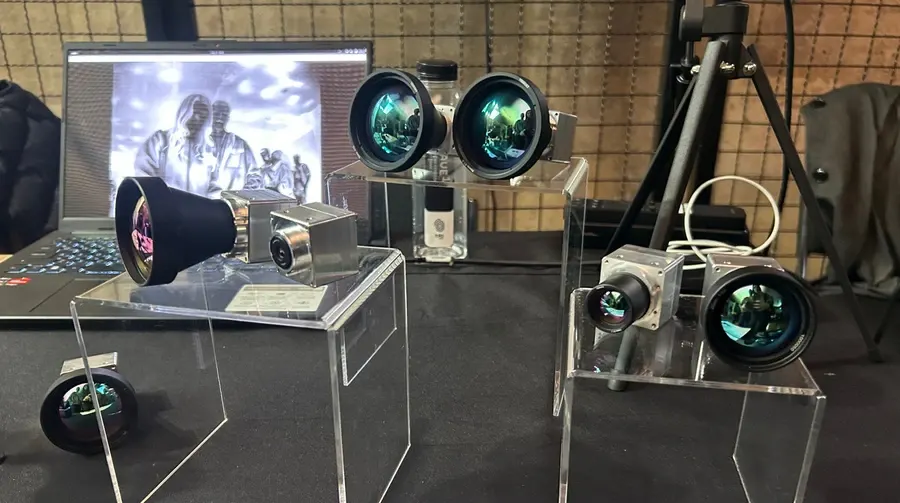
The cameras operate in a passive mode, feature high-sensitivity optics, and are manufactured without the use of Chinese components. Key elements, including the sensor and optics, are sourced from European manufacturers, while assembly and software development are carried out entirely in Ukraine.
Acoustic system for detecting Shaheds from ARes
ARes has presented an acoustic targeting system that works where optics are “blind”: in fog, smoke, cloud cover, or urban areas.
System capabilities:
- detection of Shaheds — up to 5 km;
- FPV detection — 200–300 m;
- works completely passively — does not reveal position;
- able to “read” echoes and determine the direction of the sound source;
- two versions: full-size (for mobile groups) and compact (for ground-based robotic platforms).
The approximate cost of the large version is $10,000 (for a single unit).
Components from Roboneers for UAVs and marine drones
Ukrainian company Roboneers presented several new components for UGVs and marine drones at the Brave1 Components event. Each of them complements the company’s ecosystem, which already supplies thousands of UAVs and hundreds of turrets to the Armed Forces.
The components presented are:
1) Zhalo electric trigger for the M2 machine gun
- electromechanical module for remote firing;
- used in conjunction with Shablya turrets;
- already in use in combat units.
2) Ktyr guidance module
- a board that allows a drone to autonomously capture and hit a target without communication with the operator;
- Compatible with various types of UAVs;
- cost — about $120.
3) Stabilization platform for Starlink Mini
- keeps the terminal in a horizontal position while the UAV is in motion;
- compensates for terrain and reduces signal loss;
- approximate price — up to $350.
4) Marine drone control unit
- provides autopilot, communication, and situational awareness from multiple platforms simultaneously (telemetry, video, statuses, navigation);
- allows you to control missions over long distances;
- cost depending on configuration from $12,000 to $15,000.
According to Roboneers, the company has already reduced the share of Chinese components to 60%, with 40% of components manufactured in Ukraine.
Reading now
1

Ukrainian SkyFall’s drone wins at Pentagon’s Drone Dominance selection
2
Black Forest Systems raises $400,000. Here’s what drones the startup is building
3
Sting interceptor by Wild Hornets downs costly Russian Granat-4 reconnaissance drone
4
UForce unveils Bucha middle-strike drone with a 200 km range
5
The F10 drone becomes the second Ukrainian finalist in the Pentagon’s Drone Dominance Program
By submitting this form, you give Defender Media consent to the processing of personal data.
Надсилаючи цю форму, ви надаєте Defender Media згоду на обробку персональних даних.

Latest news
1
DPA to diversify drone and ammunition orders among multiple suppliers
2
‘Ukrainska bavovna’ and Czech company Pavetra Aerospace to produce Shuhay UAV through joint venture
3
59th Assault Brigade downs Russian Ka-52 helicopter with General Cherry OPTIX FPV drone
4
Tencore develops evacuation module for TerMIT UGV
5