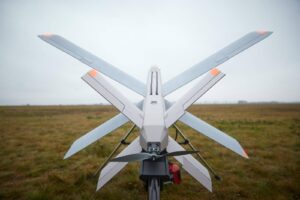
From FP-1 to FP-9, who is buying a stake in the company, ballistic missiles, Mindich and NABU: the key takeaways from the Fire Point event
According to the founders, in the coming weeks a sovereign wealth fund from one of the countries will acquire a stake in the company
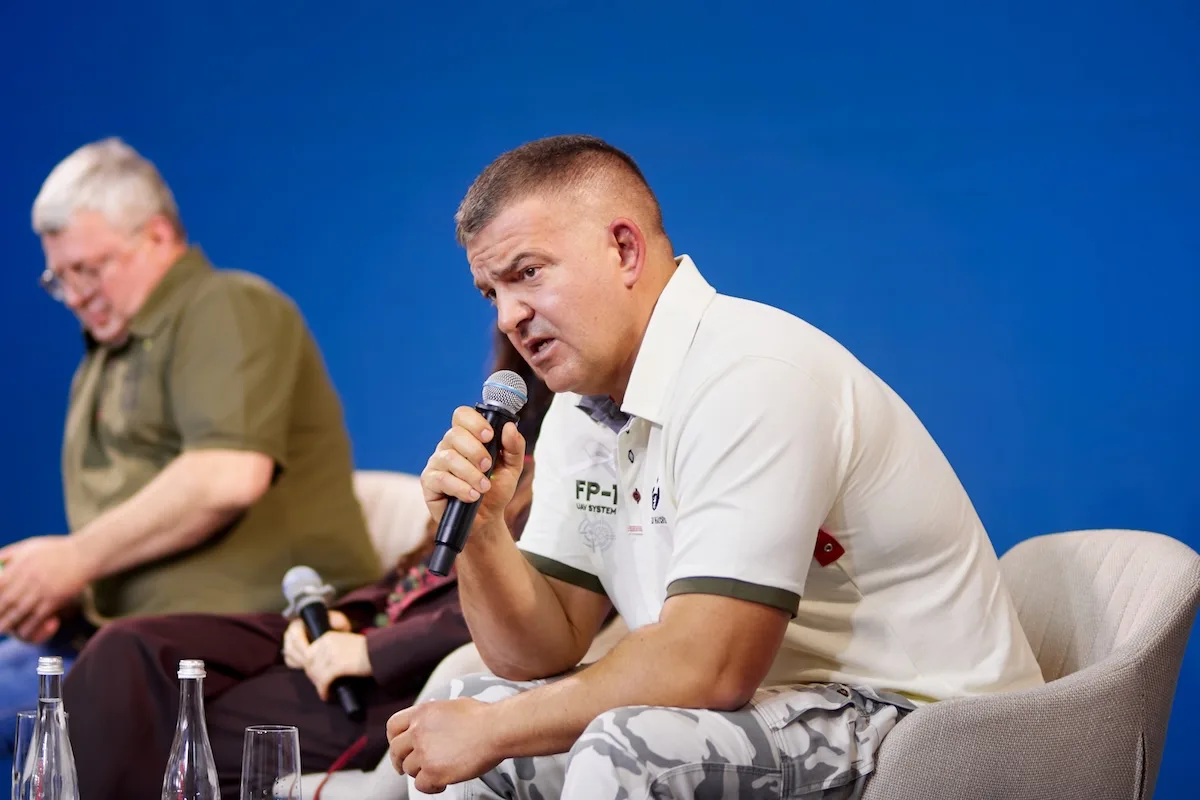
Chief engineer and main shareholder of Fire Point Denys Shtilerman / Photo courtesy of Fire Point
In 2025, Fire Point has stood out as one of the central players in Ukraine’s defence tech market. The company manufactures the Defence Forces’ primary deep-strike system and is the driving force behind Ukraine’s missile programme. At the same time, Fire Point is constantly caught up in scandals, and its story contains plenty of contradictions: an astonishingly rapid rise, anti-corruption investigations, suspicions about an opaque ownership structure, controversial personnel, and more.
Last Friday, the founders decided to meet with journalists to introduce themselves, discuss their developments and plans, and address uncomfortable questions. Defender Media attended the event and summarises the key points.
TL;DR: 12 key takeaways
- The company was founded in 2022 by Denys Shtilerman and Yehor Skalyha, later joined by Iryna Terekh. The founders say they invested $1.5 million of their own money into the project – and remain its sole shareholders to this day.
- As of November 2025, Fire Point has 3,500 employees (650 of them engineers) and 175,000 m² of production facilities. The company manufactures around 100 FP-1 drones per day.
- According to the General Staff, more than half of all enemy targets hit by deep-strike assets fall to FP-1 drones. General Staff specialists describe FP-1 as “an unequivocally successful system”, FP-2 is on its way to that, while FP-5 Flamingo is currently “an experimental system”.
- Representatives of special forces and combat units speak exclusively positively about FP-1 and their cooperation with the manufacturer.
- Former US Secretary of State and now Fire Point advisor Mike Pompeo calls the company a game-changer and believes in its global success. Alongside him, several other influential foreign figures will soon join Fire Point’s advisory board, the founders say.
- According to the founders, Tymur Mindich – suspected of large-scale corruption in Ukraine’s energy sector – has never been a Fire Point shareholder, although he did attempt to buy 50% of the project in 2024.
- In the coming weeks, Fire Point expects to announce the sale of a stake to the sovereign fund of a foreign country. That jurisdiction offers even less bureaucracy and even cheaper gas and energy than Ukraine.
- Construction of the Fire Point plant in Denmark is proceeding on schedule, with the first phase opening soon.
- According to the founders, the NABU investigation affects Fire Point only indirectly. There have been no searches at the company, and it provides all the required information to anti-corruption bodies.
- The FP-7 ballistic missile is ready and will enter service by the end of 2025; FP-9 by mid-2026.
- Fire Point is working on its own air-defence system and, together with Western companies, developing the Freyja project for a pan-European air- and missile-defence architecture.
- Fire Point also plans to build its own spaceport and launch a constellation of satellite observation and communications.
What the General Staff and combat units say about Fire Point
Speaking at the event, the spokesperson for the General Staff of the Armed Forces of Ukraine, Dmytro Lykhovii, shared the General Staff’s assessment of the company’s products. They describe the FP-1 drone as one of the most effective deep-strike assets available to the Ukrainian military. In particular, these UAVs make the largest contribution to striking Russian oil refineries.
Lykhovii states that FP-1 has been in combat use for over two years. Over this time, the drone has undergone numerous upgrades based on feedback from the military, primarily SSO operators. Today, most Ukrainian deep-strike attacks (and most successful hits) are carried out with FP-1 drones, with more than half of FP-1 launches ending successfully.
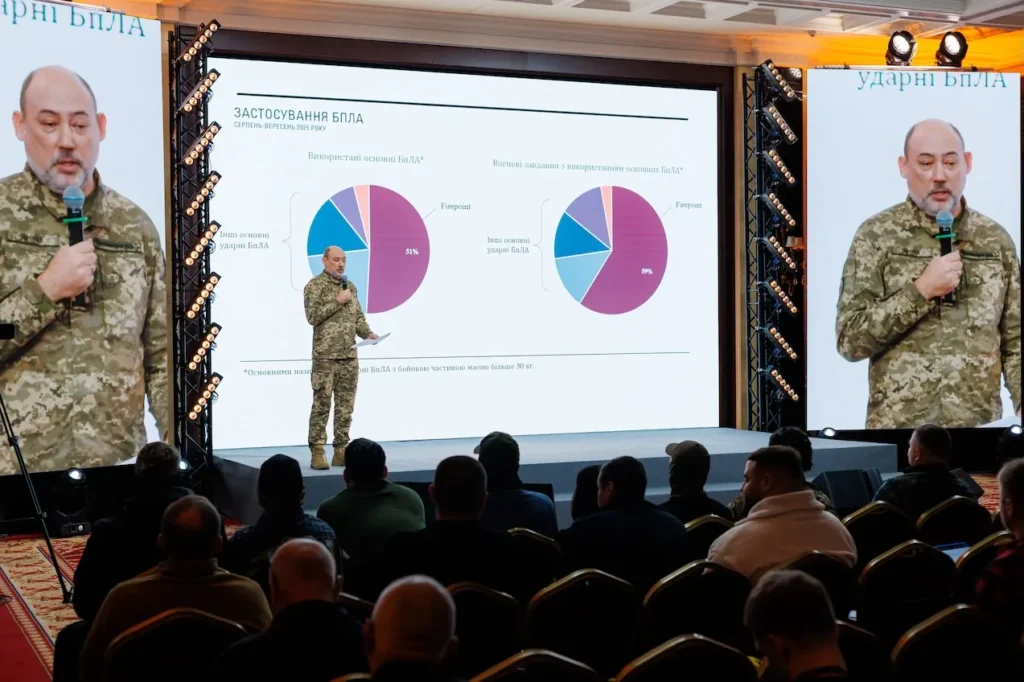
According to tracker data, FP-1 has the best route-completion rate among deep-strikes, the General Staff says. Lykhovii notes that FP-1’s effectiveness is comparable to that of the An-196 Lyutyi, but FP-1’s major advantage is price: it costs the army three times less than the An-196. Another advantage is rapid deployment and maintenance.
The General Staff also notes the performance of the medium-range FP-2 drone, although it is used in smaller numbers than FP-1. As for FP-5 Flamingo, combat launches began in spring 2025. “However, while FP-1 has already proven its effectiveness, FP-5 still has to go through that process,” Lykhovii says, citing General Staff specialists. They note that Flamingo has strong characteristics and great potential, but further development is complicated by its high unit cost.
After Lykhovii, representatives of the top units that operate Fire Point equipment took the stage – SSO, HUR, SBS, and the Lazar Group of the National Guard. All praised FP-1’s effectiveness, Fire Point’s active involvement in testing and missions, and the company’s fast response to military feedback. None of the speakers has yet used FP-5 – they say its effectiveness can only be assessed after a certain number of launches.
What the former CIA Director thinks about Fire Point
Fire Point has recently established an advisory board, which is joined by former U.S. Secretary of State and former CIA Director Mike Pompeo. He participated in the event via video and showered the company with praise.
Pompeo believes Fire Point is a game-changer that will become a powerful global defence tech player. He called Fire Point’s technologies spectacular and highlighted the company’s huge long-term potential.

He also said he was happy to join the advisory board, even though he is aware of the rumours surrounding Fire Point. According to him, the board’s mission is to make the company as transparent as possible, because becoming a global player without transparency is impossible.
Who stands behind Fire Point: Shtilerman, Skalyha, Terekh
The highlight of the evening was the appearance of Fire Point’s founders on stage: principal owner and chief engineer Denys Shtilerman, company director Yehor Skalyha, and CTO Iryna Terekh – previously the project’s most public face. They answered questions from Maria Berlinska and journalists.
Fire Point began as a volunteer initiative. When it became clear that buying and importing drones was extremely expensive, Shtilerman decided to build his own production line. Skalyha joined him (having worked with drones since 2014), as did Terekh (who knows how to organise and scale production).
Shtilerman claims Fire Point was funded with the founders’ own money – they invested $1.5 million. He did not specify the source of these funds. “I’ve always been a wealthy person, and so have Yehor and Iryna,” he says.
The partners set themselves the task of creating a drone that could carry a 50-kg warhead for 700 km. The FP-1’s first flight took place in January 2023, and it was codified in May. In August 2023, the company received its first order for 200 drones.
Fire Point and “Mindichgate”
In March 2024, FP-1 participated in trials organised by the Defence Forces, alongside the US Embassy in Ukraine. The drones had to fly a set route under EW influence and hit a target. According to Shtilerman, both Ukrainian and foreign companies participated; however, FP-1 was the only drone that successfully completed all tasks.
The founders say that this is when interest in Fire Point surged. Various parties began approaching them to buy a stake. According to Shtilerman, one such offer came from Tymur Mindich, whom he has long known and who shares his interest in the contemporary artist Shereshevsky. “We became successful not because of Mindich – Mindich came to us because we became successful,” Shtilerman says. He admits Mindich sought 50% of the company but refused to reveal the offered price.
Tymur Mindich is a Ukrainian businessman, co-owner of Kvartal 95 studio, former business partner and friend of President Zelensky, and a figure in a corruption investigation into the energy sector as part of NABU/SAP’s “Midas” operation.

Shtilerman also admits to knowing the elder brother of another Midas figure, businessman Oleksandr Zuckerman. After the full-scale invasion, Shtilerman kept his savings and his will with his brother, Mykhailo Zuckerman, because he no longer trusted banks after several financial crises. Shtilerman himself is likely mentioned on NABU tapes under the codename “Elektronik”.
Journalists also asked about former Fire Point employee Ihor Fursenko, accused by anti-corruption bodies of money-laundering in the same case. He is currently in pre-trial detention. Shtilerman says Fursenko was hired in 2025 to extract Shtilerman’s former wife and children from Russia.
The founder repeated several times that “people are not black or white – they are grey”. He believes Fursenko’s involvement was justified, as failure could have given Russia leverage over the chief engineer of one of Ukraine’s key defence enterprises.
NABU’s investigation
The company insists that NABU is investigating DCCI and AOZ officials, and Fire Point is only one of six large arms manufacturers being examined within the broader case. Shtilerman explains public interest in Fire Point with: “Lightning always strikes the tallest tree.”
Skalyha adds there have been no searches at Fire Point. The documents NABU requested were handed over back in spring 2025.
Attracting an investor and IPO prospects
The founders rejected all investor proposals in 2024, but now they are close to a strategic deal.
According to Shtilerman, Fire Point plans to announce the sale of a stake to the sovereign fund of a foreign country within weeks. Unlike Mindich and other earlier bidders, this proposal appealed to the founders. “There is even less bureaucratic burden there than in Ukraine, and electricity and gas – which we need in large amounts – are cheaper,” he says. He did not name the country, though.
Shtilerman also denied rumours that the company is considering an IPO – the founders have no such plans for now.
FP-5 Flamingo cruise missiles
According to Terekh, FP-5 production is being scaled, but she refused to specify numbers for security reasons. She noted that the bottleneck at the moment is state procurement.
Skalyha said the launches that proved the missile’s combat capability have already taken place – and can be considered successful. Still, these successes need to be made systematic, and tactics refined.
Shtilerman added that FP-5 performance would significantly improve with access to elevation maps of Russian territory. FP-5 can fly extremely low, making it nearly undetectable for enemy air defences. “If Flamingo flies at 40 metres, the Russians will not be able to see it with anything,” Shtilerman says. But without elevation data, the missile cannot avoid terrain and is likely to be lost en route.
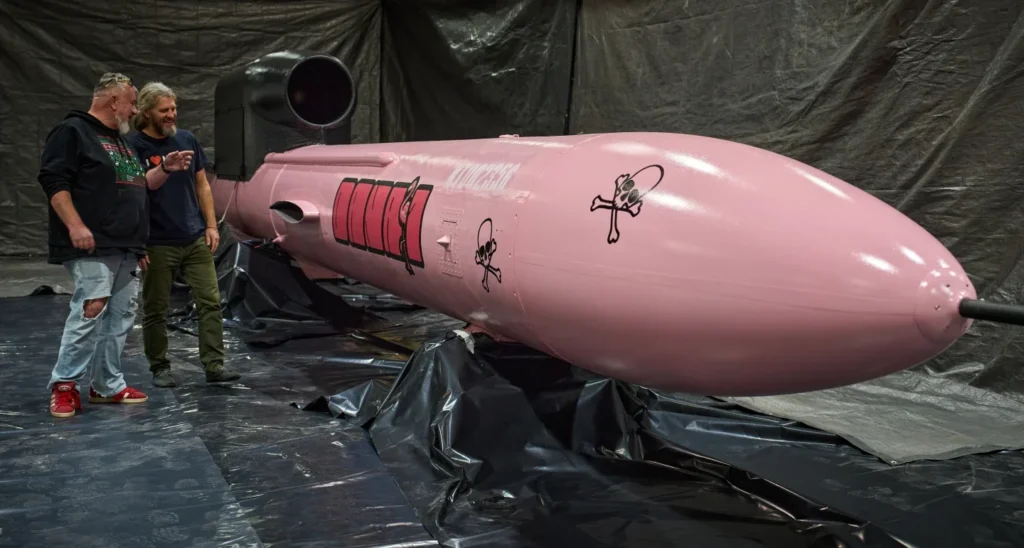
Asked about FP-5’s key advantages and its potential impact on the war, Shtilerman said these missiles can be produced in any quantity and do not require highly qualified personnel. The missile costs about €600,000, which is exceptionally cheap for such a system.
“The idea is that it can be made anywhere and by anyone,” Skalyha added. “Yes, we sacrifice aerodynamics and many other things, but this missile can be built quickly, in large numbers and cheaply.”
Shtilerman believes FP-5 missiles could “take out all Russian targets within a 3,000-km radius – except perhaps Moscow and St Petersburg due to their dense air-defence ring.”
Why FP-5, FP-7 and FP-9 are called “rocket-drones”
During his speech, General Staff representative Dmytro Lykhovii referred to the Flamingo as a jet-powered drone and as a “rocket-drone”. Iryna Terekh explained that, for now, all Fire Point systems are codified as UAVs.
“There is currently a huge difference in codification procedures between UAVs and missiles, so for the sake of simplicity many missiles are still registered as drones. That was the case with the FP-5, which we codified as a UAV in order to pass testing and enter service more quickly,” she says.
Terekh emphasised that the boom in Ukraine’s drone industry is primarily driven by two key factors. The first is the simplification of bureaucratic procedures by the state. The second is constant feedback from the military, which allows manufacturers to quickly upgrade their products. The missile programme is still lagging behind, Terekh says.
“Not only the FP-5 cruise missile, but even the ballistic systems are currently registered as UAVs,” she adds. “If missile procedures are simplified in the same way as they were for drones, we will rename our systems accordingly.”
When to expect Fire Point’s ballistic missiles
According to Shtilerman, the FP-7 short-range ballistic missile is fully ready. “We are now finalising trials. We hope it will enter service before the start of the new year,” he said.
The company hopes to bring the FP-9 “ballistic drone”, with an 850-kg warhead and a range of 800 km, into service by June 2026.
Iryna Terekh added that the company is developing both cruise and ballistic missiles using its own funds, without state money or partner-country financing. “All of it is reinvested profit from FP-1 and FP-2 drone production,” she says.
Fire Point air-defence systems and the pan-European anti-missile shield
Shtilerman admitted that Fire Point’s ballistic missiles are being developed on the basis of missiles used in Russia’s S-400 systems. Developing their own air-defence systems is the next logical step, and these too will be based on an “S-400 clone”. “But our missile is fully composite, so it is lighter and can fly further,” the businessman says. He hopes that shooting down a ballistic missile with a Fire Point air-defence system will cost less than $1 million. Currently, he says, a single missile launch costs between $3 million and $ 6 million.
In addition, Fire Point has launched an initiative to build a pan-European ballistic missile interception system based on open architecture. The project is called Freyja. According to Shtilerman, two major European companies have already agreed to join the initiative, and two more are preparing to make a decision.
Arms export and joint ventures
Shtilerman does not believe in exporting Ukrainian weapons as such – he says that navigating all European bureaucratic procedures would take any company around three years. “But outside Europe, we are in talks on the FP-5,” he says. “The idea is that we produce, say, 3,000 missiles abroad, leave half of them in the country of manufacture, and send the other half to Ukraine as payment for the export of technology.” Shtilerman hopes that the contract with foreign partners will be signed in February 2025.
During the owners’ briefing with journalists, slides showing the company’s history and future plans were displayed behind them. Among those plans are the serial production of ballistic missiles, the pan-European Frejya air-defence initiative mentioned earlier, a satellite observation and communications system, and even a spaceport. The founders did not have time to share details of that project, but they promised to hold similar press briefings once a quarter.
Reading now
1

Ukrainian SkyFall’s drone wins at Pentagon’s Drone Dominance selection
2
Black Forest Systems raises $400,000. Here’s what drones the startup is building
3
Sting interceptor by Wild Hornets downs costly Russian Granat-4 reconnaissance drone
4
UForce unveils Bucha middle-strike drone with a 200 km range
5
The F10 drone becomes the second Ukrainian finalist in the Pentagon’s Drone Dominance Program
By submitting this form, you give Defender Media consent to the processing of personal data.
Надсилаючи цю форму, ви надаєте Defender Media згоду на обробку персональних даних.

Latest news
1
DPA to diversify drone and ammunition orders among multiple suppliers
2
‘Ukrainska bavovna’ and Czech company Pavetra Aerospace to produce Shuhay UAV through joint venture
3
59th Assault Brigade downs Russian Ka-52 helicopter with General Cherry OPTIX FPV drone
4
Tencore develops evacuation module for TerMIT UGV
5