DOT-Chain Defence: How the platform bridges the needs of the military and the capabilities of business
The system has turned a logistics marathon into a sprint. What could prevent its scaling?
Media: General Cherry
Domestic engineers are intensifying the search for a game-changer — a technology able to shift the balance of power on the front lines in Ukraine’s favour. This is not necessarily a “wunderwaffe”, such as a new drone or missile; the decisive factor could be a revolution in supply. The launch of the DOT-Chain Defence platform, the driving force behind that revolution in the Ukrainian military, was called “the main achievement of the Ukrainian defence industry in 2025” by the founder of the Dovbush Hornets strike-UAV company, Andriy Onistrat.
This article on DOT-Chain Defence is the opening piece in the special project General Channel, which Defender Media is producing in partnership with Ukrainian defence tech company General Cherry. Over the coming months, we will explore the most pressing topics in Ukrainian defence tech and examine how one of the market’s key players operates.
In defence procurement, there are many moving parts, but two are critical: delivery speed and procedural transparency. In peacetime, purchases typically pass through lengthy bureaucratic cycles that can last up to six months, by which time frontline requests may already be outdated. That precise problem spurred the launch of the DOT-Chain Defence digital platform.
DOT-Chain Defence is a pilot project of the State Rear Services Operator and the Defence Procurement Agency, designed to shorten the supply chain and enable units to choose the equipment they need themselves. To assess how successful the initiative has been, Defender Media spoke to all parties involved: the platform’s administrators, represented by Alona Zhuzha, Director of the DPA’s Digitalisation Department; platform participants, represented by General Cherry founder Yaroslav Hryshyn; and military representatives — deputy commander of the Phoenix unit Andrii Poltoratskyi and the commander of a special forces unit. Their testimony reveals how, within three months, DOT-Chain Defence transformed a six-month logistical marathon into deliveries that now take just five to twelve days, highlighting the challenges that remain as the platform scales.
From a concept to the system
DOT-Chain Defence was conceived as an internal tool to help units select and rapidly receive drones. The IT system operates on the principle of a “weapons marketplace”: units pick the drones they need, while the Defence Procurement Agency handles the bureaucratic part of the process — from contract signing to payment. The pilot proved so effective that it quickly expanded beyond internal orders to include external programmes such as “Army of Drones. Bonus”. The primary objective is to shorten the route from manufacturer to frontline by removing unnecessary bureaucracy and delays.
In its first three months, DOT-Chain Defence has achieved results that, until recently, seemed unattainable. The marketplace already lists over 200 product types from more than 50 suppliers. For some items, the minimum dispatch time is just five days, while the maximum is twelve.
Alona Zhuzha says the system speeds up procurement on average fivefold, and in some cases by an order of magnitude. Where previously approval of needs and funding could take up to six months, results are now achieved in a matter of days.

Manufacturers confirm the improvement. Drone maker General Cherry, one of DOT-Chain Defence’s earliest partners, completed its first order in eight days. “The longer the supply line, the less relevant the request becomes by the time it’s fulfilled. Our task is to supply the military quickly and safely,” says Yaroslav Hryshyn.
And in practice, the speed the system promises is delivered. Andrii Poltoratskyi confirms his unit received its first order within four to five days of submission. The biggest benefit, he says, is that the bureaucratic marathon has gone: “We no longer have to gather mountains of paperwork and wait six months while it moves through justifications, submissions and approvals across multiple services and structures as we used to.”
Principles of new competition
DOT-Chain Defence has fundamentally changed relations between the state and manufacturers, encouraging genuine market competition. Zhuzha explains that, unlike a traditional state contract — which allowed a supplier to “relax” after receiving an advance payment — contracts within DOT-Chain Defence create no financial obligation until the product is actually ordered. Funds are reserved only after a military unit places an order and signs an additional agreement.
This keeps suppliers permanently motivated to improve quality: the better the product and service, the more likely they are to win orders. It forces them to work “ahead”, listing ready-to-ship items in the system. Yaroslav Hryshyn agrees that this stimulates healthy competition and gives the firm timely feedback for product upgrades.
To preserve transparency and competition, the platform includes control measures. First, penalties apply for missed delivery deadlines. Second, a feedback feature has been launched, allowing soldiers to leave comments and ratings on products, creating a de facto ranking that will directly influence other units’ purchasing decisions.
Poltoratskyi also highlights the newfound freedom of choice for frontline units. Previously, under decentralised procurement, a unit could not buy a required item through a tender if its price slightly exceeded expectations, even when it was the better option. That problem no longer exists. “Nobody asks about the price, you don’t have to justify or compare anything: we simply chose, agreed and ordered, without extra recalculations or approvals,” Poltoratskyi says.
Verification and constructive dialogue
Only verified manufacturers are admitted to the platform. Joining DOT-Chain Defence requires submitting company information to the Defence Procurement Agency, as well as a compliance review of financial stability, reputation, licenses, and the absence of links to aggressor states. After a positive compliance verdict and contract signing, a company may join the system.
In a conversation with Defender Media, the commander of a special-purpose unit stated that his formation already utilises DOT-Chain Defence actively. He called the platform “a very handy tool” in two main scenarios. “First, it replaced quick orders that used to go through volunteers. Volunteer support has clearly decreased, and now we can cover urgent needs using e-points,” the commander explained.
The second use, he said, is testing new equipment models. “We can take, for example, a hundred units of several products — one type, another, a third — to see which best meets our needs. Then we can order a large batch of whatever performs best,” he added.
Despite its high efficiency, onboarding new manufacturers remains one of the system’s operational challenges. Zhuzha does not hide that, although expectations for supplier numbers were initially higher, the team encountered a range of problems that substantially increased their workload.
The main bottleneck arises during documentation. “We often encounter inconsistencies, and correcting them can take quite some time,” she explains, noting that these issues are mostly bureaucratic in nature.
In practice, the DPA’s operational team spends significant effort refining documentation before a product appears on the marketplace. Still, since many suppliers have already passed the “first round” of corrections, this bottleneck is expected to ease soon, accelerating future contracting.
Yaroslav Hryshyn highlights that the process is supported by ongoing dialogue between the state and the market. Verification, for instance, has become more convenient for suppliers too: it’s performed once, not for each purchase, which greatly speeds up subsequent transactions.
Even before the public launch, the DPA team actively consulted with manufacturers. “We were involved in discussions about the platform’s architecture, advising on the integration of product specifications, category structures, and supply chain logic. That collaborative approach ensured a quality and rapid start,” General Cherry’s founder notes.
Challenges and concerns
Despite successes, funding for DOT-Chain Defence remains a weak point. According to Yaroslav Hryshyn, a quarter of the funds allocated for the first 12 brigades was spent in just two weeks. Given that around 180 brigades are now in the system, scaling requires additional solutions.
“If funding is not significantly increased, manufacturers may face situations where the military wants to buy their products via the system, but the budget is temporarily exhausted. That creates risks for production planning: a company sees potential orders but cannot fulfil them due toa lack of funds. For business, this adds uncertainty and requires clear dialogue from the state about prospects for additional financing,” says the founder of General Cherry.
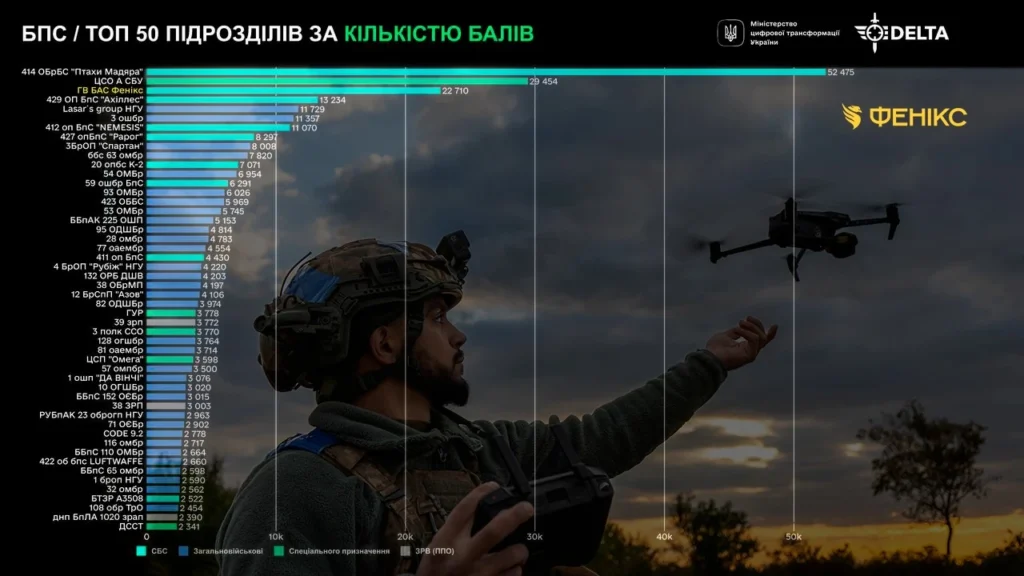
Budget limits also affect troops. “Purchasing drones with bonus ‘e-points’ is currently almost the only way for us to acquire equipment. Although point rates were raised, we now receive more points for destroyed enemy kit — the value of each point has halved and is currently equivalent to 5,000 hryvnias. It’s crucial for us that this value does not fall further,” Poltoratskyi says.
Growth and scaling
In 2026, up to 70% of all UAV deliveries to the Ukrainian Armed Forces are expected to be made via the platform. In the past week alone, DOT-Chain Defence has added options for procuring stationary and trench electronic warfare systems, with mining robots next in line.
“This will become the main channel for drone supply. If manufacturers want to develop and work with state contracts, they should be here,” Alona says.
Immediate plans for the DOT-Chain Defence team include introducing a service desk where units can report faults or request firmware updates and drone repairs. The platform also plans to expand its user base — early units from other defence forces, including the Ministry of Internal Affairs, are due to join.
Another step is to give suppliers more autonomy so they can update their catalogue and materials themselves, easing the load on the operations team. Strategically, the DPA is developing a “drone constructor” — a tool that will enable units to build bespoke requests by choosing parameters such as thermal imaging cameras, battery types, frequencies, or gimbal mounts.
Troops are eagerly awaiting the arrival of individual components on the marketplace. While drones are being procured successfully, their operation requires non-codified equipment, including relays, antennas, receivers, and transmitters. Poltoratskyi notes that these components are not covered by either unit budgets or the platform, so soldiers are currently resolving these needs themselves.
Manufacturers, meanwhile, are not rushing to abandon other supply channels, although they see DOT-Chain Defence as a strategic direction that will provide the bulk of deliveries in future. “We operate across all channels, including direct work with brigades, because that gives us feedback straight from drone operators and lets us continuously improve our products,” Yaroslav Hryshyn says.
Reading now
1

Ukrainian SkyFall’s drone wins at Pentagon’s Drone Dominance selection
2
Black Forest Systems raises $400,000. Here’s what drones the startup is building
3
Sting interceptor by Wild Hornets downs costly Russian Granat-4 reconnaissance drone
4
UForce unveils Bucha middle-strike drone with a 200 km range
5
The F10 drone becomes the second Ukrainian finalist in the Pentagon’s Drone Dominance Program
By submitting this form, you give Defender Media consent to the processing of personal data.
Надсилаючи цю форму, ви надаєте Defender Media згоду на обробку персональних даних.

Latest news
1
DPA to diversify drone and ammunition orders among multiple suppliers
2
‘Ukrainska bavovna’ and Czech company Pavetra Aerospace to produce Shuhay UAV through joint venture
3
59th Assault Brigade downs Russian Ka-52 helicopter with General Cherry OPTIX FPV drone
4
Tencore develops evacuation module for TerMIT UGV
5