Black Mirror #25. Molniya-2, Koschei, Pusher, new components in Geran-3 and other Russian miltech innovations
Overview of new Russian miltech developments for the third week of September
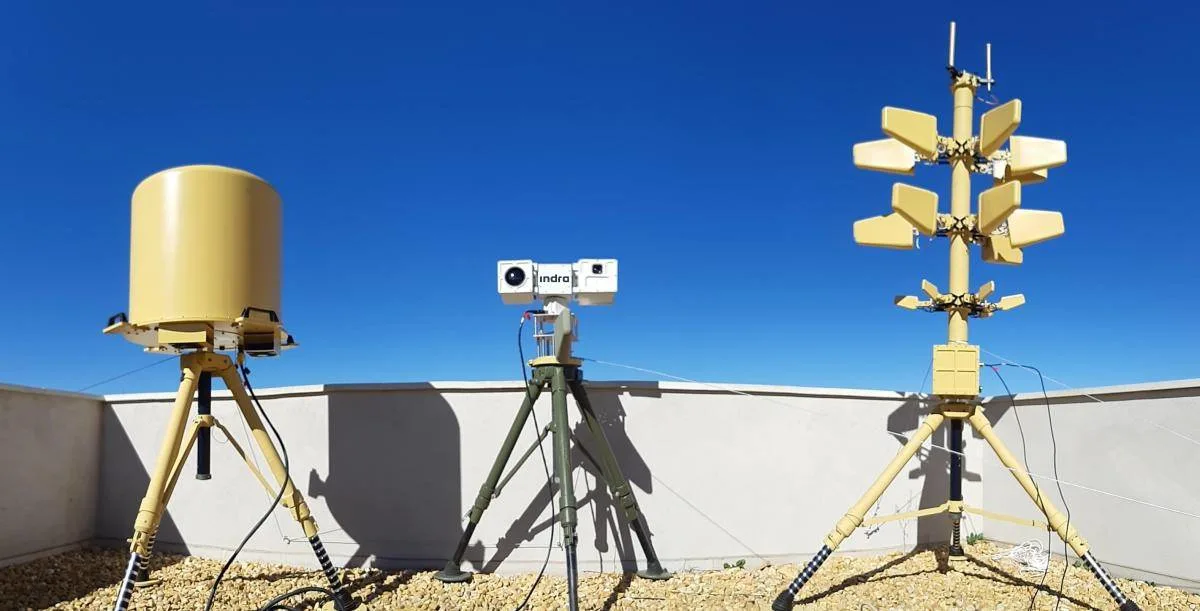
Photos here and below: Internet
Defender Media continues its Black Mirror series — a digest of the latest enemy miltech innovations, prepared to inform Ukrainian soldiers and engineers.
This week, Russia unveiled several new developments aimed at strengthening its battlefield capabilities. Among them are new UAVs, upgrades to early-warning systems and EW efficiency, as well as tactics for combining fibre-optic and radio-controlled drones in paired operations. At the same time, discussions are beginning on how to replace imported components.
Full details in Black Mirror #25.
Fibre-optic drones paired with radio-controlled attack drones
The range of Russian fibre-optic drones may increase fourfold. Engineers have developed a UAV link that can bypass electronic-warfare systems.
A primary (relay) drone is connected by a fibre-optic cable to a combat drone. During flight the distance between them is adjusted so each occupies the required position: the secondary drone carries out the strike while the primary provides observation and a communications link, remaining outside the EW engagement zone — effectively “eyes and hands” in one pair.
The cable automatically spools out and in during flight and severs under heavy tension. Multiple combat drones can be attached to a single primary drone. After the mission the primary drone returns and the cable retracts automatically.
This arrangement lets enemy drones operate longer and more effectively while minimising the risk of the cable snagging on the ground.
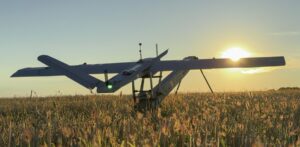
Molniya-2
Russian military forces have shown a prototype of the strike UAV Molniya-2 equipped with a 40-kilometre fibre-optic cable spool. Russian drone operators are exploring the possibility of using fibre-optic communications on wing-type drones. Their flight speed reaches 70-90 kilometres per hour, substantially exceeding the permissible limits for fibre-optic copters because of the risk of cable breakage. The standard Molniya-2 with radio-frequency communications has a flight radius of 40-50 kilometres.

These drones are used to deliver heavy warheads weighing up to 10 kilograms, for remote emplacement of anti-personnel and anti-tank mines, and as carriers for copter FPV drones over long distances. The prototype is launched from the same pneumatic catapult as the standard UAV model.
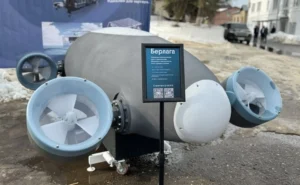
New interceptor drone Pusher
The Russians announced a new interceptor Pusher with a recoilless barrel system (no recoil when firing) chambered for 12-gauge ammunition. The drone is equipped with machine vision that helps the operator detect aerial targets and automatically destroy them. Judging by everything, the apparatus is currently at the testing stage.

ZALA ZARYA
In the Russian Ministry of Emergency Situations, the well-known company ZALA has begun using UAVs with artificial intelligence to detect fires.
The ZALA ZARYA is equipped with onboard artificial intelligence for detecting forest fire outbreaks and can analyse images in real-time, highlighting ignition points, creating automatic reports. Currently, employees of the Russian Ministry are testing the technology.

UAV jammers regulation
In Russia, drone suppression systems may effectively be equated with weapons, obliging owners of such systems to coordinate their deployment and use with the territorial bodies of the Minister of Internal Affairs.
Last year, the Russians already expanded the requirements for users of “glushilki”: now, anyone requesting frequencies for them is required to attach to the application written approval from the Ministry of Defence for the purchase of radio-electronic warfare equipment intended to counter UAVs in order to protect specific facilities.
In practice, however, many simply ignore the law and use the devices without any permits. As a result, in many regions, EW systems disrupt the operation of navigation systems. Introducing new requirements in this field is supported, but it is proposed to make the approval procedure unified and centralised.

Import substitution of UAV components
The switch to Russian components is a technological development dilemma for Russia’s military-industrial complex. At the Kazan #DroneExpo exhibition, they spoke about a production-and-operational catalogue being developed on the Ministry of Industry and Trade order, which will help determine the level of localisation of UAVs being produced in Russia.
Currently, Russia has 19 companies manufacturing electric motors, 20 companies producing flight controllers, and several facilities for batteries, cameras, and communication systems.
At the Kazan exhibition, market participants stated that a high level of localisation is a condition for receiving state support. Still, the objects and evaluation criteria require deep cooperation between enterprises and continuous analysis using specialised information systems.
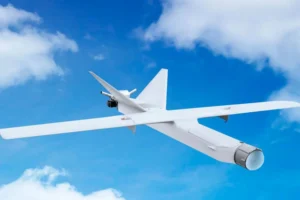
Internals of the Russian jet UAV Geran-3 series “U”
The Main Directorate of the Ministry of Defence of Ukraine has revealed the secrets of the Russian UAV Geran-3 with a turbojet engine:
- In the Geran-3 Series “U” UAV, a Chinese turbojet engine Telefly JT80 is used, thanks to which the drone is capable of moving at speeds from 300 to 370 km/h;
- The approximate operational range of use is up to 1000 km;
- The maximum speed of up to 370 km/h is reached mainly in the zones of action of Ukrainian air defence and electronic warfare, in the zones of use of UAV interceptors, and at the terminal stages of flight when descending onto the target.
The layout of modules and electronic units mainly does not differ from the gasoline versions of Geran-2” Series “Y”: in particular, it includes the standard inertial navigation system SADRA, an air pressure measurement unit (ADC), a power distribution unit (PDU), etc.
To ensure the protection of satellite navigation from electronic warfare systems, the Geran-3 uses an anti-jamming satellite navigation system with a 12-element adaptive antenna array (CRPA)—Kometa-M12.
In total, out of 45 identified foreign components, half are from American manufacturers, eight from Chinese, seven from Swiss, three from German, two from British, and one from a Japanese manufacturer.
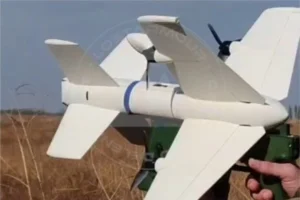
Drone-Bomber Koschey
The drone-bomber Koschey has begun to be used in the combat zone. It was created by the development company LLC Dominanta. This drone is an analogue of the Ukrainian Baba-Yaga, although technically it is an entirely different device. The project was developed at the request of volunteers from Tver. Koschey returns and carries from three to six charges. The drone is already being used in the combat zone in Ukraine.

The device’s payload is up to 15 kg. The drone can also be used to deliver supplies to hard-to-reach areas where fighters are cut off from conventional supply methods.
The company specified that the operational range of Koschey is up to 30 km.
New anti-icing technology for UAVs
Russia has patented a new technology to combat icing on fixed-wing UAVs – a special fabric made from an electrically conductive polymer thread capable of heating. The use of this fabric will help prevent ice formation, which interferes with flight.
The fabric was developed by the Kaliningrad company Ampertex, which already produces materials for heating wind turbine blades, car heating systems, and more.
In unmanned systems, its application solves several tasks at once: heating, anti-icing, removal of static electricity, and radio wave shielding. According to representatives of Fly Dron company, the technology will increase UAV energy efficiency and environmental friendliness, providing them with a competitive advantage.
Perm UAV Development Centre to acquire a robotic complex
The Perm “Ratsionalnoe nedropol’zovanie” has announced a tender for the supply of a scientific-and-production robotic complex for the development, prototyping, testing, and serial manufacture of propulsive drives/propellers and their control systems for unmanned aerial systems, with a remote operational monitoring system.
The complex will include robotic lines for the manufacture and production of small-sized gas-turbine, electric, and impeller engines, as well as an automated surface-mount line for electronic components for the production of propulsion control systems. The maximum contract value is 575.8 million rubles.
The creation of the centre envisages establishing, in the Perm region, production lines for gas-turbine engines for fixed-wing UAVs, a range of electric motors, power aviation structures, and intelligent airframe components for unmanned aircraft.
Reading now
1

Ukrainian SkyFall’s drone wins at Pentagon’s Drone Dominance selection
2
Black Forest Systems raises $400,000. Here’s what drones the startup is building
3
Sting interceptor by Wild Hornets downs costly Russian Granat-4 reconnaissance drone
4
UForce unveils Bucha middle-strike drone with a 200 km range
5
The F10 drone becomes the second Ukrainian finalist in the Pentagon’s Drone Dominance Program
By submitting this form, you give Defender Media consent to the processing of personal data.
Надсилаючи цю форму, ви надаєте Defender Media згоду на обробку персональних даних.

Latest news
1
DPA to diversify drone and ammunition orders among multiple suppliers
2
‘Ukrainska bavovna’ and Czech company Pavetra Aerospace to produce Shuhay UAV through joint venture
3
59th Assault Brigade downs Russian Ka-52 helicopter with General Cherry OPTIX FPV drone
4
Tencore develops evacuation module for TerMIT UGV
5