Black Mirror #22. The Yaz-5, the Posokh, jet engines in Shaheds, and other novelties of Russian miltech
A review of new Russian miltech developments for the last week of August

Screenshot from video footage of downed Gerbera's camera. Source: Flash Telegram channelGerbera
Downed enemy drones from the recent missile-and-drone attack on Kyiv have provided researchers of Russian weapons with a wealth of information. Among the trophies are a jet engine from a Shahed and a Gerbera with a camera that preserved footage from a Chinese factory.
Russia has also unveiled a number of new developments to strengthen its technological arsenal. These include the Yaz-5 tiltrotor, a laser mine-clearing system, and several new products from the “DroneExpo” exhibition. Details are in Black Mirror #22.
Jet-powered Shaheds used in the attack on Kyiv
Jet-powered Shahed/Geran drones took part in this week’s massive missile-and-drone attack on the Ukrainian capital. This is evidenced by the remains of one of the drones, photos of which were published by Clash Report.

During the inspection of the wreckage, fragments of electronics, a Bosch 0-580 fuel pump and a compact turbojet engine were found.
Footage from a Chinese factory found in downed Gerbera
In a downed Russian Gerbera drone (a Shahed imitator), Ukrainian troops discovered a video recording from a Chinese factory where the camera had been tested. This was reported by communications expert Serhii “Flash” Beskrestnov.
The downed drone was equipped with a Viewpro A40 camera made by the Chinese company Viewpro, with production based in Shenzhen. Geolocation of the footage, carried out by the Cyberboroshno community, confirmed that the camera was indeed tested in this city.
A single digital platform for drones
The Russian budget may allocate about 10.4 billion rubles for the first stage of creating a single digital platform for organising air traffic for manned and unmanned aircraft by the end of 2027.
The basis will be the Unified Integrated System for Planning and Use of Airspace, which will be created and implemented in two stages. The Almaz-Antey concern will be involved in the process.
The new system should ensure conflict-free flight planning of unmanned and manned aircraft in a single space, making flights safe.
New products from the DroneExpo exhibition
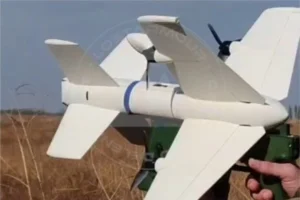
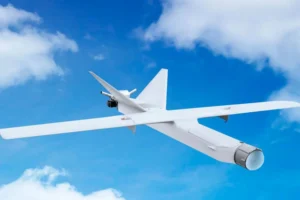
The DroneExpo exhibition is taking place in Kazan, Russia. A glider for monitoring the situation from the Novosibirsk company Bastell has already been presented at it. The company was founded less than six months ago, but, in addition to this device, it already produces Vestnik quadcopters.

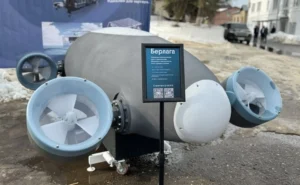
Also, JSC Phazotron-VMZ demonstrated a large tethered UAV KVV-1 at its stand, and Tambov LLC Ekoprom demonstrated a small FPV drone Bekas, apparently for extinguishing fires.

Laser cutting complex for the university
The Russian Don University has launched new equipment for drone production. This is a laser cutting complex that will help to independently produce key components for UAVs. Implementing the complex should significantly optimise the process of manufacturing drone frames.
In addition to the laser complex, about a dozen 3D printers have been installed in the university’s research and production centre. With their help, design engineers can quickly create prototypes and necessary parts for drones, adding flexibility and speed to the development process.

Tiltrotor Yaz-5
The Yaz-5 tiltrotor project continues to develop. Its developers shared a video showing the integration of the AlphaAir 10 lidar from CHC Navigation into the drone.
Due to the low stall speed (62-65 km/h), the tiltrotor is well suited for geodetic surveying, and the time the aircraft-type device is in the air is objectively longer than that of multicopters, which are currently most often used in aerial surveying. Actually, here is what is promised by the characteristics:
- flight duration – up to 130 minutes;
- payload weight – 5 kg;
- maximum take-off weight – 22 kg;
- cruising speed – 72 km/h;
- wind resistance – up to 18 m/s.
The Yaz-25 UAV is also being developed. It can carry a large payload of up to 25 kg of cargo.
Such a device with vertical takeoff and variable thrust vector of the engines on the wings is suitable not only for geodesy. It may also be used for monitoring, rescue operations or logistics. Moreover, it can fly with a load on a cable, and the equipment can be installed both in the fuselage and on a suspension outside of it.
Dome communication between two drones
The Russians conducted an experiment with a dome communication between two drones. The enterprise Sputnik System Gonets (part of Roscosmos), the company Geoscan and the Tomsk Scientific and Production Center Unmanned Aviation Systems conducted an experiment in which one drone provided communication to another.
During the experiment, the drone Geoscan with the communication radio complex Gonets was raised to a height of 4 km, creating an extended service zone with a diameter of about 340 km. The resulting “dome” was used to communicate with users, cars, and another drone.
Logistics chains can be built to perform numerous operations within such a communication.
Russian Navy replenishment
The Russian Ministry of Defence reported that the naval fleet has been replenished with three modern warships. In particular, the small missile ship Stavropol already has a universal vertical launcher 3S14UK1 of the UKSK complex, adapted for the use of Kalibr-NK, as well as other anti-ship missiles. The anti-missile and anti-aircraft screen is formed thanks to the 3M-47 Gibka air defence system module and the AK-630M-2 Duet anti-aircraft artillery complex, which are capable of intercepting enemy kamikaze UAVs, but require timely targeting by radar sensors capable of detecting small targets.
New full-cycle chip production plant
A full-cycle chip production plant is being built in Novgorod. The Russians plan to master technological processes with 800 and 600 nm standards. Despite the fact that this is an “old” technological process, the products manufactured using it are needed for the defence and space industries.
The first laser demining installation
The device for such demining is called Posoh. It neutralises explosive objects by burning the explosive substance without detonating them.
The system is capable of working on a stationary target from a distance of 30 to 700 meters. The tripod with the optical-electronic module is delivered to the position by light transport and installed at a safe distance from the object to be demined by two people.
The operator guides Posoh through a tablet or viewfinder. The command to turn on the laser is given remotely, and the process itself is broadcast to the tablet.
Reading now
1

Ukrainian SkyFall’s drone wins at Pentagon’s Drone Dominance selection
2
Black Forest Systems raises $400,000. Here’s what drones the startup is building
3
Sting interceptor by Wild Hornets downs costly Russian Granat-4 reconnaissance drone
4
UForce unveils Bucha middle-strike drone with a 200 km range
5
The F10 drone becomes the second Ukrainian finalist in the Pentagon’s Drone Dominance Program
By submitting this form, you give Defender Media consent to the processing of personal data.
Надсилаючи цю форму, ви надаєте Defender Media згоду на обробку персональних даних.

Latest news
1
DPA to diversify drone and ammunition orders among multiple suppliers
2
‘Ukrainska bavovna’ and Czech company Pavetra Aerospace to produce Shuhay UAV through joint venture
3
59th Assault Brigade downs Russian Ka-52 helicopter with General Cherry OPTIX FPV drone
4
Tencore develops evacuation module for TerMIT UGV
5