Black Mirror #17. Ilya Muromets, upgraded Shaheds, laser protection for UAVs, and other additions to Russian miltech
Review of new Russian miltech developments for the last week of July
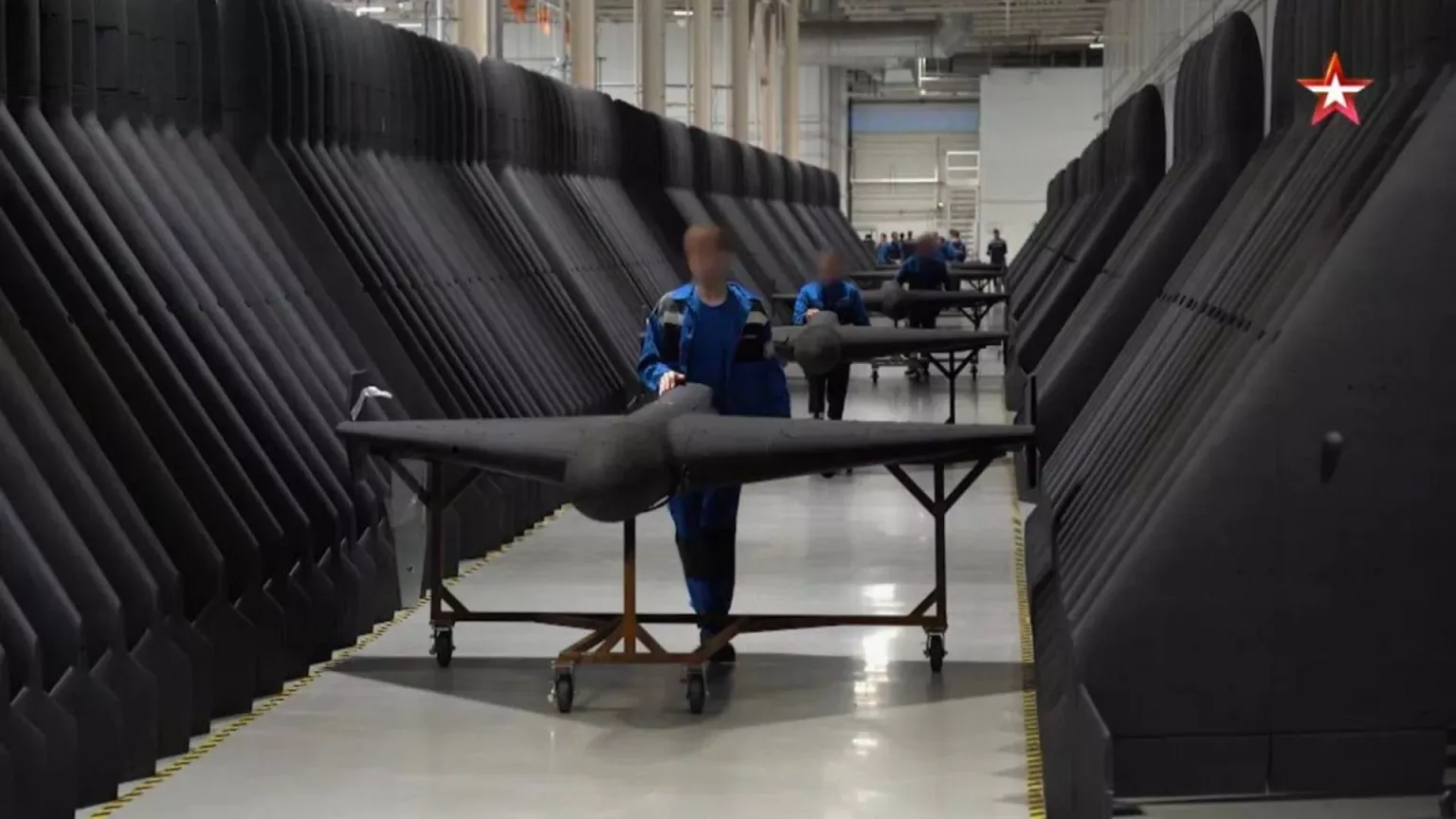
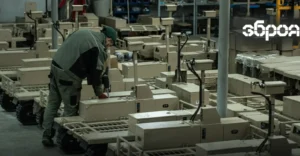
The Shaheds production plant in Alabuga / Source: Internet
Russia is scaling up production of fibre-optic drones and Shaheds, while also continuing to improve their capabilities. Other additions to this week’s Russian miltech lineup include the Corvette, Severny Veter, and Ilya Muromets drones; the Omich flamethrower system for UGVs; and a laser protection system for UAVs against anti-aircraft fire.
More in Black Mirror #17.
Laser protection of UAVs against MANPADS
The Central Research Institute of the Russian Ministry of Defence has developed a laser protection system for UAVs against man-portable air defence systems (MANPADS), designed to deflect missiles away from their target.
“When enemy MANPADS lock onto a drone, sensors detect directed laser irradiation, and an analyser determines the direction and sends a signal to the control unit. The signal then passes to the jamming and targeting units. The first generates a sufficiently powerful laser beam, while the second aims it at the location of the anti-aircraft system. The laser beam feeds false data into the missile’s guidance system,” the developers explained in their patent description.
Flamethrower system of the Omich ground robotic complex
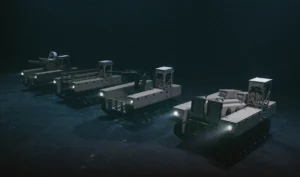
Omsk developers have created a lightweight flamethrower system that can be installed on the Omich UGV. The Omich complexes are used to evacuate wounded soldiers, deliver ammunition, food, and fuel. The complex can carry more than 500 kg, and can transport more than a ton on a trailer. It can also tow cars and minibuses.

The key advantage of the complex is its high cross-country ability, including the ability to overcome water obstacles a meter or more deep. Omich is actively used by the Russians in the combat zone.
Russians showed the factory with Shaheds
A new major report has appeared from the factory for the production of Shaheds (“Geraniums”) in Alabuga. The general director of the enterprise quite cunningly formulated the answer to the question about production volumes. According to him, “there was a plan to produce several thousand “Geraniums”, and now we produce nine times more”.
In Russia, the production of engines is localised (the plant has foundries for casting engine blocks), microelectronics, fuselages and wiring. The only large-scale production of two-stroke engines in the Russian Federation is located here.

New dummy targets to exhaust Ukrainian air defence
The Main Directorate of Intelligence of the Ministry of Defense of Ukraine on the portal War and Sanctions published the components of a new UAV, which is currently used by the Russian Federation as a reconnaissance and dummy target to detect Ukrainian air defense positions and overload it. According to some reports, it can also carry a warhead weighing up to 15 kg.
The device has a delta-wing fuselage, similar to the Shahed 136, but much smaller. All components and units are of Chinese origin. The UAV is equipped with a Chinese copy of the Australian RFD900x data transmission module from RFDesign. The product is designed for long-distance data transmission (up to 40 km in direct visibility).
DLE engines have previously been used by Russia in the Gerbera and Parodiya UAVs, and KST servos in the Shahed 136.
Shaheds on radio control
Based on the example of the found Russian Gerberas and other UAVs with modems, one can conclude that the enemy is probably preparing to equip some of the Shaheds with radio control. Such Shaheds will be able to ‘communicate’ with each other, work as signal repeaters for each other, and be controlled by radio.
This will make it possible to attack moving targets, see the operation of air defence systems online, conduct reconnaissance, and attack targets where Ukrainian electronic warfare has blocked GPS.
Korvet and “North Wind”
The Leningrad Region will launch mass production of Korvet hexacopter drones with a flight range of up to 75 km and a maximum payload of up to 15 kg, as well as the Severny Veter aircraft-type UAV. The production site will be launched on the basis of the complex rehabilitation and adaptation cluster.

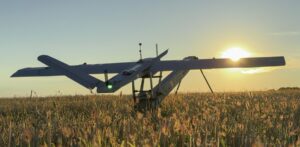
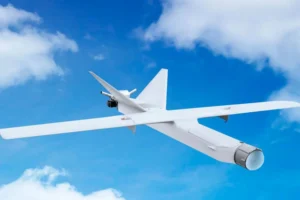
Severny Veter was developed by specialists from the Russian Weapons Center and the Pushkin Dvor Production Association. It can be used as a kamikaze drone, for reconnaissance, and as a decoy to reveal the operation of enemy air defense systems. The drone with a new communication system was tested at the training ground and is being supplied to the Russian military.
Ilya Muromets for the air evacuation of the seriously injured
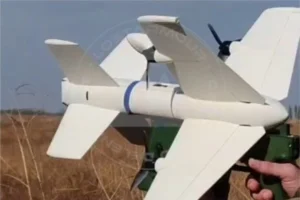
The Russian Federation is creating an “invisible” drone Ilya Muromets for the air evacuation of seriously injured. The wounded are planned to be placed in containers made of composite materials, equipped with life support systems. The device will be created using stealth technologies to reduce radio visibility.
In addition, they plan to build inertial navigation systems that will allow the UAV to navigate in electronic warfare conditions and to avoid air defence systems. Currently, the payload is up to 100 kg, and in the future, they plan to increase it to 200 kg. The task remains to completely localise the production of the UAV for evacuation.
UAV for bad weather photography
Russians have tested a UAV for taking pictures in bad weather conditions. The multicopter-type UAV is equipped with a radar with a synthesized aperture to obtain detailed images without visibility.
The tests were carried out at the Volosovo airfield in the Moscow region. They allowed the – finalizing the pre-production sample. It will be released by the end of 2025. Currently, the focus is on refining the software algorithms and preparing for the next phase of testing in the VTOL format.
Increased production of fibre optic FPV drones
The CEO of the Ushkuynik research and production centre said that it intends to increase production volumes to “tens of thousands per month.”
Almost a year after the start of deliveries of the Russian fibre optic drones Prince Vandal Novgorodskiy, their production rate has increased from 500 units to tens of thousands and continues to grow. They plan to increase the range of the drones to 50 kilometres, as this is the maximum range of radio-controlled copters commonly used on the front, operating in conjunction with a drone mother.
The developers also announced a series of new fibre optic drones, ground robotic complexes and sea drones.
Reading now
1

Ukrainian SkyFall’s drone wins at Pentagon’s Drone Dominance selection
2
Black Forest Systems raises $400,000. Here’s what drones the startup is building
3
Sting interceptor by Wild Hornets downs costly Russian Granat-4 reconnaissance drone
4
UForce unveils Bucha middle-strike drone with a 200 km range
5
The F10 drone becomes the second Ukrainian finalist in the Pentagon’s Drone Dominance Program
By submitting this form, you give Defender Media consent to the processing of personal data.
Надсилаючи цю форму, ви надаєте Defender Media згоду на обробку персональних даних.

Latest news
1
DPA to diversify drone and ammunition orders among multiple suppliers
2
‘Ukrainska bavovna’ and Czech company Pavetra Aerospace to produce Shuhay UAV through joint venture
3
59th Assault Brigade downs Russian Ka-52 helicopter with General Cherry OPTIX FPV drone
4
Tencore develops evacuation module for TerMIT UGV
5