Black Mirror #15. Kinzhal drone, domestic engines and batteries for UAVs, and other updates from Russian miltech
A review of new Russian miltech developments for the second week of July

Kalashnikov's remote surveillance system | Source: Internet
Several new Russian miltech developments were unveiled this week at the Innoprom-2025 exhibition in Yekaterinburg. Among them are the Kinzhal interceptor drone, capable of speeds up to 300 km/h, and a reusable single-stage launch vehicle called Korona. Russia also showcased a new laser system for countering drones, a three-coordinate passive radar, domestically produced UAV engines and batteries, and mesh network technology integrated into decoy drones.
Details in Black Mirror #15.
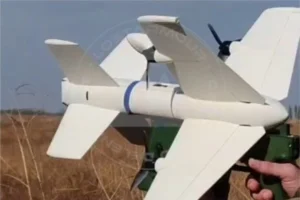
“Kinzhal” — now also a drone
At the Innoprom-2025 exhibition in Yekaterinburg, a namesake of the hypersonic missile “Kinzhal” was unveiled — a small interceptor drone developed by ASF-Innovations, capable of reaching speeds up to 300 km/h.
This UAV is a partial structural analogue of the FPV interceptor quadcopters “Yolka,” widely used by Russian forces. It is equipped with a nose-mounted mid-wave infrared homing seeker.

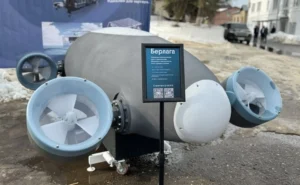
Korona launch vehicle
At the Innoprom-2025 exhibition, the Roscosmos State Corporation presented a mock-up of the reusable single-stage Korona launch vehicle, as well as models and mock-ups of its components that have already passed tests.
It is claimed that the rocket offers an unprecedentedly low cost of payload deployment, is economically viable, and has the capability not only to deploy but also to retrieve the payload.
Posoh laser passed the test
Russian company LazerBuzz, developer of the “Posokh” anti-drone laser system, announced that the system has successfully passed testing. Using a laser beam at a distance of 500 meters, the Russians were able to disable the drone engine on a static mock-up.

The developers plan to use this system against Ukrainian “deep strike” drones, specifically the An-196 “Lyutyi” UAVs. It is expected that the “Posokh” will be able to engage such drones at distances of up to 1,500 metres.
The power of the presented laser installation with a target guidance system was 3 kW, but there is already a version of the complex with a capacity of 80 kW for the protection of industrial and critical infrastructure.
Domestic batteries for UAVs
The Russian company Lyotech will begin to manufacture batteries for UAVs. According to it, currently 98% of batteries for these purposes come to Russia from abroad. The launch of mass production is already being prepared in the Leningrad region.
The company will probably have to compete with Transport of the Future company, which, together with the Moscow government, promised to build a gigafactory that should completely cover the country’s need for lithium-ion batteries for UAVs.
Russian engines for drones
In addition to producing their own batteries, the Russians have also started manufacturing UAV engines domestically. One of the companies involved is Aviator, whose engine is designed for drones with a takeoff weight of up to 30 kg. The company states that this engine is made up of 95% Russian materials and components. According to Aviator’s CEO, the enterprise was the first in Russia to use frequency controllers based on a domestic component base.

Currently, small-scale production of the engine has been organized (about 100-200 engines per month), and the company is already supplying them to drone developers. As soon as the appropriate order appears, the production volumes may increase.
The frequency regulator in the engine changes the frequency of the electrical energy supply to control the engine rotation speed, which allows it to be smoothly changed and reduce energy consumption, especially in systems with variable load.
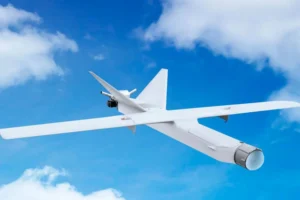
Reconnaissance UAV from Kalashnikov
The Kalashnikov Concern has developed and started deliveries under contracts of the Granat-4-E transportable remote surveillance complexes.
The new UAV provides, among other things, laser guidance for high-precision ammunition with a passive laser homing head in the near tactical zone.

The flight speed range of the Granat-4-E UAV is 90-130 km/h, the take-off weight is no more than 55 kg, the radius of application in direct visibility is up to 55 km, the maximum flight altitude is 3000 m, and the launch is carried out from a catapult.
Three-coordinate locator
The Rosel company has developed a solution for detecting low-visibility objects, including drones on fibre optics – a three-coordinate passive coherent locator (3D PCL). Its main advantage and difference from traditional radars is the absence of its own radiation. This makes it invisible to radio intelligence, which ensures the protection of the device and the operator.
3D PCL analyses the phase and amplitude of the received signals, giving the exact coordinates of the detected potential source of danger, in azimuth, range and height. The product retains its technical characteristics in a difficult radio-technical environment – it works normally among reinforced concrete buildings, using repeatedly reflected signals. Unlike optical and infrared systems, 3D PCL remains effective in any weather conditions and time of day.

The locator can “see” light-engine aircraft at a distance of several tens of kilometres. By detecting a wide range of stealth objects, including drones on fibre optics, 3D PCL allows you to effectively control the air, surface and ground space of the protected object.
Mesh networks in Gerberas
The Ukrainian military reports that a Mesh network element was found on the downed Russian Gerber decoy drone – an industrial-grade HX wireless router made by the Chinese company Shenzhen Sinosun Technology Co., Ltd.
The manufacturer’s website indicates that the HX-50 router is equipped with two external antennas and operates at 2.4 GHz and 5.8 GHz frequencies. According to the company, this is enough to provide stable coverage over an area of 50 to 100 square km.
The devices in this series are compatible with Wi-Fi and 5G/4G networks, have industrial protection against external influences, and also operate in a wide range of temperatures and voltages, providing high-speed and reliable wireless connection.
The Mesh network is designed for “seamless” transmission over a distance. In the context of drones, such a network could be organised between them to share information. For example, it could allow for determining how many drones in a group remain active and continue to move towards their targets.
Reading now
1

Ukrainian SkyFall’s drone wins at Pentagon’s Drone Dominance selection
2
Black Forest Systems raises $400,000. Here’s what drones the startup is building
3
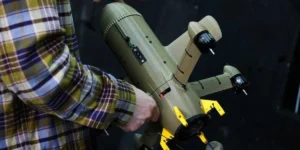
Sting interceptor by Wild Hornets downs costly Russian Granat-4 reconnaissance drone
4
UForce unveils Bucha middle-strike drone with a 200 km range
5
The F10 drone becomes the second Ukrainian finalist in the Pentagon’s Drone Dominance Program
By submitting this form, you give Defender Media consent to the processing of personal data.
Надсилаючи цю форму, ви надаєте Defender Media згоду на обробку персональних даних.

Latest news
1
DPA to diversify drone and ammunition orders among multiple suppliers
2
‘Ukrainska bavovna’ and Czech company Pavetra Aerospace to produce Shuhay UAV through joint venture
3
59th Assault Brigade downs Russian Ka-52 helicopter with General Cherry OPTIX FPV drone
4
Tencore develops evacuation module for TerMIT UGV
5