Dorozvidka #5: “the war of robots,” Bavovna.ai, Droid TW, as well as Kushnerska, Rudominsky, and Zaluzhnyi
A weekly roundup of key insights from publications in Ukrainian and international media
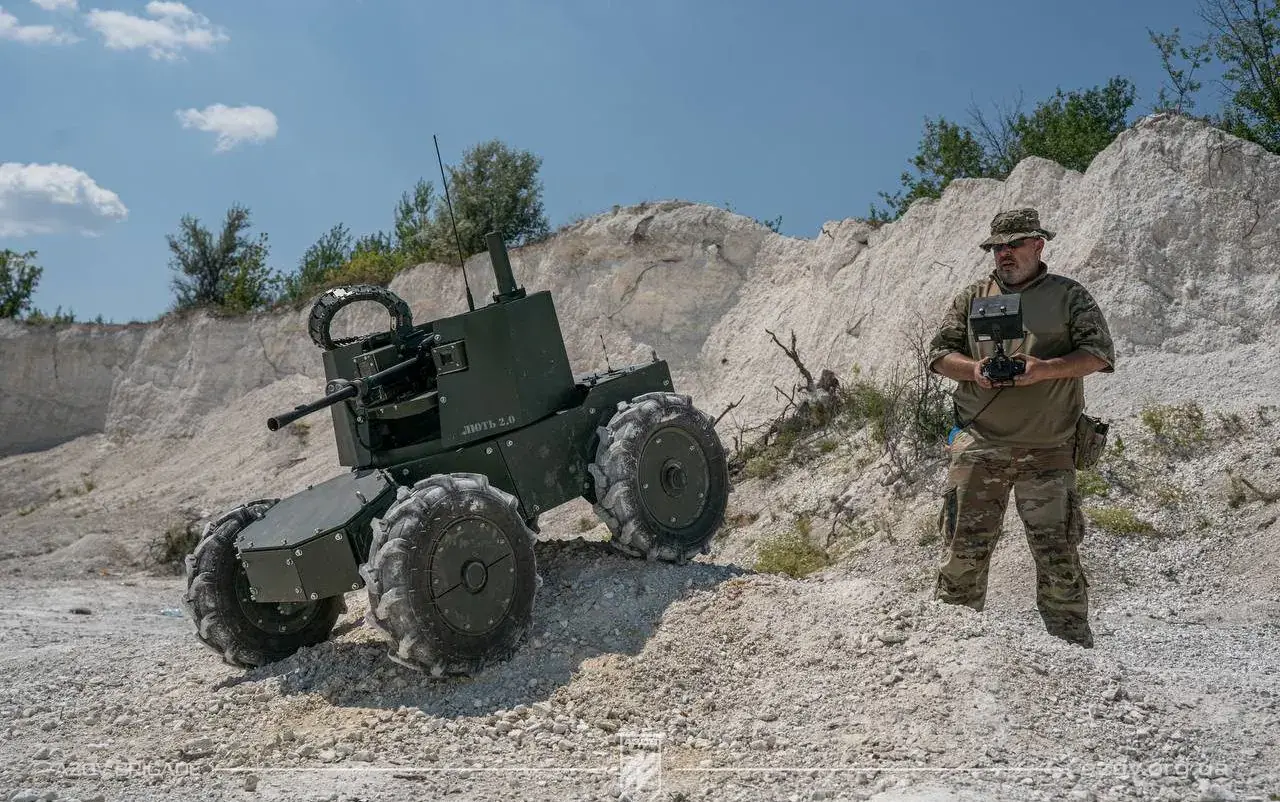
Groud Robotic System, LIUT 2 (Image Credits: The Telegraph)
In Dorozvidka section, Defender publishes updates from the editorial backlog over the past week, as well as interesting materials from Ukrainian and international media.
Today’s selection includes: a list of the most promising defence tech startups in Europe, General Zaluzhnyi’s speech on modern warfare, an interview with the CEO of Brave1 marking the cluster’s second anniversary, insights from a conversation with the co-founder of Himera, New Zealand drones for Ukraine, as well as Western articles and podcasts about the “war of robots” in Ukraine.
Brave1’s Nataliia Kushnerska on two years of cluster work
Nataliia Kushnerska, CEO of the state defenсe tech cluster Brave1, gave an interview to Ukrinform ahead of the project’s second anniversary. Here are a few key figures and facts she shared:
- Over 3,500 solutions from more than 1,500 Ukrainian companies are registered on the Brave1 platform;
- 90% of all Ukrainian drone and ground robot manufacturers are members of the cluster;
- Brave1 has already awarded developers more than 500 grants totalling over 2.2 billion UAH;
- For 2025, the cluster has 650 million UAH in government funding for grant support and over 2 billion UAH for special financing;
- With Brave1’s support, cluster companies are actively attracting private investment. In 2023, they raised $8 million, in 2024 — $40 million, and Kushnerska expects $100 million to be invested in Ukraine’s defence tech sector in 2025;
- Brave1’s portfolio includes over 290 investors from 35 countries. More than 70 companies secured investor funding last year. According to Kushnerska, some undisclosed investments exceeded $10 million per round;
- Among the priority areas for 2025 are the development of missiles, lasers, drone carriers, underwater drones, and explosive mixtures and substances.
Vestbee highlights the most promising defence tech startups in Europe — two Ukrainian projects on the list
The European platform for venture investors, Vestbee, reached out to some of the most active investors in Europe’s growing defence tech landscape — including Balnord, Coinvest Capital, Keen Venture Partners, and Superangel — to gather their insights on the most promising startups driving innovation in the sector.
Among the startups mentioned by experts are two Ukrainian projects. In particular, Marcin Kowalik, General Partner at Balnord, highlighted Bavovna.ai — Ukrainian startup developing AI-powered navigation systems for UAVs that operate in GPS-denied or jammed environments. The company is capitalizing on one of the most crucial defence tech trends as its solutions address a fundamental vulnerability in modern warfare — the dependence on satellite navigation systems that can be jammed or spoofed.
Meanwhile, Giuseppe Lacerensa, partner at Keen Venture Partners, singled out the Ukrainian startup Himera. It creates tactical communication systems for global defence forces, leveraging their unique access to an active modern battlefield.
Who else is on the list:
Advanced Protection Systems, Poland
Revobeam, Poland
ELFys, Finland
Vidoc Security Lab, Poland
StarFlight Dynamics, Germany
SensusQ, Estonia
Materials Nexus, the UK
Wayren, Estonia
Evitado, Germany
SkyCorp Technologies, Estonia
NAD (Nordic Air Defence), Sweden
26Marshals, the UK
Labrys Technologies, the UK
Project Q, Germany
Scaleout Systems, Sweden
Hefring Marine, Iceland
Misha Rudominsky – on the History of Himera, the flagship G1 PRO Radio, and fundraising
Lyft99 Kyiv Hub published a short interview with Misha Rudominsky, co-founder of the Himera project, which was listed among the startups highlighted by Vestbee.
For 25-year-old Rudominsky, this is his third startup. After the full-scale invasion began, it became clear that the issue of communication between military forces had to be addressed. This is how Himera was born – from the first sketch to a 3D-printed prototype took six months, and another 7-8 months were needed to launch production.
Today, HIMERA has 6,000 users within the Defence Forces. Rudominsky plans to reach 100,000 users or more. Himera radios are already being supplied to the USA, EU countries, and South America.
The Telegraph – on Ukraine’s “Robot War”
The Telegraph has published an article about robotic systems that are being actively integrated into Ukraine’s Defence Forces. According to the publication, this year Ukraine will deploy 15,000 unmanned ground vehicles (UGVs) on the front lines.

The article highlights that such systems can help compensate for the lack of personnel and the numerical advantage of the enemy. One of the examples mentioned in the article is the UGV “Zmiy,” which allows for remote mine clearing. The article also mentions other Ukrainian UGVs such as “Lyut,” D21-12R, “Hyena,” and others.
The authors of the article emphasize that while ground drones are not yet used on the frontline as actively as aerial drones, UGVs are in the active development stage and could become one of the main military trends of 2025.
The Ministry of Defence showcased the UGV Droid TW
This week, another Ukrainian UGV was highlighted by the Ministry of Defence of Ukraine. The official website of the ministry published an article about Droid TW – the flagship product of the company DevDroid.
Droid TW is a UGV on a tracked platform, capable of performing reconnaissance and strike missions. In December 2024, the Ministry of Defence codified the development after extensive testing, and now Droid TW is already being procured for the Ukrainian Armed Forces and is in use.

Key advantages of the Droid TW include:
- Ammunition capacity ranging from 480 to 1,000 rounds (12.7 mm or 7.62 mm), capable of hitting enemy personnel or equipment at distances up to 1 km;
- A thermal imager with the ability to select different display modes on the operator’s monitor. Target detection range: up to 1.5 km during the day, up to 1 km at night;
- The ability to detect, recognise, and track targets autonomously;
- A ballistic calculation system to enhance shooting accuracy;
- Support for military communication systems, as well as Starlink and LTE technologies;
- Deployment in combat mode within 5 minutes;
- An AI-based system for recognising enemy personnel.
Podcast about the “drone war” on Financial Times
The Financial Times released a podcast about how drones have changed the course of the war in Ukraine. FT correspondent John Thornhill and his colleagues visited Kyiv to learn more about how the war has sparked a boom in Ukrainian defence technologies and how they have transformed the battlefield. Western journalists saw firsthand how these drones are made and discussed what lessons the rest of the world can learn from Ukraine’s experience.
A transcript of the conversation is also available on the FT website.
Zaluzhny: once again about the realities of modern warfare
On April 25, the former Commander-in-Chief of the Armed Forces of Ukraine, Valeriy Zaluzhny, spoke at the Ukraine–United Kingdom defence technology forum. “Ukrainian Pravda” published the text of his speech.
General Zaluzhny once again emphasised that the Russo-Ukrainian war has completely changed the architecture of modern combat. Drones play a key role, creating a 15-kilometre zone of continuous death at the front line. At the same time, the development of electronic warfare (EW) has rendered expensive missiles and precision-guided shells ineffective. As a result, at the operational level, the war has reached a deadlock. Classic offensive actions have become almost suicidal.
To read about six conclusions from the Russo-Ukrainian war and five directions manufacturers should focus on, see the full version of the speech.
Ukraine will receive drones worth $40 million from New Zealand’s Syos Aerospace
The United Kingdom will purchase New Zealand drones from Syos Aerospace for Ukraine. This was reported by the Post publication, citing British Prime Minister Keir Starmer.
“Militarnyi” notes that the flagship model of Syos Aerospace is the SA200 unmanned helicopter, which has a payload of 200 kg and a flight duration of two hours. With an additional fuel tank, it has a range of up to 1,000 km and over 8 hours of operation.

Other products from Syos Aerospace:
- The autonomous surface drone SM300 has a payload capacity of 300 kg and a range of 650 miles.
- The SG400 UGV ground robotic complex has a payload of 500 kg and a range of up to 230 km.
In last week’s Dorozvidka, Defender covered news about Ukraine’s missile program, an interview with the commander of the UAV regiment, investments in a military training application, personnel changes in the Ministry of Defence, and some unfortunate news from one of Ukraine’s leading manufacturers of EW and CBRN equipment.
Reading now
1
Ukrainian SkyFall’s drone wins at Pentagon’s Drone Dominance selection
2
Black Forest Systems raises $400,000. Here’s what drones the startup is building
3
Sting interceptor by Wild Hornets downs costly Russian Granat-4 reconnaissance drone
4
UForce unveils Bucha middle-strike drone with a 200 km range
5
The F10 drone becomes the second Ukrainian finalist in the Pentagon’s Drone Dominance Program
By submitting this form, you give Defender Media consent to the processing of personal data.
Надсилаючи цю форму, ви надаєте Defender Media згоду на обробку персональних даних.

Latest news
1
DPA to diversify drone and ammunition orders among multiple suppliers
2
‘Ukrainska bavovna’ and Czech company Pavetra Aerospace to produce Shuhay UAV through joint venture
3
59th Assault Brigade downs Russian Ka-52 helicopter with General Cherry OPTIX FPV drone
4
Tencore develops evacuation module for TerMIT UGV
5