Ukrainian manufacturer of laser targeting systems M-FLY attracts $1.3 million investment
Resist.ua, MITS Capital and Freedom Fund participated in the round
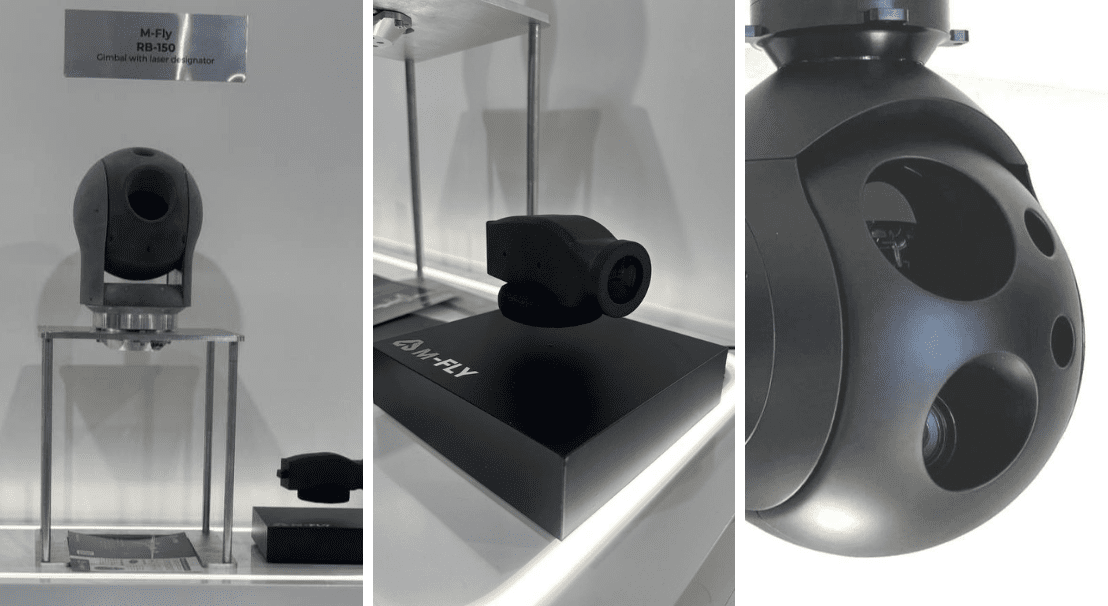
Image Credits: M-FLY
Ukrainian startup M-FLY, which develops a laser guidance system and suspensions for UAVs, has raised $1.3 million from a group of funds and angel investors. The project’s founders disclosed this in an interview with AIN.UA.
Resist.ua, MITS Capital, Freedom Fund, Borys Shestopalov, and other private investors from Ukraine, Denmark, Grenada, the United States, and Estonia participated in the round. In 2024, the team also received two grants from Brave1, totalling $75,000. Defender has selected the most essential things from the story of M-FLY’s founders.
History of the project
At the beginning of the full-scale war, M-FLY CEO Vladyslav Myhovych and his partners began assembling a team of volunteers to address the impact of the EW. Over time, they concluded:
- A laser targeting system could be the best solution to this problem.
- You can’t build a project like this on a volunteer basis.
This is how M-FLY became a startup. In September 2023, the partners opened their first office in Kyiv and began to form a team. At first, they developed with their own money, with help from family and friends. In January 2024, the project was backed by the first strategic investor, an Estonian miltech company that develops acoustic communication modules that determine the direction from which the Shahids are flying.
The funds raised in this round will be used to develop a laser-targeting device and semi-active guidance heads. ‘This solution is unique in its EW resistance and high accuracy (over 95% hit rate). In addition, the M-FLY development can be used for air defence installations,’ the startup says.
What exactly does M-FLY develop?
M-FLY is a company that develops dual-purpose deep-tech products. The main product is a laser guidance system that consists of two units. The first is a high-precision platform with a laser inside, called a designator, which allows you to illuminate targets with a laser. The second unit is the seeker module, which sees and flies at the laser spot.
The seeker can be integrated into reconnaissance aircraft, bomber drones, ground robotic systems and surface drones. The Seeker module can be integrated into FPV drones, kamikaze aircraft and free-fall bombs. In the future, the team also wants to integrate the system into short-range missiles to create air defence systems.
M-FLY aims to increase the effectiveness of night missions and extend the life cycle of bomber drones. The project team claims that their products will increase the number of hits (out of 1.2 million drones, more than a million fail to hit the target) and reduce the impact of EW. When an FPV drone flies towards a target and activates EW, it may not always be able to reach and hit due to obstacles. M-FLY’s development allows the laser spot to be captured from a distance of several kilometres for the warhead. The system flies to hit the target as soon as the optical spot is captured, even without communication.
The startup says that in the future, this technology can be used to build a fully autonomous complex for patrolling the territory, identifying priority targets, and autonomous strikes powered by AI and a swarm of drones.
What is the development stage?
Currently, M-FLY technology is still in the prototype stage, but all product elements have already been tested separately. The team says that they are in the process of integrating with several UAV manufacturers that may become customers of the startup. The founders expect to make a full release of the technology and launch the first sales by the end of the second quarter of 2025.
‘Now we are finalising the small details with the electronics inside. It’s a routine story that takes a little longer than we expected,’ the team says. The next step will be comprehensive testing of the entire technology.
After successful completion of the tests and integration with the UAV developers, M-FLY plans to raise the next round of $3-5 million, which will allow it to produce some of the parts in-house. ‘Our idea is to help the army, polish the technology, refine it, and when the war is over, scale up towards exports and sales globally,’ the founders say.
Reading now
1
Ukrainian SkyFall’s drone wins at Pentagon’s Drone Dominance selection
2
Black Forest Systems raises $400,000. Here’s what drones the startup is building
3
Sting interceptor by Wild Hornets downs costly Russian Granat-4 reconnaissance drone
4
UForce unveils Bucha middle-strike drone with a 200 km range
5
The F10 drone becomes the second Ukrainian finalist in the Pentagon’s Drone Dominance Program
By submitting this form, you give Defender Media consent to the processing of personal data.
Надсилаючи цю форму, ви надаєте Defender Media згоду на обробку персональних даних.

Latest news
1
DPA to diversify drone and ammunition orders among multiple suppliers
2
‘Ukrainska bavovna’ and Czech company Pavetra Aerospace to produce Shuhay UAV through joint venture
3
59th Assault Brigade downs Russian Ka-52 helicopter with General Cherry OPTIX FPV drone
4
Tencore develops evacuation module for TerMIT UGV
5